
By Alan Zhao
Co-founder & CEO, 2Firsts
This article reflects the author’s personal views only.
Key Points:
- The authorization of on! PLUS is not a routine PMTA clearance, but an early demonstration of how the FDA is structuring review timelines, enforcement boundaries, and ongoing compliance obligations under its nicotine pouch acceleration pilot.
- A close comparison of the FDA’s announcements for ZYN (January 2025) and on! PLUS (December 2025) shows a shift in regulatory messaging—from explaining why nicotine pouches are acceptable, to defining how the category is to be managed, constrained, and monitored over time.
- The FDA’s “accelerated review” does not signal lower scientific standards; rather, it reflects a process redesign aimed at reducing procedural uncertainty through more focused reviews and real-time communication with applicants.
- Comparing the authorized product portfolios of ZYN and on! PLUS suggests that FDA scrutiny is moving beyond individual SKUs toward an assessment of overall product structure, including flavor coverage and nicotine strength configuration.
- For companies, as regulatory expectations become clearer, continued hesitation carries rising risk; PMTA compliance is shifting from a discretionary investment to a prerequisite for competing in the U.S. nicotine pouch market.
- For regulators, a clear, stable, and science-based review framework can help compliant products dominate the mainstream market, reinforcing a positive feedback loop between enforcement and market order.
1 | on! PLUS Secures an MGO: A Regulatory Decision That Warrants Closer Attention
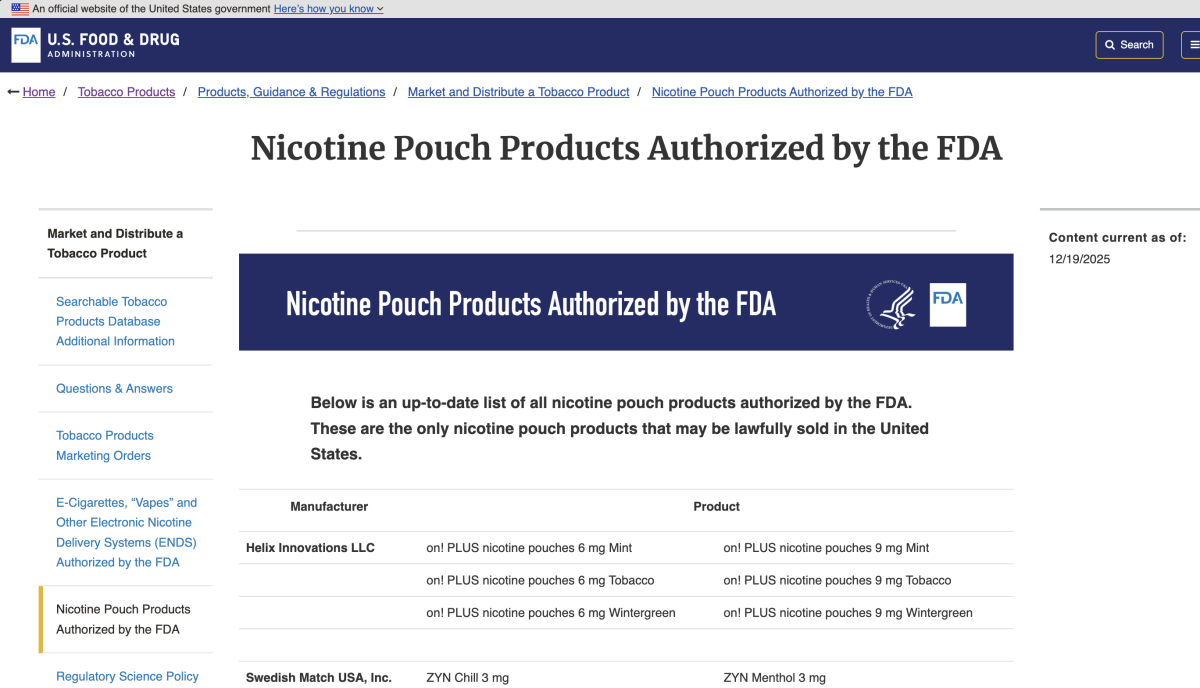
On December 19, 2025, the U.S. Food and Drug Administration (FDA) granted marketing authorization to six on! PLUS nicotine pouch products manufactured by Altria through the premarket tobacco product application (PMTA) pathway. The decision brought to a close a review process that had lasted more than a year and marked on! PLUS as one of the first products authorized under the FDA’s nicotine pouch review acceleration pilot.
Altria subsequently confirmed via its official social media accounts that the authorization applies only to the six products specified in the FDA’s announcement, while three additional on! PLUS products remain under review. The company also said it would resume accepting new retail orders in Florida, North Carolina and Texas, with e-commerce sales expected to follow.
From a regulatory filing perspective, the on! PLUS PMTA submission was substantial. Altria disclosed that its wholly owned subsidiary, Helix Innovations LLC, submitted the applications to the FDA in June 2024, with documentation exceeding 25,000 pages. The submission, prepared with input from more than 50 experts, covered multiple flavor and nicotine strength combinations and included ingredient disclosures, manufacturing facility information and supporting scientific studies.
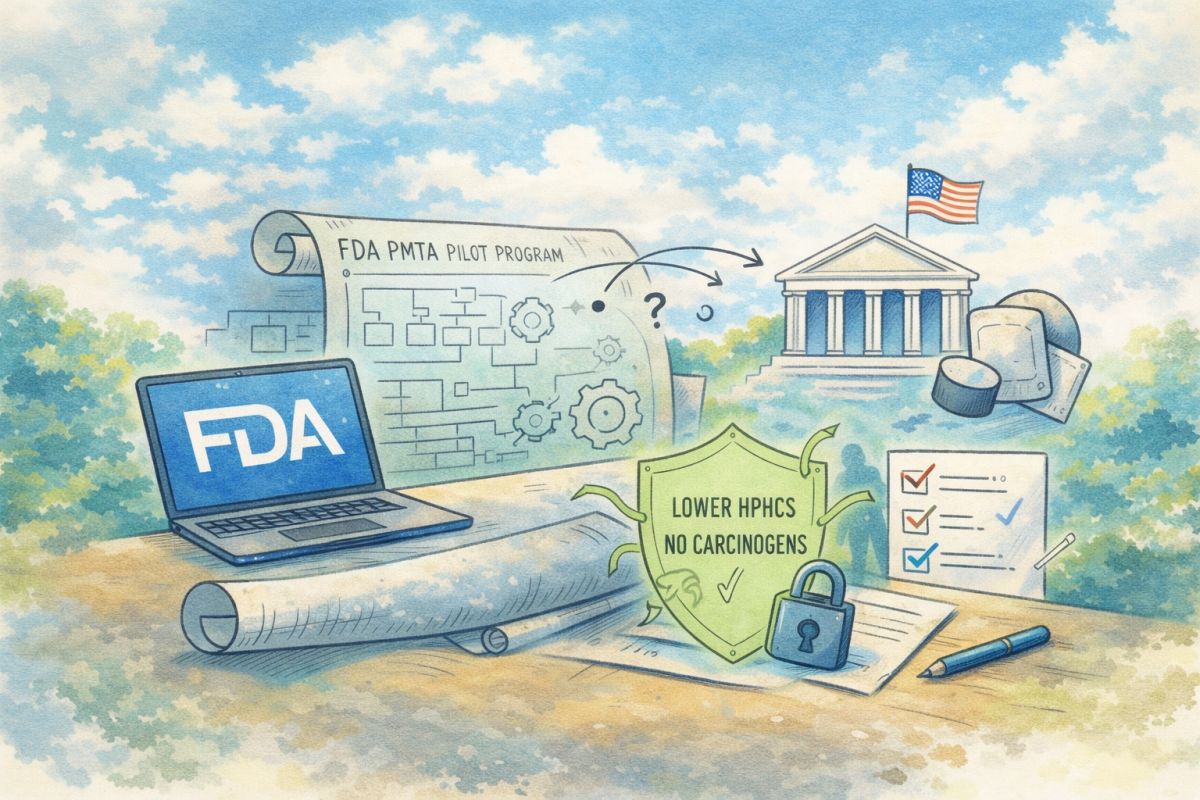
Notably, prior to the FDA’s final decision, Altria had moved ahead with preparations for a market launch of on! PLUS in 2025. As previously reported exclusively by 2Firsts, the company indicated plans to introduce the products in selected states in the autumn of 2025, a move that drew industry attention. At the time, Altria also made clear that the products had not yet received FDA marketing authorization and emphasized that it continued to cooperate with the agency’s review process. The on! PLUS applications were later included in the FDA’s nicotine pouch PMTA acceleration pilot launched in September 2025.
In its December 19 announcement, the FDA underscored that the marketing authorization is limited strictly to the six specified products, does not extend to other Helix or Altria offerings, and does not mean the products are “FDA approved” or considered safe. The agency reiterated that no tobacco product is risk-free and that the authorization was issued under the statutory standard of being “appropriate for the protection of the public health” as set out in the Family Smoking Prevention and Tobacco Control Act.
These seemingly routine but repeatedly emphasized caveats are precisely why the on! PLUS authorization should not be viewed as a standard PMTA clearance. Taken together, the handling of the review timeline, the structure and tone of the FDA’s announcement, and the product’s position within the acceleration pilot provide a useful starting point for examining how the agency is currently approaching the regulation of nicotine pouch products.
2 | Reading the FDA’s Two Announcements Side by Side: What Has Actually Changed?
At a glance, ZYN and on! PLUS both ended up with FDA marketing granted orders, which can make the outcomes look broadly similar. But a close reading of the FDA’s January 2025 announcement on ZYN and its December 2025 announcement on on! PLUS shows that the agency’s emphasis has shifted in noticeable ways.
The change is less about a single headline statement and more about what the FDA chooses to highlight, what it downplays, and what it no longer feels the need to explain.
2.1 The FDA no longer explains what nicotine pouches are
In the ZYN announcement, the FDA did something basic but telling: it introduced nicotine pouches to the public. The agency noted that this was the first time it had authorized products commonly referred to as “nicotine pouches,” and it explained what they are and how they are used.
That is not surprising. When a product category is being authorized for the first time, regulators often need to address foundational questions about what the product is and why it can be assessed within the regulatory framework.
By December, that explanatory layer had largely disappeared. In the on! PLUS announcement, the FDA did not spend time defining the category. Instead, it moved directly to process, standards and risk management. In practical terms, nicotine pouches are no longer treated as a new category that requires introduction, but as one that can be evaluated under an established framework.
2.2 The December text more forcefully draws the boundary around “safety”
The ZYN announcement devoted significant space to explaining why the products could meet the public health standard, citing lower levels of harmful constituents, evidence of complete switching among adults, and relatively low youth use.
In the on! PLUS announcement, the framing is comparatively more restrained on those points. Instead, the FDA repeatedly reinforces boundary language: the products are not FDA approved, authorization does not mean they are safe, the order applies only to the specific products listed, and there is no safe tobacco product.
As a matter of text and tone, this repeated boundary-setting reduces the room for the market to interpret a PMTA outcome as a safety endorsement, particularly in the context of an accelerated review program.
2.3 “Risk” expands beyond youth use
In the ZYN announcement, the risk discussion largely centers on youth use: whether the category could attract underage users, supported by survey data and a commitment to ongoing monitoring.
In the on! PLUS announcement, that frame is broadened. Youth exposure and marketing remain central, but the FDA also brings accidental exposure risks for young children into the authorization narrative, including an explicit requirement tied to child-resistant packaging.
In other words, the regulatory lens is no longer limited to who uses the products. It increasingly includes who might be exposed to them in everyday settings, including non-users in the household.
2.4 The MGO increasingly reads like an operating framework, not just a gate pass
Taken together, these differences suggest that the on! PLUS authorization reads less like a one-time market entry decision and more like a framework for ongoing operation.
The ZYN announcement leans more on post-market monitoring logic: the FDA will watch outcomes and can act if problems emerge.
The on! PLUS announcement goes a step further, embedding expectations on packaging, marketing restrictions, and ongoing tracking and reporting more directly into the authorization framework. The message is not only that the FDA will monitor compliance, but that the company is expected to operate within clearly defined conditions going forward.
Seen this way, on! PLUS looks less like a routine authorization and more like a case the FDA is using to illustrate how nicotine pouches are expected to be managed, constrained and continuously evaluated at this stage of regulation.
3 | Acceleration in Practice: How on! PLUS Turned an FDA Pilot Into a Real Outcome
When the FDA announced its nicotine pouch PMTA acceleration pilot in September 2025, the signal was clear: review efficiency needed to improve. At the time, however, the industry’s real question was not whether acceleration was desirable, but whether it would materialize in actual decisions—and what, if anything, would change as a result.
The marketing authorization granted to on! PLUS is the first case that allows those questions to be examined in practice.
3.1 Faster does not mean looser—it means different
In outlining the pilot, the FDA repeatedly stressed that acceleration would not come at the expense of scientific rigor. Instead, the agency pointed to a more focused review of the most critical elements for the category, combined with more frequent, real-time communication with applicants.
That logic appears explicitly in the on! PLUS authorization. Unusually, the FDA took the step of explaining in its decision that changes to communication and process design enabled the review to be completed more quickly while maintaining established scientific standards.
Read this way, the message to industry is not that science has become more permissive, but that a significant portion of PMTA uncertainty has been procedural rather than substantive. The pilot is aimed squarely at that problem.
3.2 Nicotine pouches are being placed within a settled framework
The “continuum of risk” concept referenced in the pilot announcement is reflected directly in the on! PLUS decision. The FDA does not describe nicotine pouches as safe products. Instead, it consistently frames them in relative terms, with the central question being whether they can support adult smokers in moving away from more harmful forms of tobacco use.
That framing signals a broader shift. Nicotine pouches are no longer treated as a marginal category that must repeatedly justify its existence. They are being evaluated within a structured risk hierarchy, where trade-offs are weighed and managed rather than debated from first principles.
In regulatory terms, the focus is moving away from whether the category should exist at all and toward how it should be governed.
3.3 What the pilot really changes is tempo
For many companies, the most difficult aspect of the PMTA process has not been the final decision, but the long and often fragmented communication cycle. After submission, applicants frequently wait months before receiving concentrated rounds of deficiencies late in the review.
The pilot seeks to change that rhythm. By increasing feedback frequency and enabling real-time exchanges, the FDA aims to identify issues earlier and reduce the need for repeated back-and-forth later in the process.
The on! PLUS case supports that intent, at least in how the agency describes it. Although the overall review still took more than a year, the FDA’s emphasis on “record time” and “real-time communication” suggests that predictability—not raw speed—is what the agency wants industry to focus on.
3.4 Why on! PLUS became the first test case
If the goal of the pilot is to test a new review model, the choice of the first product matters.
From a regulatory perspective, on! PLUS fits several criteria. The product category is clearly defined and already accepted within the FDA’s risk framework. Its flavor and nicotine strength combinations are relatively contained, limiting the number of contested variables. And the PMTA submission itself was large and well structured, providing a practical basis for sustained interaction between the applicant and the agency.
This is not a judgment about product quality. It is an indication that on! PLUS was well suited to testing process mechanics rather than probing regulatory limits.
3.5 The pilot was never just about speed
Taken together, the pilot announcement and the on! PLUS authorization suggest that the FDA’s objective is not simply to authorize more products more quickly. The larger goal is to establish a review model that can be replicated across a growing category without weakening regulatory control.
That helps explain why the on! PLUS announcement devotes so much attention to process, obligations and boundaries, rather than presenting the decision as a straightforward efficiency win.
In that sense, on! PLUS functions less as a routine authorization and more as a public demonstration—not of who gets through the gate, but of how the FDA expects the PMTA process to operate at this stage of nicotine pouch regulation.
4 | Reading the Signals in the Authorization List: Flavor Structure and Nicotine Strength as Regulatory Reality
Earlier sections focused on how the FDA signals its thinking through announcements and process design. Whether those signals hold, however, is ultimately reflected in outcomes—specifically, in the structure of the products that make it onto the authorization list.
In that sense, the list itself often says more than the accompanying text.
So far, FDA-authorized nicotine pouch products are concentrated in two brands: ZYN and on! PLUS. Both have cleared the PMTA pathway, but the way their authorized portfolios are structured—across flavors and nicotine strengths—differs in meaningful ways. Those differences are unlikely to be accidental.
4.1 The issue is not whether flavors exist, but how they are structured
The authorization outcomes show that the FDA has not adopted a blanket ban on flavors for nicotine pouches. ZYN’s authorized portfolio spans a relatively broader range of flavors, while on! PLUS is notably more restrained, focusing on a smaller set of more traditional options.
The key point is not the permissibility of any single flavor, but whether the overall flavor structure remains manageable.
In ZYN’s case, the broader flavor range is paired with clear internal limits: each flavor is offered in only a small number of nicotine strengths, and the naming conventions remain anchored in familiar categories such as mint, wintergreen, coffee, citrus and cinnamon. There is no sprawling system of highly segmented or suggestive sub-flavors. By contrast, on! PLUS presents a more concentrated lineup, which inherently reduces the regulatory friction that can accompany flavor expansion.
From a regulatory perspective, these are two variations on the same principle. The question is not whether flavors are present, but whether they are organized in a way that can be monitored and governed over time.
4.2 Nicotine strength is becoming part of the structural assessment
Flavor is only one dimension. Nicotine strength configuration is increasingly another.
Based on the authorization outcomes, ZYN’s approved products span the lower to mid-range of nicotine strengths, while on! PLUS skews toward mid-to-higher strengths. This divergence does not imply a simple regulatory preference for “higher” or “lower” nicotine levels. Instead, it points to a portfolio-level approach to risk management.
Rather than evaluating individual parameters in isolation, the FDA appears to be looking at combinations: how wide the flavor range is, how many strength options are attached to each flavor, and whether strength levels are confined to clearly defined and limited bands.
Viewed this way, nicotine strength is no longer just a product characteristic. It becomes part of the broader question of whether a product portfolio is predictable and manageable from a regulatory standpoint.
4.3 on! PLUS as a process case, not a boundary test
Seen in hindsight, the suitability of on! PLUS as the first product to move through the acceleration pilot also reflects its structural choices.
A limited number of flavors combined with a clearly defined strength matrix places the portfolio in a lower-controversy zone. That does not maximize market reach, but it does make the product well suited to testing how a new review process functions in practice.
This reinforces a broader point: the value of a “model” case lies less in pushing regulatory boundaries than in demonstrating how existing rules operate when applied consistently.
4.4 From individual SKUs to portfolio-level scrutiny
Another notable shift is that FDA review in the nicotine pouch category is no longer confined to assessing whether a single product is acceptable.
In both the ZYN and on! PLUS cases, what is effectively under review is the entire product portfolio—whether the combination of flavors, strengths and marketing considerations remains within controllable limits.
That helps explain why FDA communications repeatedly stress that authorizations apply only to the specific products listed, and that any additions or modifications require separate review.
At this stage, PMTA scrutiny increasingly resembles an assessment of whether a company can manage a portfolio responsibly over time, not just whether it can submit a technically sound application.
4.5 The list itself defines the boundary
Taken together, the authorization outcomes point to a clear reality. The FDA is not using the authorization list to signal expansion. Instead, it is using results to draw boundaries.
Those boundaries are not set out in a standalone policy document. They emerge through specifics: how flavors are constrained to interpretable categories, how nicotine strengths are kept within defined ranges, and how portfolios avoid open-ended expansion.
For the industry, the significance of the authorization list goes beyond identifying who has been approved. It functions as a practical map, showing which kinds of product structures are easier to understand, review and supervise under the current regulatory framework.
5 | Nicotine Pouch Companies Should Stop Hesitating and Move on PMTA Applications
Through my work in media and research, I have spoken with a wide range of nicotine pouch companies. Many say they are committed to long-term, compliant development in the U.S. market and are prepared to invest in PMTA submissions. In practice, however, most remain hesitant.
The reason is straightforward. A full PMTA can require an investment of roughly $3 million to $5 million, and companies often struggle to assess whether that investment will lead to a timely and predictable outcome.
Against that backdrop, the MGO granted to on! PLUS can be read as a clear signal from the FDA: the review framework for nicotine pouches is becoming more defined, and continued hesitation carries its own risks.
From a competitive standpoint, the implications are equally important. With ZYN and on! PLUS now authorized, and with market expectations that other major brands—such as VELO—may also move toward compliance, the U.S. nicotine pouch market is beginning to see a more robust supply of authorized products. This is true both at the brand level and in terms of product characteristics such as flavor offerings and nicotine strengths.
Once the compliance threshold has been crossed, the basis of competition inevitably shifts. The next phase will not be defined by who can complete a PMTA, but by who can compete effectively within a compliant market. The structure of the U.S. nicotine pouch market is entering a period of accelerated reconfiguration.
For companies that continue to delay, the risk is no longer limited to the PMTA process itself. By the time an application is completed, higher brand barriers and structural advantages may already be in place, raising both competitive pressure and the cost of entry.
6 | Clear, Transparent and Science-Based Regulation Is a Competitive Advantage
Looking back, many of the frustrations voiced by companies, media and industry stakeholders around the PMTA process stemmed from a lack of clarity in how reviews were conducted. In August 2025, Altria announced plans to launch on! products via social media before receiving PMTA authorization—a reflection of the uncertainty that characterized that period.
That environment is now changing. As the FDA has moved to clarify PMTA standards for nicotine pouches, companies are better positioned to invest in compliance with greater confidence. An increase in the number of compliant players, in turn, pushes the market toward greater formalization. As authorized products come to dominate mainstream channels, the space available to illicit or gray-market offerings narrows.
This dynamic works in both directions. A more compliant market strengthens the competitive position of authorized products, which in turn reinforces companies’ willingness to invest in science and regulatory engagement. Over time, a positive feedback loop between regulation and the market can take hold.
From this perspective, on! PLUS represents more than one company moving forward. It illustrates a wider potential outcome: when rules are clear and enforcement is stable, compliance can shift from being a cost imposed on both regulators and firms to a benefit that supports the system as a whole.
Other markets may find this experience worth close consideration.
Read More
Exclusive: Altria Confirms FDA Grants Marketing Authorization to on! PLUS, Ending More Than a Year of PMTA Review
Interpreting FDA’s ON! PLUS Authorization: What the Agency’s Press Release Reveals About Its Nicotine Pouch Review Model
Breaking News | FDA Adds ON! Plus Nicotine Pouches to PMTA-Authorized List
Disclaimer
This article is provided solely for professional research, industry discussion, and informational purposes. Any references to brands, companies, products, technologies, or policies are made for factual reporting and analytical purposes only, and do not constitute endorsement, recommendation, promotion, or advertising by 2Firsts.
Nicotine-containing products, including but not limited to cigarettes, e-cigarettes, heated tobacco products, and nicotine pouches, carry significant health risks. Readers are responsible for complying with all applicable laws and regulations in their respective jurisdictions, including age restrictions and access limitations.
The information contained in this article should not be regarded as investment, legal, medical, regulatory, or commercial advice. While 2Firsts strives to ensure the accuracy and reliability of its content, it does not assume liability for any direct or indirect loss arising from errors, omissions, inaccuracies, or reliance on the information contained herein.
This article is not intended for individuals below the legal age for accessing tobacco or nicotine-related information in their jurisdiction.
Copyright Notice
This article is either original content produced by 2Firsts or content reproduced, translated, summarized, or adapted from third-party sources with attribution where applicable. The intellectual property rights of the original content remain with 2Firsts or the respective original rights holders.
No individual or organization may copy, reproduce, distribute, republish, modify, translate, or otherwise use this content without prior authorization. Any unauthorized use may result in legal action.
For copyright-related inquiries, corrections, or removal requests, please contact: info@2firsts.com.
AI-Assisted Translation and Editing Notice
Portions of this article may have been translated, edited, or reviewed with the assistance of artificial intelligence tools to improve efficiency and readability. Due to the limitations of AI-assisted translation and editing, discrepancies, omissions, or inaccuracies may exist when compared with the original source.
Where applicable, readers are advised to refer to the original source for the most complete and accurate information. If you identify any errors or believe that any content infringes upon your rights, please contact us at info@2firsts.com, and we will review and address the matter promptly.