Key Points
● Revenue Growth: RLX Q1 net revenues rose 96.2% year over year to RMB 1.586 billion.
● International Business: Overseas markets accounted for 72.3% of net revenues, becoming the main revenue source for the quarter.
● European Operations: A May 2025 acquisition and an acquired European entity put local market operations under closer industry watch.
● Supply-Chain Integration: Shenzhen-based Nexus highlights RLX’s effort to connect R&D, manufacturing and commercial operations.
● Growth Sustainability: A one-time impact from China’s export policy changes means later quarters will be key to assessing recurring growth.
2Firsts
Shenzhen, May 20, 2026
RLX Technology Inc. (NYSE: RLX) reported a 96.2% rise in first-quarter revenue on May 20, with international business accounting for nearly three-quarters of sales, underscoring the company’s growing reliance on overseas markets.
The company said net revenues reached RMB 1.586 billion ($229.9 million) in the first quarter of 2026, compared with RMB 808.3 million in the first quarter of 2025. U.S. GAAP net income rose 32.1% to RMB 294.2 million, while non-GAAP net income increased 41.4% to RMB 357.3 million. International business accounted for 72.3% of net revenues in the quarter.
RLX is China’s only U.S.-listed e-vapor company, making its quarterly disclosures one of the few public benchmarks for tracking how a leading Chinese brand is expanding outside its home market.
The company attributed the revenue increase mainly to international expansion and contributions from a May 2025 acquisition. Chief Financial Officer Chao Lu also cited momentum in international operations, accretion from an acquired European entity, progress in mainland China, and a one-time impact from changes in China’s export policies.

Overseas Business Drives the Quarter
The most important disclosure in the report was the revenue mix. In the first quarter of 2026, international business accounted for 72.3% of RLX’s net revenues, making overseas markets the company’s main revenue source for the period.
The figure shows a clear shift in RLX’s growth base. It also provides a public reference point for China’s broader e-vapor sector, where overseas markets have become more important after tighter domestic rules on flavored products and retail channels.
The filing, however, did not disclose international revenue by region, product category or margin. It also did not separate the profitability of international operations from the mainland China business. The 72.3% figure shows scale, but it does not yet show the quality or durability of that overseas growth.
European Entity Puts Local Operations to the Test
RLX said its first-quarter revenue growth benefited from a May 2025 acquisition and contribution from an acquired European entity, making Europe one of the key operating clues in the filing.
The company did not identify the European entity. Separately, 2Firsts reported in June 2025 that U.K. public filings showed British e-vapor retailer Totally Wicked had come under the control of Wittyace UK Holding, which held more than 75% of the company. The filings also showed Ying Wang and Chao Lu appointed as directors from May 31, 2025. 2Firsts noted at the time that the names closely matched those of RLX CEO Ying “Kate” Wang and CFO Chao Lu, while the precise relationship with RLX required further confirmation.
RLX’s first-quarter filing does not confirm whether the European entity it cited is the same transaction previously reported by 2Firsts. For now, the disclosure should be treated as a reporting lead rather than a confirmed link.
The lead is still significant for industry readers. For Chinese e-vapor companies, overseas expansion is moving beyond exports into competition over channels, compliance and local operating capacity. Acquiring or investing in a local entity may give companies access to retail networks and market knowledge, but it also brings integration, tax and regulatory costs.
In Europe, where regulation and taxation are becoming more complex, local operating capacity is becoming one of the key variables for whether Chinese e-vapor companies can sustain overseas growth.
Shenzhen-Based Nexus Highlights RLX’s Supply-Chain Integration
RLX also highlighted supply-chain integration in its first-quarter filing. Ying “Kate” Wang, the company’s co-founder, chairperson and chief executive officer, said RLX had integrated research and development, manufacturing and commercial operations into Nexus to improve supply-chain efficiency and respond to rising demand.
“We also integrated our R&D, manufacturing, and commercial operations into Nexus,” Wang said, describing the hub as part of the company’s effort to drive supply-chain efficiencies and meet demand growth.
The filing did not disclose Nexus’ location. 2Firsts understands that Nexus remains based in Shenzhen. That detail matters: even as international business accounts for a much larger share of RLX’s revenue, part of the company’s key operating and supply-chain coordination remains anchored in the center of China’s e-vapor supply chain.
For Chinese e-vapor companies, globalization is not only about shifting sales overseas. It also requires stronger back-end capabilities. As companies enter more overseas markets, they face different tax systems, product standards, packaging rules, environmental requirements and compliance procedures. The ability to respond quickly to those differences is becoming part of global operating capacity.
Seen in that context, Nexus appears to serve as an operating anchor for RLX to coordinate product development, production response and market execution. For a Chinese e-vapor company whose international business already accounted for 72.3% of first-quarter revenue, that capability will matter as it adapts to regulatory and demand changes across multiple markets.
The filing also showed that RLX’s gross margin rose to 31.8% in the first quarter from 28.6% a year earlier. The company attributed the increase mainly to a favorable revenue mix and further supply-chain optimization.
Trade Show Display Points to Broader Product Set
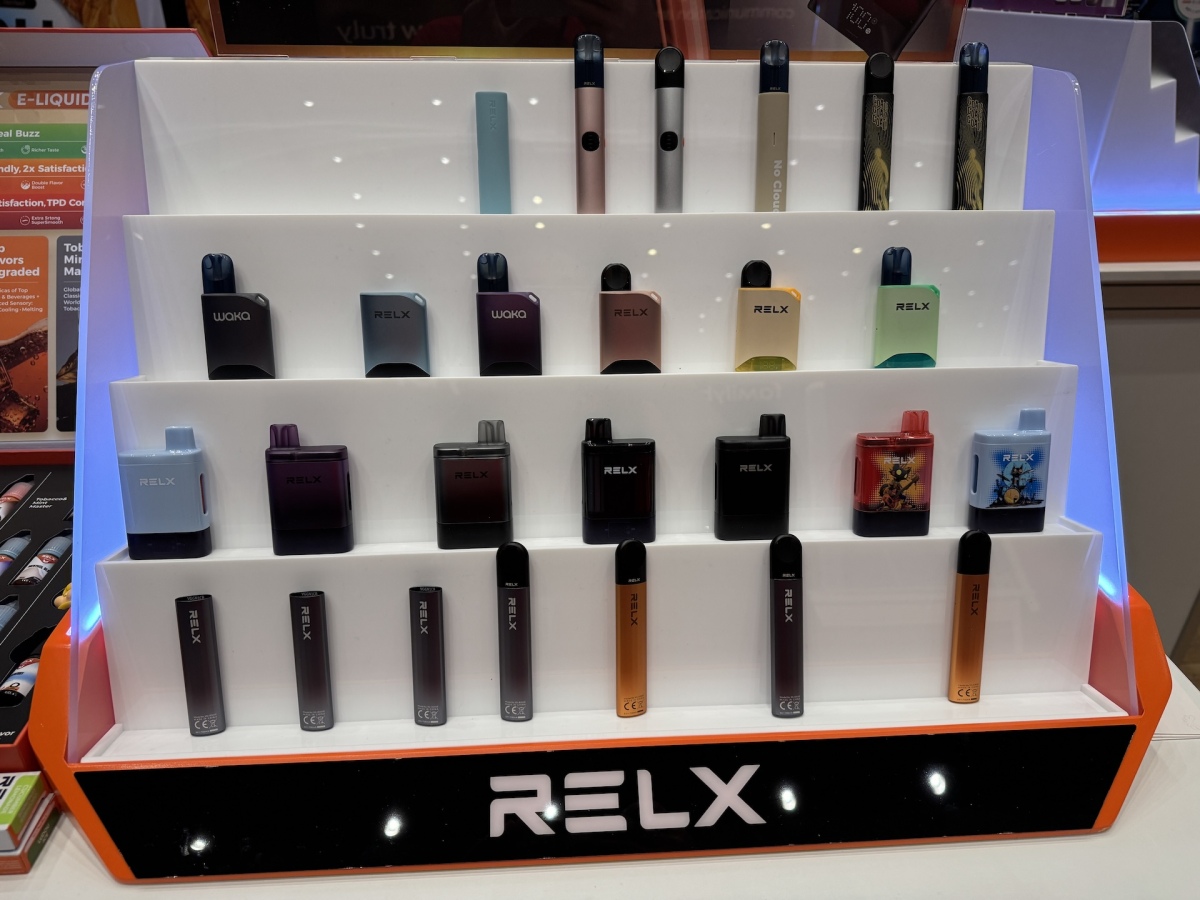
The earnings release did not break down revenue by product format. But 2Firsts’ reporting from EVO NXT 2026 in Prague showed RELX presenting a broader product set than conventional vaping devices.
At the trade show, RELX displayed vaping devices, RELX-branded e-liquids, oral nicotine products and a nasal product concept within the same booth. The presentation did not center on a single hardware line, but placed several product formats side by side.
The e-liquid display used language including “TaxFriendly” and “TPD Compliant,” pointing to formulation, taxation and regulatory positioning rather than flavor promotion alone. Oral nicotine products and a nasal product concept were also shown, indicating that RELX was presenting a wider category portfolio to European industry audiences.
That matters in the European context. The region is facing tighter rules on disposable vapes, rising scrutiny of flavors, environmental concerns and new tax pressure. In such markets, reliance on a single product format may increase regulatory and commercial exposure.
One-Time Export Policy Impact Tests Growth Sustainability
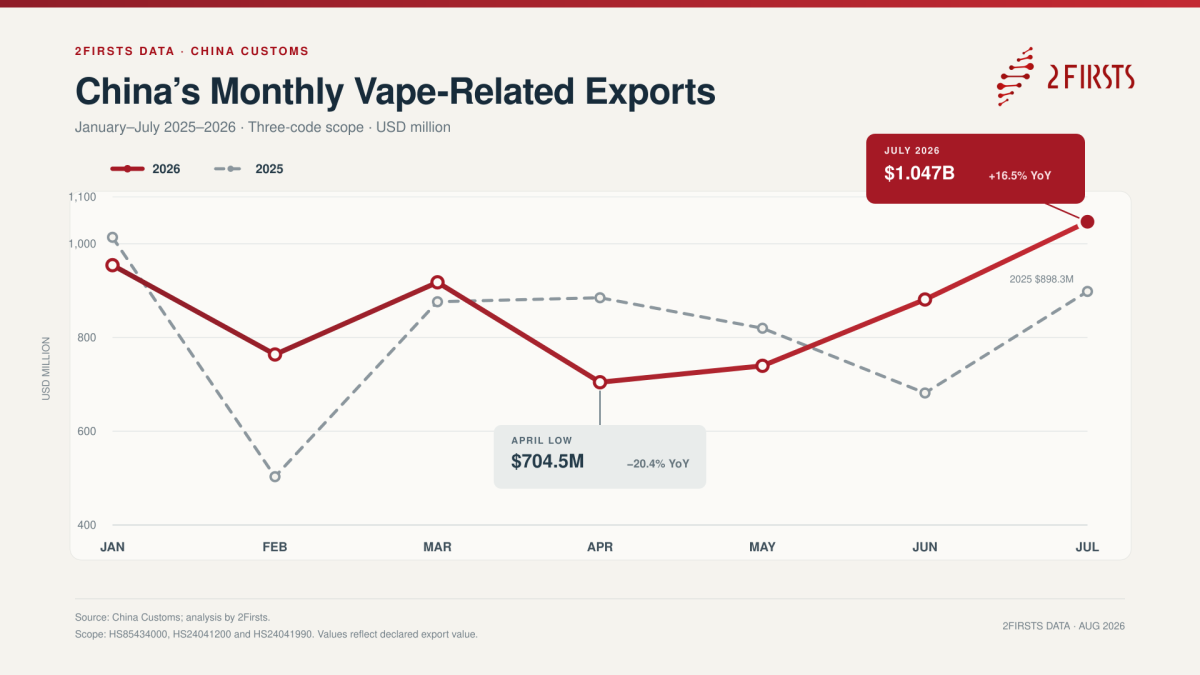
Lu said first-quarter revenue growth was partly supported by a one-time impact from changes in China’s export policies.
That factor means RLX’s first-quarter growth should not be read entirely as recurring operating momentum. International expansion and acquisition contribution may reflect a structural shift in the business, while a policy-related one-time impact may not continue in later quarters.
RLX did not specify which export policy change was involved or how much revenue it contributed. It is therefore unclear how much of the quarter’s revenue increase came from sustained demand, and how much from shipment timing or a policy window.
The second and third quarters of 2026 will be key periods to watch in assessing whether RLX’s first-quarter growth reflects a more durable international operating model or a combination of structural expansion and temporary factors.
A Public Benchmark for China’s E-Vapor Globalization
RLX’s first-quarter filing shows more than a single company’s quarterly performance. It reflects a more complex phase in the overseas expansion of Chinese e-vapor companies: overseas markets are becoming a major revenue source, European operations are moving into focus, supply-chain coordination is gaining importance, and product strategy is showing signs of expanding beyond a single device format.
As China’s only U.S.-listed e-vapor company, RLX provides a rare public reference point for tracking how a leading Chinese brand is building its international business. Compared with an earlier export-manufacturing model, its latest filing points to a more sophisticated global operating structure involving acquired assets, local market access, supply-chain coordination, product-portfolio expansion and responses to policy changes across markets.
Key issues to watch include the role of the European entity in RLX’s international business, the profitability of overseas operations, whether the one-time export policy impact fades in later quarters, and whether a broader product portfolio can generate recurring revenue.
2Firsts will continue to track RLX Technology’s internationalization and its implications for China’s e-vapor industry.
(Cover image generated by AI.)

Disclaimer
This article is provided solely for professional research, industry discussion, and informational purposes. Any references to brands, companies, products, technologies, or policies are made for factual reporting and analytical purposes only, and do not constitute endorsement, recommendation, promotion, or advertising by 2Firsts.
Nicotine-containing products, including but not limited to cigarettes, e-cigarettes, heated tobacco products, and nicotine pouches, carry significant health risks. Readers are responsible for complying with all applicable laws and regulations in their respective jurisdictions, including age restrictions and access limitations.
The information contained in this article should not be regarded as investment, legal, medical, regulatory, or commercial advice. While 2Firsts strives to ensure the accuracy and reliability of its content, it does not assume liability for any direct or indirect loss arising from errors, omissions, inaccuracies, or reliance on the information contained herein.
This article is not intended for individuals below the legal age for accessing tobacco or nicotine-related information in their jurisdiction.
Copyright Notice
This article is either original content produced by 2Firsts or content reproduced, translated, summarized, or adapted from third-party sources with attribution where applicable. The intellectual property rights of the original content remain with 2Firsts or the respective original rights holders.
No individual or organization may copy, reproduce, distribute, republish, modify, translate, or otherwise use this content without prior authorization. Any unauthorized use may result in legal action.
For copyright-related inquiries, corrections, or removal requests, please contact: info@2firsts.com.
AI-Assisted Translation and Editing Notice
Portions of this article may have been translated, edited, or reviewed with the assistance of artificial intelligence tools to improve efficiency and readability. Due to the limitations of AI-assisted translation and editing, discrepancies, omissions, or inaccuracies may exist when compared with the original source.
Where applicable, readers are advised to refer to the original source for the most complete and accurate information. If you identify any errors or believe that any content infringes upon your rights, please contact us at info@2firsts.com, and we will review and address the matter promptly.