
2Firsts Special Report|China’s Nicotine Pouch Manufacturing Goes Global: A Supply Chain Reshaped and Redirected

Nov.21.2025
2Firsts Special Report|China’s Nicotine Pouch Manufacturing Goes Global: A Supply Chain Reshaped and Redirected
China’s nicotine pouch manufacturing expanded rapidly in 2024 but cooled sharply in 2025. Meanwhile, global demand continued to grow strongly, with multinational tobacco companies increasing investment, prompting some Chinese manufacturers to accelerate the shift of production to Southeast Asia and Europe.

Key Points


  • Domestic industry pivots sharply: After explosive expansion in 2024, Chinese nicotine pouch manufacturing saw widespread production cuts and exits by mid-2025, with cooling evident across the upstream and mid-stream supply chain.


  • Global demand remains robust: Brands such as ZYN, VELO and on! continued to post strong growth in the U.S. and Europe, with multinational tobacco companies reporting sustained gains in nicotine pouch performance.


  • Supply chain restructuring accelerates: Driven by rising international demand, some Chinese manufacturers have begun shifting production plans overseas. Southeast Asia is absorbing capacity through its established manufacturing ecosystems, while Europe is gaining strategic attention due to its proximity to core consumer markets.


2Firsts, November 21, 2025 —In 2024, China’s nicotine pouch industry experienced rapid expansion. A large number of e-cigarette brands, pharmaceutical companies, packaging suppliers and equipment manufacturers entered the sector, seeking to capture what was widely seen as the next major opportunity. From non-woven substrates to filling systems to pouch-forming and packaging equipment, the supply chain took shape quickly.


However, entering mid-2025, the domestic market began to shift. Many nicotine pouch manufacturers reduced capacity or suspended operations, and both upstream and mid-stream segments cooled collectively. Industry activity and the number of active players declined sharply from the previous year.


In contrast to the contraction on the domestic manufacturing side, the global nicotine pouch industry continued expanding at a fast pace. Financial disclosures from multinational tobacco companies and rising consumption in emerging markets show nicotine pouches spreading from the United States and Nordic countries to broader regions worldwide, becoming one of the fastest-growing categories within the tobacco alternatives sector.


Between these two diverging curves, a quiet migration of the supply chain is taking place.


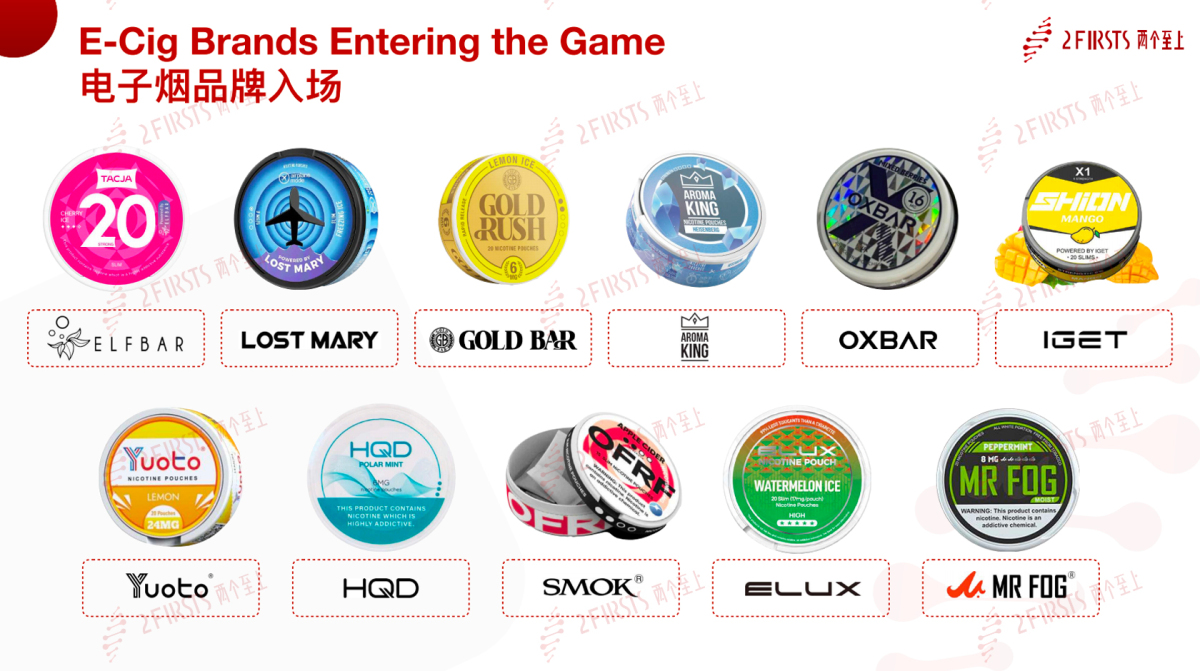
According to early research and long-term observation by 2Firsts, China’s nicotine pouch boom first appeared in late 2023 and peaked in mid-2024. At that time, nearly every major e-cigarette manufacturer considered or entered nicotine pouch production, and almost all mainstream vaping brands launched their own pouch products.
 

2Firsts Special Report|China’s Nicotine Pouch Manufacturing Goes Global: A Supply Chain Reshaped and Redirected
Image: Slide from 2Firsts’ presentation at the Nicotine Pouch Summit in Malaysia in September 2024 | Source: 2Firsts


On the supply chain side, multiple equipment manufacturers showcased nicotine-pouch machinery at Shenzhen-area atomization supply chain exhibitions, making it one of the most visited sections of the show that year.


But this momentum reversed quickly in 2025.


“Factories started closing in May, and by the second half of the year almost everything had stopped,” recalled a long-time industry participant who entered the category during its early phase. He is among the earliest group involved in domestic nicotine pouch manufacturing. Now, he said, the number of companies engaged in pouch production has fallen sharply.


While domestic production cooled, the global nicotine pouch sector remained active.


Financial reports from several international companies (Q3 2025 and FY2025 results) show continued strength in nicotine pouch businesses:


· PMI: nicotine pouch shipments doubled; ZYN U.S. sales +39%
· BAT: VELO annual shipments reached 5.36 billion pouches, +33.6% year-on-year
· Altria: on! shipments +14.8% year-on-year; U.S. market share 16.6%
· Imperial Brands: ZONE expanded to around 100,000 U.S. retail points
· TPB: nicotine pouch revenue up 627.6% year-on-year
· Haypp Group: nicotine pouches accounted for 68% of all oral nicotine sales


(Read more:Global Tobacco Companies’ Latest Earnings Review: Nicotine Pouch Business Shows Broad Strength, Emerging as a Key Growth Driver


From supply to retail, and from the United States to Europe, both multinational tobacco companies and mid-sized firms have positioned nicotine pouches as a core growth engine.


Against the backdrop of domestic cooling and continued overseas demand, several companies have begun accelerating their overseas production planning.


In Southeast Asia, Indonesia and Malaysia have attracted companies conducting site visits or exploring cooperative manufacturing. Some industry sources noted that Batam, Indonesia, has become a landing point for a small number of manufacturers due to its free trade zone conditions. In Malaysia, local licensed manufacturers stated that several Chinese companies have sought cooperation, using entrusted or contract manufacturing to begin production on a shorter timeline.


In Europe, markets such as Poland and Nordic countries have drawn attention because they sit close to major consumer markets, offer established supply chain capabilities, and hold higher levels of industry credibility. According to 2Firsts’ research, these regions have become key considerations for some Chinese companies exploring long-term overseas layouts.

BAT New Categories Revenue Rises 18% in H1 2026 as Broad Portfolio Offers More Ways to Win—and Lose
British American Tobacco’s New Category revenue rose 18% at constant rates in the first half of 2026. Nicotine-pouch brand Velo expanded rapidly, while Vuse recovered as U.S. enforcement against illicit e-vapor products strengthened. Heated-tobacco platform glo remained under pressure, and cigarettes continued to provide most of the group’s profit and cash. Compared with PMI and JT, BAT has more routes to growth—but also greater regulatory, investment and execution risks across its broader portfolio.
BAT
Jul.30
PMI Expands Colorado Investment to $1.2 Billion to Boost ZYN Nicotine Pouch Production
Philip Morris International (PMI) is expanding its investment in its Golden, Colorado campus, bringing total investment to approximately $1.2 billion to support its smoke-free products business. The investment will strengthen PMI’s research, production and innovation capabilities in smoke-free products. As one of the world’s largest tobacco companies, PMI has continued advancing its “Smoke-Free Future” strategy through heated tobacco, oral nicotine and other reduced-risk product categories.
PMI
Jul.28
U.S. Ninth Circuit Upholds FDA Denial of MH Global’s Flavored Vape PMTA Applications
The U.S. Court of Appeals for the Ninth Circuit upheld the FDA’s denial of MH Global LLC’s applications to market flavored electronic nicotine delivery systems (ENDS). The court ruled that FDA’s comparative-efficacy framework, which requires applicants to show that flavored products provide greater cessation or switching benefits than tobacco-flavored alternatives, is consistent with the Tobacco Control Act’s “appropriate for the protection of the public health” standard. The court also found that FDA was not required to establish the framework through notice-and-comment rulemaking.
Aug.26
Science | International Experts Propose a New Smoking Cessation Pathway, Citing Higher Quit Rates With E-Cigarettes Than Nicotine Replacement Therapy
A new expert paper in JAMA urges U.S. clinicians to include nicotine e-cigarettes in smoking-cessation discussions, citing higher quit rates than nicotine replacement therapy. It also stresses that products must deliver enough nicotine to replace cigarettes, dual use should be brief, and complete switching is the goal. 2Firsts argues the recommendations matter beyond clinics: public-health professionals should reassess relative risk, regulators should preserve sufficient product appeal for adult smokers, and manufacturers should focus on helping users quit cigarettes more sustainably.
SCIENCE
Aug.03 by 2Firsts Perspectives
JAMA Issues First U.S. Clinical Guidance on Vaping for Smoking Cessation, Urging Complete Switch From Cigarettes
JAMA has published a Special Communication offering systematic recommendations for U.S.-based clinicians on the use of nicotine e-cigarettes in adult smoking cessation. Developed by the Harm Reduction Workgroup of the Society for Research on Nicotine and Tobacco’s Treatment Research Network, the paper recommends including e-cigarettes alongside FDA-approved cessation medications in risk-benefit discussions. It cites high-certainty evidence that nicotine e-cigarettes achieve higher quit rates than nicotine replacement therapy and evidence suggesting efficacy comparable to highly effective medications such as varenicline and cytisine. For adults who choose vaping to quit, the authors recommend FDA-authorized products, sufficient nicotine delivery and a rapid, complete transition away from cigarettes rather than prolonged dual use.
Aug.13
French Vape Market Under Pressure as Europe’s First Listed Vape Company Kumulus Vape Reports 7.8% H1 Revenue Decline, Retail Sales Rise 41.5%
Kumulus Vape, Europe’s first publicly listed vape company, reported a 7.8% year-on-year decline in first-half 2026 revenue. Amid changing conditions in France’s vape market, the company said channel diversification helped offset pressure, with physical store sales increasing 41.5% year on year. Listed on Euronext Access Paris in 2019 and later transferred to Euronext Growth Paris, Kumulus Vape is viewed as a representative company of Europe’s vape sector. Its performance highlights the industry’s shift from rapid expansion toward more operationally focused growth.
Jul.27