Australian Border Force: Illegal tobacco and vaping products worth A$1 billion in tax revenue gap intercepted in Q2 2025

Feb.05
Australian Border Force: Illegal tobacco and vaping products worth A$1 billion in tax revenue gap intercepted in Q2 2025
Australian Border Force intercepts over $1 billion worth of illegal tobacco and e-cigarettes, totaling 467+ tons. Leading enforcement against smuggling.

Key Points

  • Total Value: In the second quarter of the 2025/26 financial year (1 October to 31 December 2025), the tax evasion associated with illicit tobacco and e-cigarettes intercepted at Australia's borders amounted to approximately A$1 billion (approximately US$680 million).
    Weight: Over 467 tonnes of illicit cigarettes and loose tobacco were seized.
  • New South Wales: 14.4 million cigarettes seized from a Chinese shipping container in October; 2.5 tonnes of molasses tobacco (concealed behind "fruit juice") seized days later; 52,800 e-cigarettes seized from a Kuala Lumpur-bound container in November, declared as "dumbbells" and "trampolines".
  • Rise in e-cigarette liquid smuggling: 3 litres seized from Hong Kong air freight in Adelaide (declared as aroma diffusers); over 5.5 litres seized from multiple parcels originating UK and France via Brisbane international mail.
  • Victoria Airport: Multiple passenger smuggling cases in recent months originating from Lebanon and Taiwan; one case involving a female passenger arriving from Lebanon is pending prosecution.


2Firsts, Feb 5, 2026


According to the Australian Border Force (ABF), illicit tobacco and vapes linked to an estimated A$1 billion in evaded duty were stopped at the Australian border in Q2 of FY2025/26 (Oct 1–Dec 31, 2025), including seizures totaling more than 467 tonnes of illicit cigarettes and loose-leaf tobacco. Using the rate A$1 = US$0.68, the evaded duty figure is approximately US$680 million.


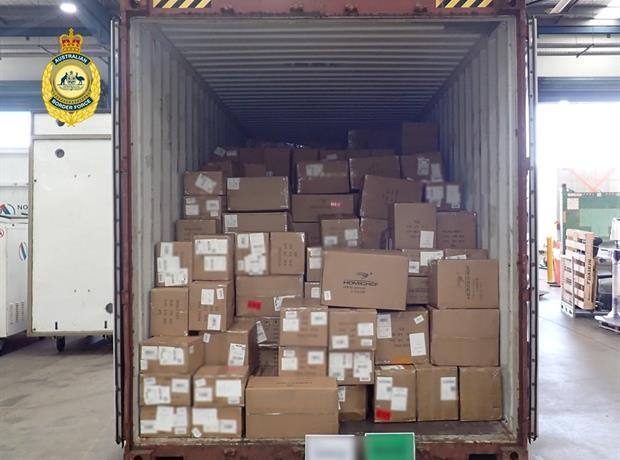
ABF said sea cargo interceptions featured prominently. In New South Wales, Australia, officers seized over 14.4 million cigarettes in mid-October from a shipping container originating from China. Days later, they found more than 2.5 tonnes of molasses tobacco concealed behind “juice” consignments. In November, ABF discovered 52,800 vapes in a container from Kuala Lumpur, Malaysia, which had been declared as “dumbbells and trampolines.”


ABF also flagged a rise in vape liquid detections. In Adelaide, Australia, officers seized three litres from air cargo originating in Hong Kong, declared as diffuser fragrance. In Brisbane, Australia, officers intercepted multiple international mail consignments from the UK and France, totaling more than 5.5 litres.


In Tasmania, Australia, ABF reported one of its largest cigarette seizures just before Christmas, after officers searched a container from Poland and uncovered more than 5.4 million illicit cigarettes, falsely declared as stretch film.


At Melbourne Airport in Victoria, Australia, ABF detected multiple traveler-smuggling attempts over the past three months, including:


  • a male traveler and companion arriving from Lebanon with 7kg of tobacco;
  • a male traveler from Taiwan with 23,400 cigarettes concealed in luggage;
  • a female traveler from Lebanon carrying 11.5kg of tobacco and 13,200 cigarettes (pending prosecution);
  • two male travelers from Lebanon with over 5,000 cigarettes and 11.75kg of tobacco.


Illicit Tobacco and Vape Enforcement Commander Greg Dowse said the figures underscore that illicit tobacco remains a top ABF priority, adding that ABF targets the black-market business model before goods reach Australia and continues post-border through cooperation and intelligence sharing. ABF encouraged anyone with information to contact Border Watch.


Image source: Australian Border Force (ABF)


We welcome news tips, article submissions, interview requests, or comments on this piece.

Please contact us at info@2firsts.com, or reach out to Alan Zhao, CEO of 2Firsts, on LinkedIn


Notice

1.  This article is intended solely for professional research purposes related to industry, technology, and policy. Any references to brands or products are made purely for objective description and do not constitute any form of endorsement, recommendation, or promotion by 2Firsts.

2.  The use of nicotine-containing products — including, but not limited to, cigarettes, e-cigarettes, nicotine pouchand heated tobacco products — carries significant health risks. Users are responsible for complying with all applicable laws and regulations in their respective jurisdictions.

3.  This article is not intended to serve as the basis for any investment decisions or financial advice. 2Firsts assumes no direct or indirect liability for any inaccuracies or errors in the content.

4.  Access to this article is strictly prohibited for individuals below the legal age in their jurisdiction.


Copyright


This article is either an original work created by 2Firsts or a reproduction from third-party sources with proper attribution. All copyrights and usage rights belong to 2Firsts or the original content provider. Unauthorized reproduction, distribution, or any other form of unauthorized use by any individual or organization is strictly prohibited. Violators will be held legally accountable.

For copyright-related inquiries, please contact: info@2firsts.com


AI Assistance Disclaimer


This article may have been enhanced using AI tools to improve translation and editorial efficiency. However, due to technical limitations, inaccuracies may occur. Readers are encouraged to refer to the cited sources for the most accurate information.

We welcome any corrections or feedback. Please contact us at: info@2firsts.com

Canada Health Minister Says She Is Not Considering Looser Nicotine Pouch Retail Rules as PMI-Linked Group Pushes for Wider Access
Canadian Health Minister Marjorie Michel says she is not considering loosening retail restrictions on nicotine pouches. Canada regulates pouches containing 4 mg or less of nicotine per unit as non-prescription nicotine replacement therapy and requires newer NRT formats such as pouches to be sold from behind pharmacy counters. Meanwhile, Unsmoke Canada, linked to Philip Morris International's Canadian business, is pushing to allow pouches in convenience stores and other general retail outlets. Health Canada also acknowledges continued unauthorized sales, while recent research shows rising pouch use among Canadian youth aged 16 to 19.
Sep.24
South Korea Vape Strategies Diverge as BAT Reconsiders Exit and PMI Takes VEEV to About 14,000 Stores
BAT Rothmans says it previously considered exiting South Korea's vaping market because of competitive pressure from unregulated products, but is now reassessing conditions following changes to the country's nicotine regulatory framework. Vuse and other BAT vaping products remain available through existing distribution channels. The statement followed a South Korean media report that interpreted BAT's broader withdrawal from selected Vapour markets as a full exit from South Korea. Meanwhile, Philip Morris International launched VEEV inPRIME in the country in June and began expanding distribution to around 14,000 convenience stores and other retail channels in July. The contrasting moves highlight differing investment strategies as South Korea's regulated vaping market evolves.
Aug.14
Reuters Tracks Big Tobacco’s Shift Beyond Cigarettes as Nicotine Pouches Vie for the Next Growth Curve
As cigarette markets face long-term pressure, major tobacco companies are increasingly turning to nicotine pouches in search of growth beyond combustible tobacco. Reuters has examined whether nicotine pouches can become the next strategic growth platform for companies including Philip Morris International, British American Tobacco and Japan Tobacco. PMI strengthened its position through the acquisition of Swedish Match and its ZYN brand, while BAT and JTI continue expanding their own nicotine pouch portfolios. The category has gained attention because of its smoke-free, device-free format, but regulation, youth-use concerns and market scale will determine whether it can become a long-term growth engine.
Regulations
Aug.18 by 2Firsts Perspectives
Kantar Study Finds More Than 93% of Vape Products in Ukraine Fail Regulatory Requirements
According to Interfax-Ukraine, a study conducted by market research firm Kantar Ukraine at the request of major tobacco companies found that more than 93% of vape products in Ukraine did not fully comply with regulatory requirements. The research examined product categories, brand distribution and consumer purchasing channels, showing that pod systems and disposable vapes represent major segments of the market, while offline retail remains the dominant purchasing channel. The findings highlight ongoing compliance challenges in Ukraine’s vape market.
Aug.26
Product | PMJ Adds Bold Ruby to IQOS ILUMA i Lineup in Japan, Convenience-Store Rollout Starts Sept. 29
Philip Morris Japan (PMJ) launched Bold Ruby as a new regular color for the IQOS ILUMA i and IQOS ILUMA i ONE in Japan on September 16, 2026, priced at JPY 6,980 and JPY 3,980, respectively. Initial sales began through IQOS online and physical channels, with convenience stores and selected tobacco retailers set to follow from September 29. Bold Ruby is a regular rather than limited-edition colorway and is available for the ILUMA i and ILUMA i ONE, but not the ILUMA i PRIME. The release does not involve changes to the devices' core hardware or functions.
Sep.22
China Tobacco Plans CNY 60 Billion Investment in ICBC, Agricultural Bank as Strategic Ties Extend Beyond Equity
China National Tobacco Corporation and several subsidiaries plan to invest a combined CNY 60 billion ($8.7 billion) in share placements by Industrial and Commercial Bank of China and Agricultural Bank of China as strategic investors. The agreements extend beyond equity investment to corporate governance, banking services and supply-chain finance. The filings also disclose 2025 data on China Tobacco’s tax and profit contributions and industry scale.
Sep.07