Azerbaijan Parliament Passes E-cigarette Ban Bill in First Reading

Dec.22.2025
Azerbaijan Parliament Passes E-cigarette Ban Bill in First Reading
Azerbaijan’s Milli Majlis has approved, in its first reading, a bill that would ban the import, export, production, storage, wholesale and retail sale, and use of electronic cigarettes and their components. The bill amends the Law on Tobacco and Tobacco Products, classifying nicotine-containing e-cigarettes as tobacco products while explicitly excluding heated tobacco products. If adopted, the law would take effect on February 1, 2026.

Key Points


  • Azerbaijan’s parliament approved an e-cigarette ban bill at first reading;
  • The ban covers all stages of circulation and use;
  • Nicotine-containing e-cigarettes are defined as tobacco products;
  • Heated tobacco products are excluded from the e-cigarette definition;
  • The bill is scheduled to take effect on February 1, 2026.


2Firsts, December 2025,22 – Azerbaijan’s Milli Majlis has adopted, in the first reading, a bill proposing a ban on the import, export, production, storage, wholesale and retail sale, and use of electronic cigarettes and their components.


The bill was discussed during a plenary session as amendments to the Law on Tobacco and Tobacco Products. The document states that nicotine-containing electronic cigarettes are included within the definition of tobacco products.


Under the draft law, an electronic cigarette is defined as a product intended to deliver nicotine-containing or nicotine-free vapour into the human body through the respiratory tract, used with a device featuring a mouthpiece or other components, including cartridges and containers, whether disposable or refillable.


The bill specifies that heated tobacco products are not considered electronic cigarettes. Heated tobacco products are defined as products consisting of tobacco and non-tobacco components that deliver nicotine-containing aerosol through heating without combustion and without producing tobacco smoke.


The clarification and introduction of new definitions are intended to allow for more precise legal classification and differentiation of tobacco products, including heated tobacco products and electronic cigarettes.


In parallel, corresponding amendments are proposed to the Tax Code and the Law on Advertising. These include removing disposable electronic cigarettes and e-liquids from the list of excisable goods, abolishing related tax rates, and aligning advertising restrictions with the new definitions.


If adopted, the law will enter into force on February 1, 2026.


Image source: zerkalo


We welcome news tips, article submissions, interview requests, or comments on this piece.

Please contact us at info@2firsts.com, or reach out to Alan Zhao, CEO of 2Firsts, on LinkedIn


Notice

1.  This article is intended solely for professional research purposes related to industry, technology, and policy. Any references to brands or products are made purely for objective description and do not constitute any form of endorsement, recommendation, or promotion by 2Firsts.

2.  The use of nicotine-containing products — including, but not limited to, cigarettes, e-cigarettes, nicotine pouchand heated tobacco products — carries significant health risks. Users are responsible for complying with all applicable laws and regulations in their respective jurisdictions.

3.  This article is not intended to serve as the basis for any investment decisions or financial advice. 2Firsts assumes no direct or indirect liability for any inaccuracies or errors in the content.

4.  Access to this article is strictly prohibited for individuals below the legal age in their jurisdiction.


Copyright


This article is either an original work created by 2Firsts or a reproduction from third-party sources with proper attribution. All copyrights and usage rights belong to 2Firsts or the original content provider. Unauthorized reproduction, distribution, or any other form of unauthorized use by any individual or organization is strictly prohibited. Violators will be held legally accountable.

For copyright-related inquiries, please contact: info@2firsts.com


AI Assistance Disclaimer


This article may have been enhanced using AI tools to improve translation and editorial efficiency. However, due to technical limitations, inaccuracies may occur. Readers are encouraged to refer to the cited sources for the most accurate information.

We welcome any corrections or feedback. Please contact us at: info@2firsts.com

South Korea Constitutional Court Upholds Volume-Based E-Liquid Tax, With Challenged Rates at KRW 370 and KRW 628 per Milliliter
South Korea's Constitutional Court has upheld fixed taxes on nicotine-containing e-cigarette liquids based on solution volume, ruling that challenged provisions imposing KRW 370 per milliliter in individual consumption tax and KRW 628 per milliliter in tobacco consumption tax do not violate the Constitution. The cases stemmed from historical disputes involving importers that reported nicotine as being extracted from tobacco stems rather than leaves. South Korea has since broadened its tobacco definition to include synthetic nicotine, while current tax laws provide reduced rates for certain products not derived from tobacco.
Sep.18
Florida Governor DeSantis Expands TANF Restrictions, Blocking Welfare Benefits From Buying Tobacco and Vapes
Florida Governor Ron DeSantis announced an expansion of Temporary Assistance for Needy Families (TANF) restrictions that would prohibit Electronic Benefit Transfer (EBT) funds from being used to purchase tobacco and vaping products. The state will amend its TANF State Plan and submit the changes for federal approval. Florida officials said the restrictions would not affect eligibility for temporary cash assistance or the amount of benefits received, but would change how funds can be spent.
Aug.25
How Large Is France’s Off-Channel Tobacco Market? Logista Says It Has Become Structural, While the Official Estimate Is 17.7% and Some Industry Studies Put It Above 50%
Logista France says tobacco consumption outside France’s official tobacconist network has become a large and structural market phenomenon, but official and industry estimates differ sharply. France’s TAFE study estimates that 17.7% of tobacco consumption escaped domestic taxation in 2023, with most of that volume attributed to cross-border purchasing rather than street sales. Some industry studies use broader off-channel definitions and put the figure above 50%. Meanwhile, French Customs seized 547.94 tonnes of tobacco in 2025, up 12%, showing continued pressure from illicit trade.
Sep.04
Product | BAT Expands VELO Travellers’ Collection With Mexico, Spain and Sweden Summer Edition Nicotine Pouches
British American Tobacco (BAT) Global Travel Retail has expanded the VELO Travellers’ Collection with three new Summer Editions: Mexico, Spain and Sweden. Inspired by destination themes, the new nicotine pouch variants are designed for global travel-retail channels. The launch further strengthens VELO’s positioning as a travel-retail exclusive product collection.
Aug.27
Japan Survey Finds 49.5% Would Cut Tobacco Use if Prices Rise, 64.6% Show Interest in Nicotine-Free Alternatives
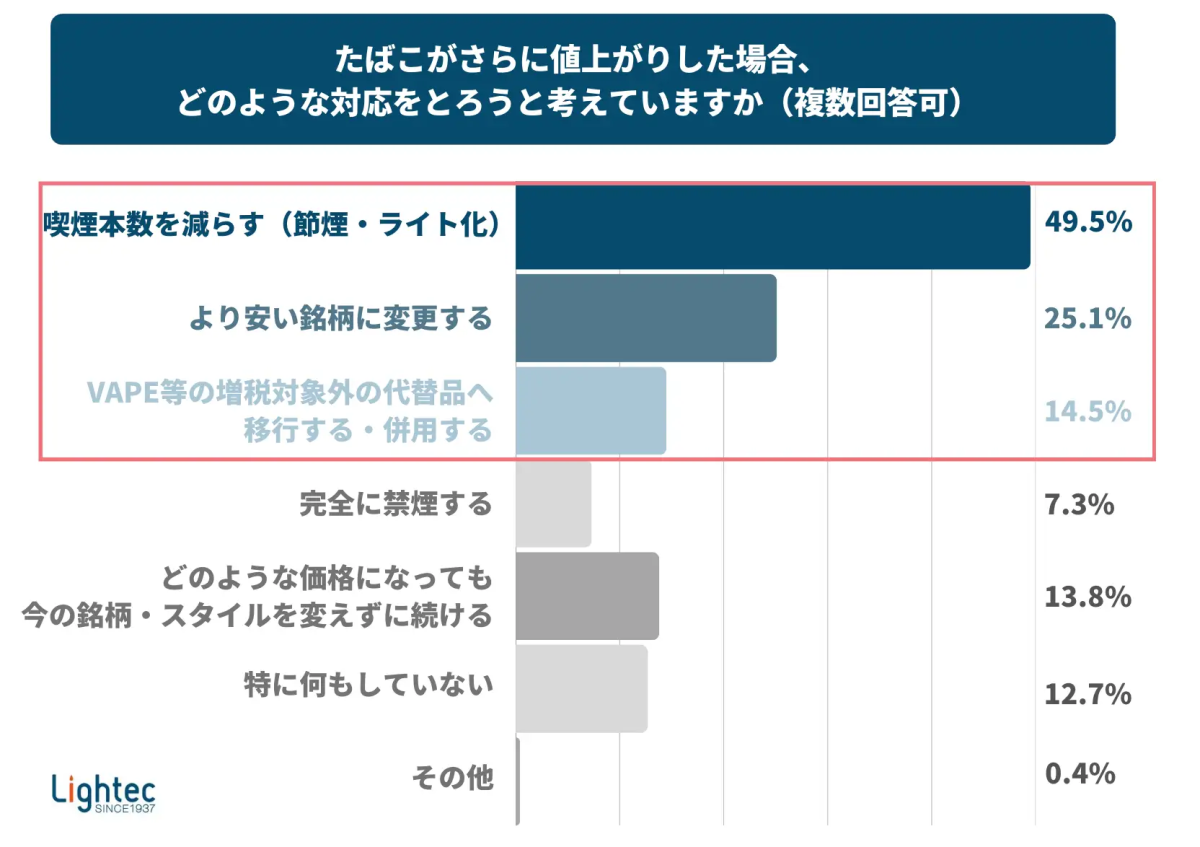
A September online survey commissioned by Japanese smoking-accessories company Lightec found that 49.5% of respondents would consider reducing tobacco use if prices rose further, while 25.1% would consider switching to cheaper brands and 14.5% would consider using or combining alternatives such as vapes and nicotine-free herbal sticks. Another 64.6% expressed some level of interest in such alternatives. The survey covered 1,088 respondents aged 20 to 70 and was conducted by a company that sells NICOLESS nicotine-free vaping and herbal-stick products, meaning its findings should not be treated as representative of Japan's smoking population.
DATA
Oct.12
German Bundestag Passes Tobacco Tax Hikes: Vape Liquid Duty to Reach €0.44/ml, Heated Tobacco Taxes to Rise and Cigarettes Seen Near €12 a Pack
Germany's Bundestag passed amendments to the Tobacco Tax Act on October 15, 2026, setting out annual excise tax increases from 2027 through 2030 for e-cigarette liquids, heated tobacco, cigarettes and other tobacco products. Under the Finance Committee's amended bill, duty on qualifying e-liquids will rise from €0.32/ml in 2026 to €0.44/ml in 2030, an increase of 37.5%. Heated tobacco will retain its tax calculation based on 80% of the corresponding cigarette excise duty. The average price of a 20-cigarette pack is projected to approach €12 by 2030, with some brands potentially reaching €14. The legislation is projected to generate approximately €11.8 billion in additional tax revenue over four years and remains subject to further legislative procedures.
Regulations
Oct.19