BAT's R.J. Reynolds Loses Appeal on Graphic Cigarette Warning Labels, US Supreme Court Rules

Nov.26.2024
BAT's R.J. Reynolds Loses Appeal on Graphic Cigarette Warning Labels, US Supreme Court Rules
The US Supreme Court has rejected BAT's R.J. Reynolds appeal against new graphic cigarette warning labels, which feature health-related images such as cancer and lung disease. This decision ends a long legal battle and leaves in place a ruling from a lower court that confirms the new warnings do not violate tobacco companies' First Amendment rights.

The US Supreme Court upheld a lower court's decision, rejecting the appeal filed by R.J. Reynolds, a subsidiary of British American Tobacco(BAT), seeking to block the FDA's new graphic cigarette warning labels.


This ruling follows a series of legal battles and leaves in place a decision from the federal appeals court, confirming that the new warnings- featuring images of serious health conditions like cancer, and lung disease- do not violate tobacco companies' First Amendment rights.
 

BAT's R.J. Reynolds Loses Appeal on Graphic Cigarette Warning Labels, US Supreme Court Rules
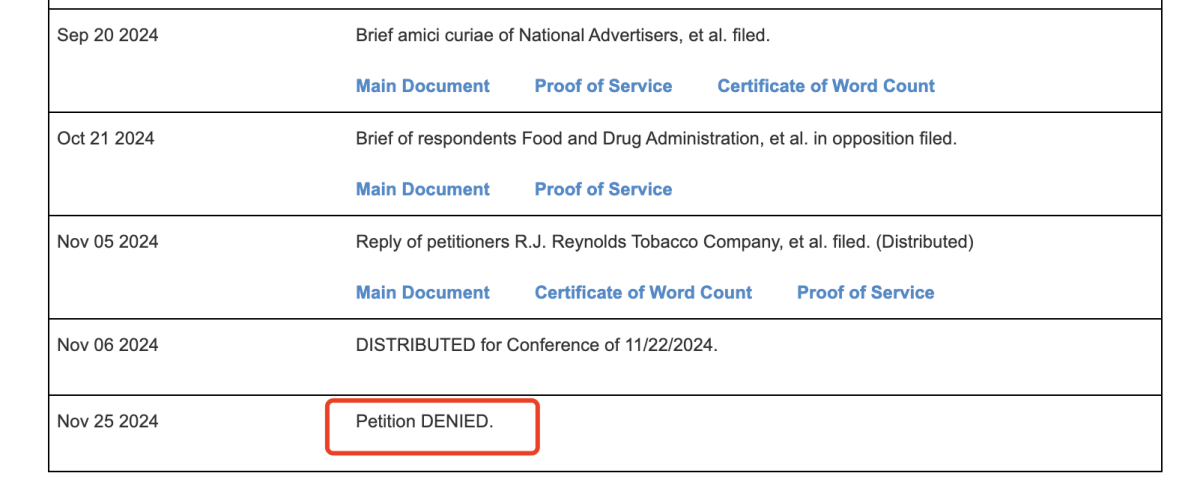
R.J. Reynolds Tobacco Company, et al., Petitioners v. FDA: The court denied the petition. | Image source: Supreme Court of the US


Under the Tobacco Control Act of 2009, Congress required that cigarette packaging and advertisements feature "nine new warnings that would rotate regularly", covering "the top 50 percent of the front and rear panels" of each cigarette pack, and at least "20 percent of the area of the advertisement". 


In 2011, FDA issued a rule implementing these warnings. However, tobacco companies, including R.J. Reynolds, challenged the rule, arguing it violated their First Amendment rights. 


In 2012, the D.C. Circuit Court ruled that the specific images used in FDA's original rule were problematic.  


Over the following years, FDA conducted additional research and consumer testing. In 2020, it issued an updated rule with 11 new graphic warning labels based on these findings. 


Despite FDA's revisions, R.J. Reynolds and other tobacco companies continued to challenge the 2020 warnings, arguing that they were a form of "compelled speech".They contended that the images would overshadow their messaging. They argued that the "emotional response" evoked by the images was "provocative and misleading".


The Fifth Circuit Court of Appeals upheld FDA's 2020 rule, citing Zauderer v. Office of Disciplinary Counsel (1985), which allows the government to require factual, uncontroversial disclosures in commercial speech for public health purposes. 


The court found that the graphic warnings were scientifically accurate, supported by the Surgeon General's report. It also ruled that any emotional reaction to the images did not change their factual content, as their primary purpose was to inform the public about smoking's health risks.


Additionally, FDA emphasized that the warnings are based on "the best available science" and that their primary purpose is to inform the public about the well-established health risks of smoking. 


After the Fifth Circuit Court's ruling, the petitioners (the tobacco companies) sought a review by the U.S. Supreme Court, arguing that the lower courts had misapplied the law.


Finally, the US Supreme Court rejected the appeal On 25, November 2024, leaving the FDA's regulation intact. The graphic warnings are set to take effect starting December 2025, 15 months after the final regulations are issued.
 

BAT's R.J. Reynolds Loses Appeal on Graphic Cigarette Warning Labels, US Supreme Court Rules
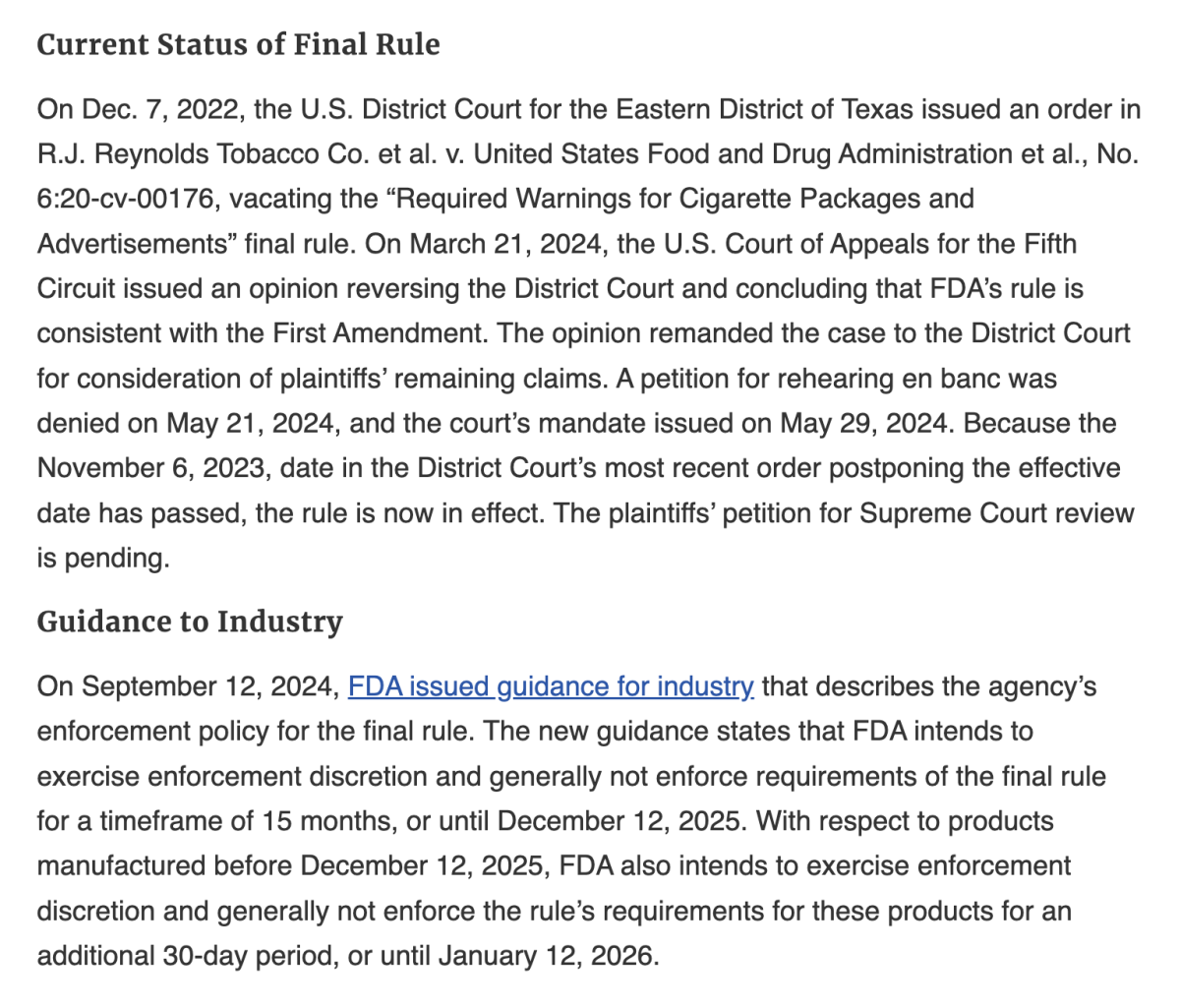
FDA statement on September 12, 2024 | Image source: FDA


FDA's new regulation will be enforced "15 months after the issuance" of the Secretary's regulations, meaning the labels will be displayed on cigarette packaging and advertisements by December 2025.  
 

BAT's R.J. Reynolds Loses Appeal on Graphic Cigarette Warning Labels, US Supreme Court Rules
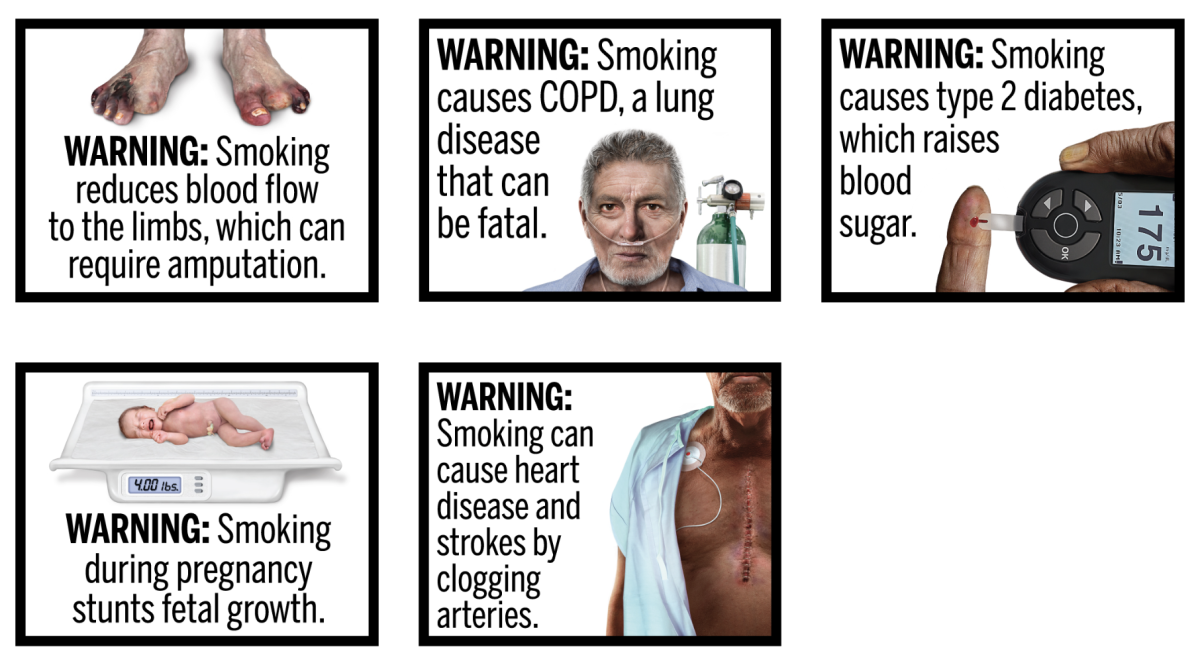
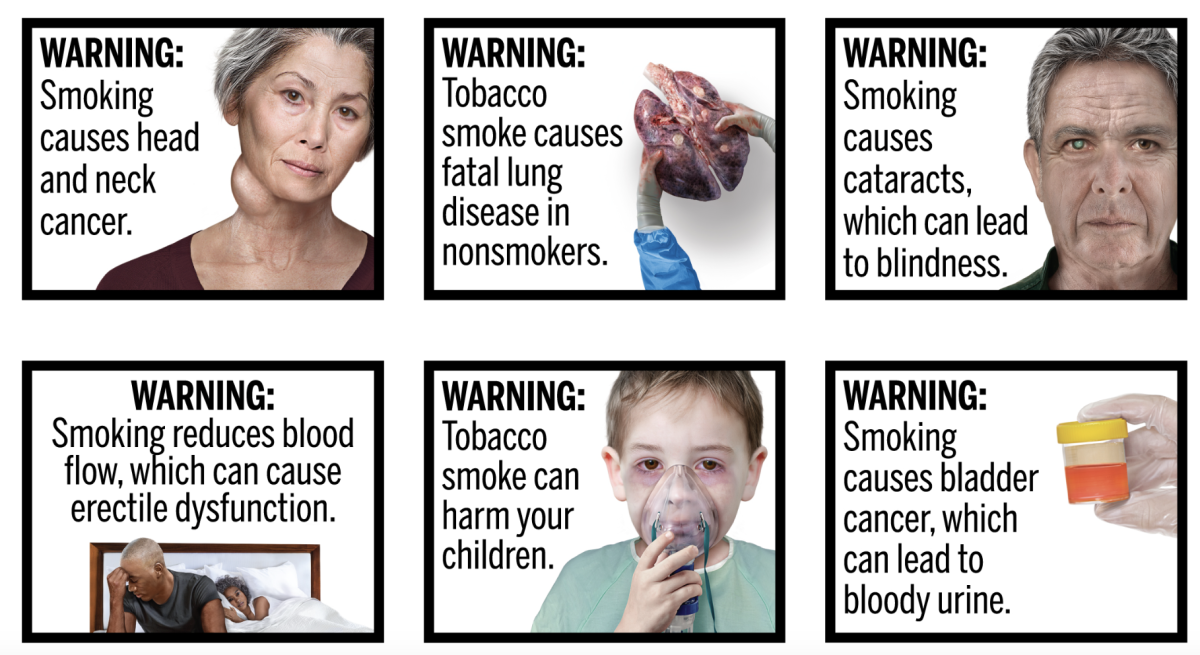
Required Warnings for Cigarette Packages and Advertisements | Image source: FDA


BAT's R.J. Reynolds Loses Appeal on Graphic Cigarette Warning Labels, US Supreme Court Rules
Required Warnings for Cigarette Packages and Advertisements | Image source: FDA


The new graphic warnings include a range of images, such as a woman with a neck tumor and a child with an oxygen mask, both of which convey the "negative health consequences of smoking".  

 

UK Local Council Proposes £5 Refundable Deposit on Vape Devices
Norwich City Council is set to debate a proposed vape deposit scheme that would require consumers to pay an extra refundable £5 per device at purchase, with the money returned when the device is handed back, as recent recycling-facility fires, including a major Widnes blaze reportedly very likely caused by a vape, draw greater attention to the risks of improperly discarded lithium-battery devices.
Jul.01
PMI Oral Products Chief Says Lack of Rules May Push Nicotine Pouch Market Into Illicit Trade
Nick Ricketts, President of Oral Products at Philip Morris International (PMI), told Logos Press that nicotine pouches should be brought under clear regulatory frameworks covering nicotine limits, flavor rules, age verification, sales controls and marketing standards, arguing that the absence of clear rules or blanket bans may push consumer demand into illegal or semi-legal channels.
Jul.06
Nasdaq-Listed Vape Company iSpire Technology Restructures Leadership as Tuanfang Liu Becomes Sole CEO, BTIG Initiates Coverage on ODM Growth Opportunity
Nasdaq-listed vape company iSpire Technology has restructured its leadership team, with Tuanfang Liu becoming the company’s sole chief executive officer (CEO) and Michael Wang appointed CEO of Aspire North America. The move ends iSpire’s previous co-CEO structure and creates clearer responsibilities between group strategy and regional execution. Separately, BTIG initiated coverage on iSpire Technology with a Buy rating and a $3.50 price target, identifying ODM growth opportunities as a key investment factor.
Jul.27
JT Plans ¥800 Billion Investment in Heated Tobacco Over Three Years, Betting on Ploom as Second Growth Engine
Japan Tobacco Inc. (JT) CEO Takehiko Tsutsui said the company plans to invest about ¥800 billion (approximately US$5.4 billion) in heated tobacco products over three years through 2028, aiming to establish Ploom as a second growth engine after combustible cigarettes. Tsutsui said Ploom AURA helped JT increase its share of Japan’s heated tobacco market to 15.8% in the first quarter of 2026. Ploom products are now available in 29 markets, with Ploom AURA sold in 25 markets including Japan. JT also plans to continue its cigarette business while positioning its food operations, particularly frozen noodle products in North America, as another growth opportunity.
Jul.23
Vape Vending Machine Concerns Rise in German-Speaking Europe as Schools and Age Checks Come Into Focus
Recent reports from Germany and Switzerland show growing concern over vape and tobacco vending machines near schools or in public settings, with parents, teachers and residents questioning youth access, age-verification controls and the sale of vapes alongside snacks and drinks.
Jul.06
UK Disposable Vape Ban Marks One Year as Adult Use Falls to 8% and Youth Use to 13%
One year after the UK ban on single-use disposable vapes took effect, YouGov data commissioned by Action on Smoking and Health shows that 13% of 11-17-year-old vapers and 8% of adult vapers now mainly use disposable products.
Jun.18