Buryat Customs Seize Hidden Tobacco Stash in Russian Border

Regulations by 2FIRSTS.ai
Dec.26.2023
Buryat Customs Seize Hidden Tobacco Stash in Russian Border
Russian Border Guards discovered a hidden compartment filled with smuggled tobacco on a bus from Mongolia. The driver attempted to bring 1150 packs of cigarettes illegally into Russia.

According to a report by the Baikal Daily News Agency on December 26th, customs officers at the Buryat customs in Russia discovered a hidden compartment filled with smuggled tobacco on a bus coming from Mongolia.


It has been reported that the driver attempted to smuggle over 1150 packages of tobacco into the country from Mongolia stealthily. The customs officials uncovered and seized the tobacco at the border inspection station. The driver had submitted relevant documents for the bus upon entering the station and declared that there were no items requiring declaration on board. However, through the inspection of the mobile scanning system, customs officials discovered the tobacco concealed within the ventilation system of the bus.


The offender admitted that he attempted to smuggle tobacco into Russia for the purpose of evading customs checks, driven by commercial interests. In order to accomplish this, he had pre-emptively dismantled the ventilation system on the overhead passenger seats and concealed 115 packages of tobacco within it.


Shortly afterwards, Vrezh Tatevosyan, the director of the customs station, explicitly stated that according to the customs law of the Eurasian Economic Union, each adult citizen is only allowed to bring a maximum of 200 packs of cigarettes, or 50 cigars, or 200 heated tobacco products (cigarettes), or 250 grams of tobacco into the member countries of the union.


We welcome news tips, article submissions, interview requests, or comments on this piece.

Please contact us at info@2firsts.com, or reach out to Alan Zhao, CEO of 2Firsts, on LinkedIn


Notice

1.  This article is intended solely for professional research purposes related to industry, technology, and policy. Any references to brands or products are made purely for objective description and do not constitute any form of endorsement, recommendation, or promotion by 2Firsts.

2.  The use of nicotine-containing products — including, but not limited to, cigarettes, e-cigarettes, nicotine pouchand heated tobacco products — carries significant health risks. Users are responsible for complying with all applicable laws and regulations in their respective jurisdictions.

3.  This article is not intended to serve as the basis for any investment decisions or financial advice. 2Firsts assumes no direct or indirect liability for any inaccuracies or errors in the content.

4.  Access to this article is strictly prohibited for individuals below the legal age in their jurisdiction.


Copyright


This article is either an original work created by 2Firsts or a reproduction from third-party sources with proper attribution. All copyrights and usage rights belong to 2Firsts or the original content provider. Unauthorized reproduction, distribution, or any other form of unauthorized use by any individual or organization is strictly prohibited. Violators will be held legally accountable.

For copyright-related inquiries, please contact: info@2firsts.com


AI Assistance Disclaimer


This article may have been enhanced using AI tools to improve translation and editorial efficiency. However, due to technical limitations, inaccuracies may occur. Readers are encouraged to refer to the cited sources for the most accurate information.

We welcome any corrections or feedback. Please contact us at: info@2firsts.com

Indiana’s Foreign-Made Vape Ban Takes Effect, Forcing Brands and Retailers to Adjust Supply Chains
A new Indiana law restricting the sale of foreign-made vape products has taken effect, requiring retailers to adjust inventory and sourcing practices. According to The Sun, WDRB and other reports, some local vape shops are reviewing product origins and supplier information to comply with the new requirements. The measure represents a broader shift in U.S. vape regulation, with oversight expanding beyond product authorization and sales rules toward manufacturing origin and supply-chain management.
Jul.24
Tobacco Companies Are Redesigning Nicotine Products. BAT Wins Three Red Dot Awards
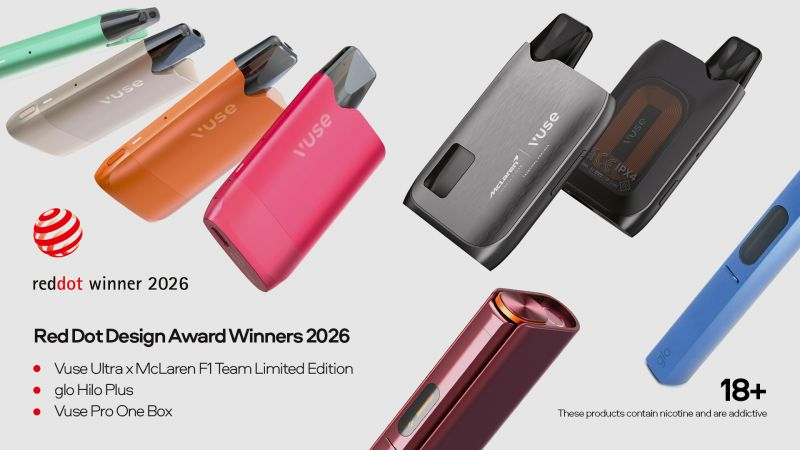
According to BAT and the Red Dot Design Award website, BAT’s glo Hilo Plus, Vuse Pro One Box and Vuse Ultra x McLaren F1 Team Limited Edition received Red Dot recognition in the Product Design 2026 competition.BAT said the awards reflect not only the design quality of the individual products but also the development of design as a core internal capability across industrial design, user experience and sustainability. Red Dot’s product pages describe glo Hilo Plus as a two-part tobacco heater with a pen and charging case, plus a touch-sensitive AMOLED display. Vuse Pro One Box is described as a rechargeable e-cigarette with replaceable pods, USB-C charging and a switchable VapourBoost mode. Vuse Ultra x McLaren F1 Team Limited Edition brings motorsport-inspired design elements into a compact e-cigarette device and includes exchangeable batteries.
Jul.17
BAT New Categories Revenue Rises 18% in H1 2026 as Broad Portfolio Offers More Ways to Win—and Lose
British American Tobacco’s New Category revenue rose 18% at constant rates in the first half of 2026. Nicotine-pouch brand Velo expanded rapidly, while Vuse recovered as U.S. enforcement against illicit e-vapor products strengthened. Heated-tobacco platform glo remained under pressure, and cigarettes continued to provide most of the group’s profit and cash. Compared with PMI and JT, BAT has more routes to growth—but also greater regulatory, investment and execution risks across its broader portfolio.
BAT
Jul.30
2Firsts Data | China’s Vape-Related Exports Rise 16.5% in July 2026 as U.S.-Bound Shipments Jump 53.5%
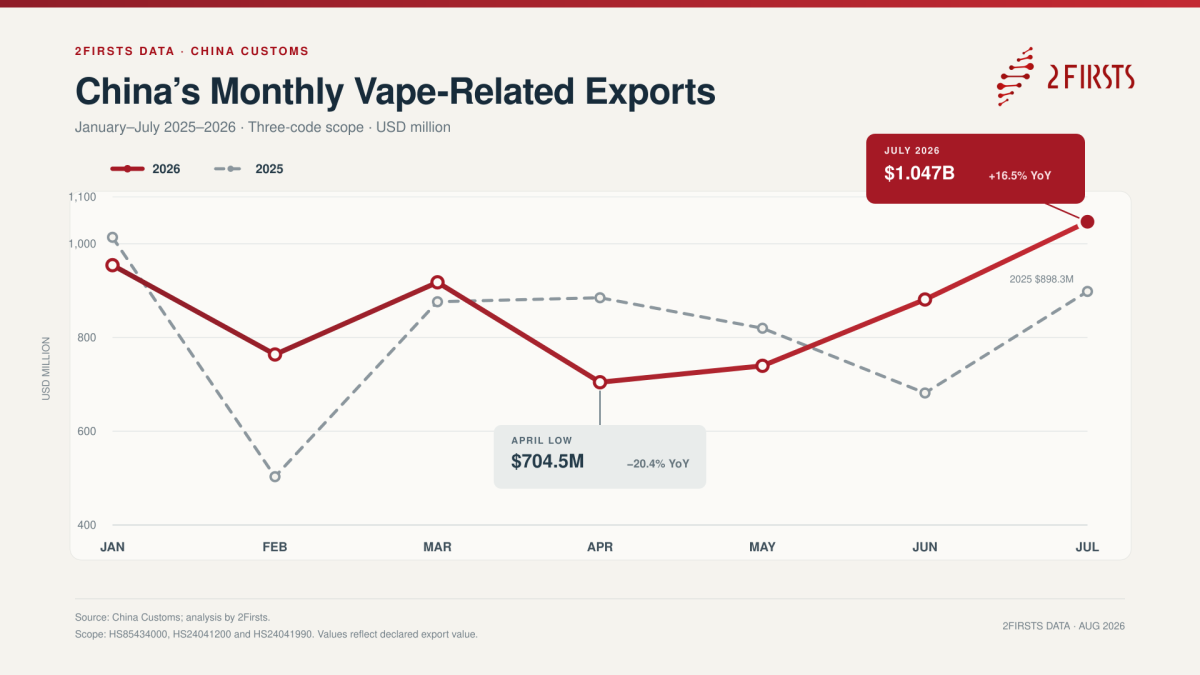
China’s vape-related exports reached $1.047 billion in July 2026, up 16.5% year on year and the highest monthly total of the year. Growth was heavily concentrated in the U.S., where exports jumped 53.5% to $404 million and accounted for 94.9% of the overall increase. Exports to all other markets rose just 1.2%. By category, nicotine-containing non-combustible products—primarily vapes—under HS24041200 rose 24.7% and generated 95.5% of the total increase. Vape-device exports under HS85434000 fell 0.4%, while other nicotine-substitute products under HS24041990 grew 88.9% but remained comparatively small.
DATA
Aug.24
South Korea’s New Vape Rules Raise Bar for E-Liquid Makers and China-Linked Supply Chains, Expert Says
South Korea’s new vape regulations are reshaping the e-liquid market, raising compliance requirements for manufacturers, retailers and overseas suppliers. In an interview with 2Firsts, Korean nicotine products specialist Sam Kim discusses licensing barriers, inventory impacts, China-linked supply chains, and emerging regulatory challenges around nicotine analogues, nicotine-free products and DIY mixing. The Korean case may offer broader insights as governments worldwide adapt to rapidly evolving nicotine products.
Jul.16
EU Trade Department Faces Scrutiny Over Contacts With Tobacco Industry
European Ombudswoman Teresa Anjinho has opened an inquiry into how the European Commission’s Directorate-General for Trade handles interactions with the tobacco industry. The case follows a complaint from a civil society organisation that alleges regular, unnecessary and non-transparent contacts between DG TRADE and tobacco industry representatives, raising questions over compliance with the EU’s obligations under the WHO Framework Convention on Tobacco Control. The inquiry remains ongoing, and the Ombudswoman has not reached any finding of maladministration.
Aug.24