Cambodia arrests 60 for selling and using e-cigarettes.

Aug.24.2022
Cambodia arrests 60 for selling and using e-cigarettes.
Cambodia detains 60 people for selling and using e-cigarettes, warning against further offenses; authorities conducted 10 raids in a month.

In Cambodia, approximately 60 individuals have been detained for selling and using electronic cigarettes, and have been warned not to commit the crime again.


On August 22nd, the Deputy Director of the Anti-Drug Department of Cambodia's Ministry of Interior announced that in the past month, authorities had conducted 10 raids on electronic cigarette businesses. Between June 23rd and August 22nd, 12 individuals were detained and charged with offenses related to this industry.


He stated that although the use of electronic cigarettes and heated tobacco products (HTP) is not illegal, selling electronic cigarettes still violates the government regulations that ban the import and commercial use of electronic cigarettes.


In Phnom Penh, police seized 19 electronic cigarettes, 215 sets of e-cigarette guns, and 1417 bottles of e-cigarette oil during a raid.


On August 22, Deputy Police Chief Phay Raksmey stated that police carried out a raid on a club in Kandal the previous night. The owner was questioned for selling electronic cigarettes, and revealed that two other individuals involved in the operation were also detained for selling electronic cigarette products.


He added that they did not engage in any other criminal activity, and therefore the police followed the guidelines of the National Anti-Drug Committee (NACD) and have signed a contract with them to cease the sale of electronic cigarettes. During the raid, the police detained 40 young men and women who also signed relevant contracts before being taken home.


Deputy Police Chief Phay Raksmey stated that the sale of electronic cigarettes was discovered after receiving information from the Cambodian Movement for Health (CMH). CMH Executive Director Mom Kong said, "Using e-cigarettes can harm brain cells and may cause serious lung damage due to the vapor they contain.


Statement:


This article is compiled from third-party information and is intended for industry-specific knowledge exchange and learning purposes.


This article does not represent the views of 2FIRSTS, and 2FIRSTS cannot confirm the truthfulness or accuracy of its content. The translation of this article is only intended for industry exchange and research purposes.


Due to limitations in translation skills, the translated article may not accurately reflect the original text. Please refer to the original article for accuracy.


2FIRSTS maintains complete alignment with the Chinese government regarding any domestic, Hong Kong, Macau, Taiwan, or foreign-related statements and positions.


The copyright of the compiled information belongs to the original media and author. If there is any infringement, please contact us for deletion.


Disclaimer

This article is provided solely for professional research, industry discussion, and informational purposes. Any references to brands, companies, products, technologies, or policies are made for factual reporting and analytical purposes only, and do not constitute endorsement, recommendation, promotion, or advertising by 2Firsts.

Nicotine-containing products, including but not limited to cigarettes, e-cigarettes, heated tobacco products, and nicotine pouches, carry significant health risks. Readers are responsible for complying with all applicable laws and regulations in their respective jurisdictions, including age restrictions and access limitations.

The information contained in this article should not be regarded as investment, legal, medical, regulatory, or commercial advice. While 2Firsts strives to ensure the accuracy and reliability of its content, it does not assume liability for any direct or indirect loss arising from errors, omissions, inaccuracies, or reliance on the information contained herein.

This article is not intended for individuals below the legal age for accessing tobacco or nicotine-related information in their jurisdiction.


Copyright Notice

This article is either original content produced by 2Firsts or content reproduced, translated, summarized, or adapted from third-party sources with attribution where applicable. The intellectual property rights of the original content remain with 2Firsts or the respective original rights holders.

No individual or organization may copy, reproduce, distribute, republish, modify, translate, or otherwise use this content without prior authorization. Any unauthorized use may result in legal action.

For copyright-related inquiries, corrections, or removal requests, please contact: info@2firsts.com.


AI-Assisted Translation and Editing Notice

Portions of this article may have been translated, edited, or reviewed with the assistance of artificial intelligence tools to improve efficiency and readability. Due to the limitations of AI-assisted translation and editing, discrepancies, omissions, or inaccuracies may exist when compared with the original source.

Where applicable, readers are advised to refer to the original source for the most complete and accurate information. If you identify any errors or believe that any content infringes upon your rights, please contact us at info@2firsts.com, and we will review and address the matter promptly.

FDA Authorizes 24 VELO Nicotine Pouches, Increasing U.S. Authorized Total by 56%
The U.S. FDA authorized 24 VELO nicotine pouch products from a British American Tobacco subsidiary, raising the total number of authorized products from 43 to 67, a 55.8% increase. The newly authorized 4 mg products include lime and passion fruit flavors and feature certified child-resistant packaging. VELO's first FDA marketing authorization adds BAT to a list previously limited to PMI and Altria products, while bringing the agency's nicotine pouch review pilot total to 47 authorized products.
Oct.30
Product|AIR Files U.S. PMTA for Crown Switch. Can Greentank's Chip Technology Deliver a Compliance and Competitive Advantage?
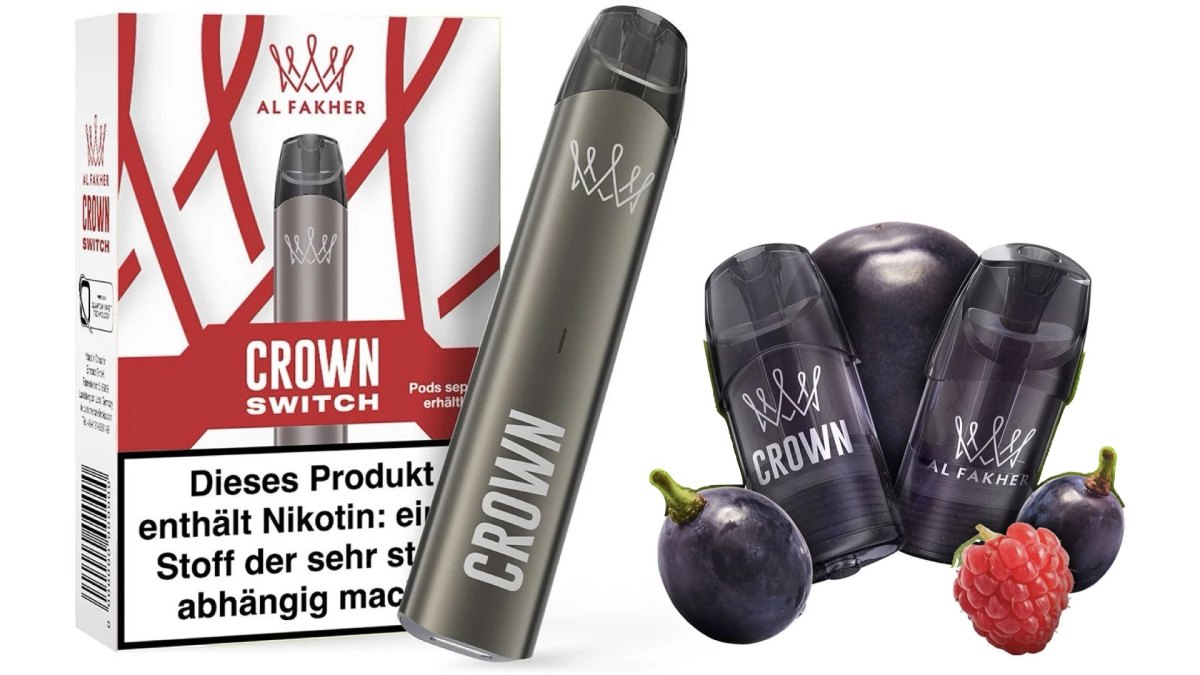
AIR Global PLC (NASDAQ: AIIR) announced on November 5, 2026, that it had submitted a Premarket Tobacco Product Application (PMTA) to the U.S. Food and Drug Administration (FDA) for Crown Switch, its rechargeable pod vape platform. First launched in Germany in November 2025, the device uses Quantum Chip atomization technology developed by Canadian vaporization technology company Greentank Innovations. German retail versions feature 2mL prefilled pods containing 18mg/mL nicotine in six flavors, while AIR has separately tested two 5% nicotine formulations intended for U.S. development. AIR invested $20 million in Greentank in July and reported approximately $3.4 million in U.S. PMTA-related regulatory costs for the first nine months of 2026. The Crown Switch application has been submitted, but the FDA has not granted marketing authorization.
product
Nov.13
Special Report|Virginia Vape Directory Shows Contrast Between Vuse and JUUL Pod Systems and CrossBar 20K, Loon Flavored Disposables
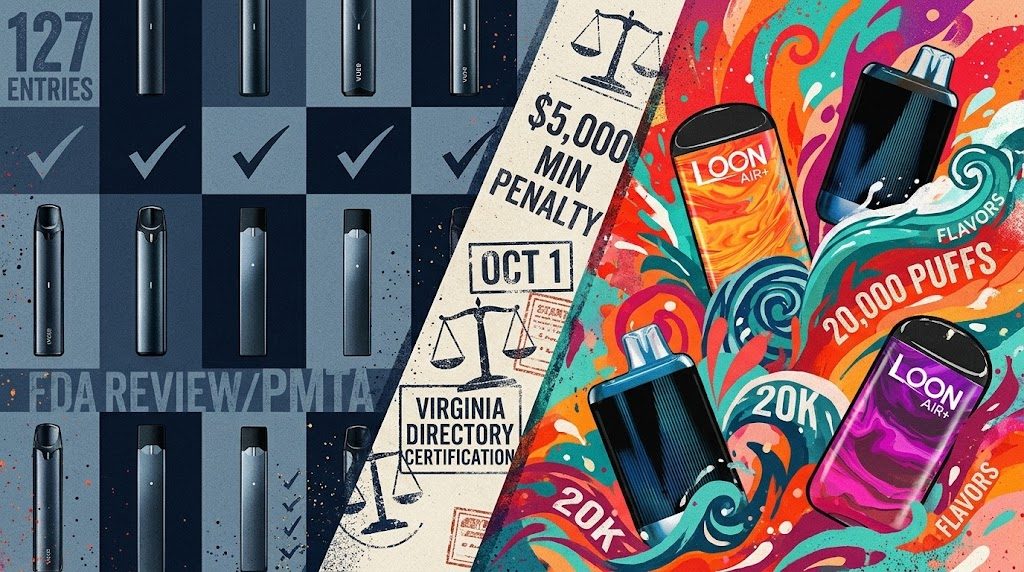
A 2Firsts analysis of Virginia's liquid nicotine and vapor product certification directory identified 213 product records from 15 manufacturers. Companies associated with BAT, Altria, Imperial Brands, JTI and JUUL account for 127 entries. The directory also includes independent brands CrossBar 20K, Loon and Breeze. CrossBar advertises a 13mL disposable capable of up to 20,000 puffs, while Loon has 16 disposable entries featuring fruit, cooling and beverage-related flavors. Of all records, 120 are labeled as under FDA PMTA review. Virginia introduced revised penalties on October 1, 2026, including a minimum first-violation civil penalty of $5,000 per unlisted product, alongside new retail tobacco permitting requirements.
Regulations
Oct.30
South Korea's Synthetic Nicotine Tax Take Estimated at Just 1.3% of Forecast as Imports Plunge Nearly 97%
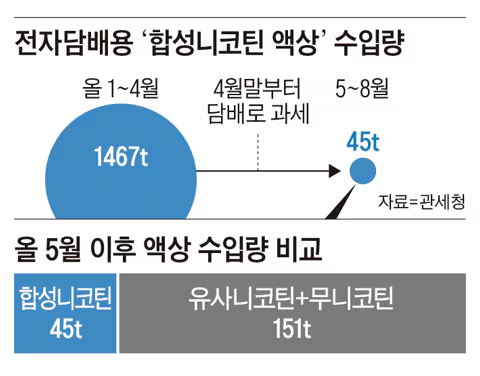
After synthetic nicotine was placed under tobacco regulation on April 24, 2026, South Korea’s tax collections from synthetic-nicotine vaping products fell far short of government projections. The Chosun Ilbo reported on November 18 that Ministry of Health and Welfare data showed national health promotion charges on synthetic-nicotine liquid e-cigarettes totaled 765 million won from April 24 through September. Using statutory rates, the newspaper estimated combined major taxes and charges at about 2.622 billion won—on a monthly basis roughly 1.3% of an earlier forecast after temporary tax reductions. Customs data showed synthetic-nicotine imports dropped from about 1,467 metric tons in January–April to 45 metric tons in May–August, a nearly 97% decline. Imports of nicotine-analog and nicotine-free liquids totaled 151 metric tons in May–August, exceeding synthetic-nicotine imports in the same period, though both categories were also below January–April volumes.
Regulations
Nov.19
China’s Vape-Related Exports Rose 4.5% in Q3 2026 as 21.6% Growth in Shipments to the UK Offset a Decline in Shipments to the US
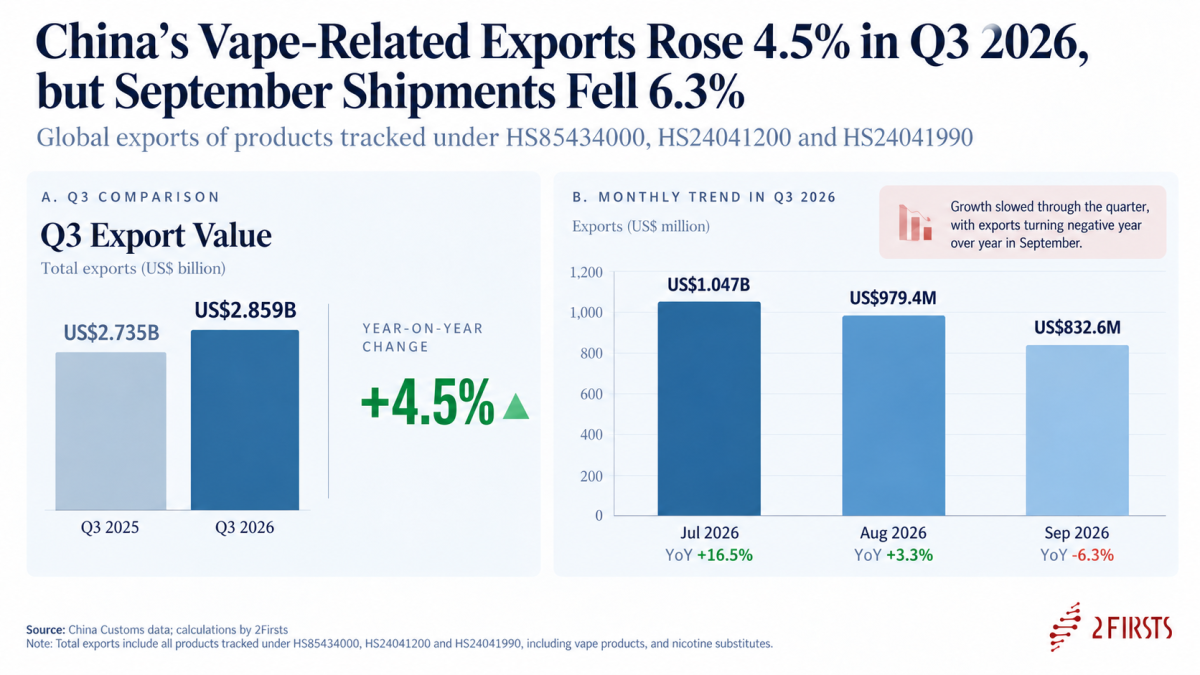
China's vape-related exports rose 4.5% year over year to $2.86 billion in the third quarter of 2026, led by stronger shipments to the United Kingdom as exports to the United States declined. UK-bound shipments increased 21.6%, adding $81.9 million, while US exports fell 5.2%, or $53.6 million. Growth weakened through the quarter, with September exports down 6.3% globally and 37.8% to the US. Nicotine-containing vape products accounted for more than 82% of the quarterly net increase, while device exports were nearly flat. Nine-month exports totaled $7.82 billion, up 4.0%.
DATA
Oct.26
North Carolina Tightens Vape Product Directory Enforcement, Expands State and Local Powers as Violators Face Fines, Product Seizures and License Suspension or Revocation
North Carolina has expanded enforcement of its vapor product directory rules, authorizing more state and local law enforcement participation and establishing a task force led by the State Bureau of Investigation. The legislation requires at least one unannounced compliance inspection annually for retailers, distributors and wholesalers handling covered products. Penalties effective October 1, 2026, include civil fines of $500–$750 for a first violation and $1,000–$1,500 for repeated violations within 12 months, along with potential license suspension or revocation. Manufacturers may face penalties of $10,000 per unlisted product. The measures strengthen the product directory system established in 2024.
Regulations
Oct.28