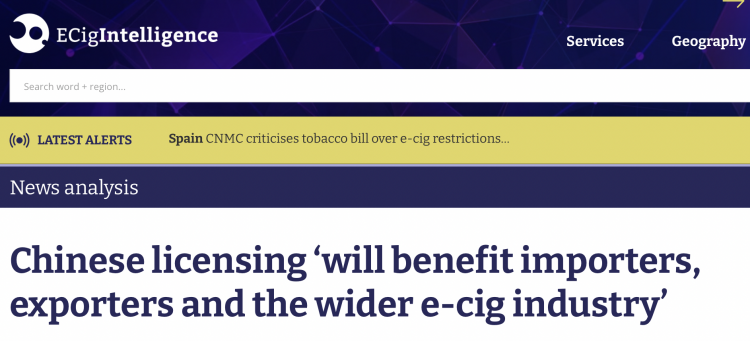
2FIRSTS was invited to attend the tobacco exhibition in Dortmund, Germany where they delivered a speech titled "China's e-cigarette regulations and its impact on e-cigarette trade" at the forum. Upon hearing the presentation, ECigIntelligence, an international tobacco data research institution, wanted to delve deeper into China's electronic cigarette policies. They conducted an online interview with 2FIRSTS after the event and used their views as a reference to write an article introducing the impact of China's e-cigarette regulatory policies on the global e-cigarette industry. ECigIntelligence quoted 2FIRSTS views as follows:
The licensing system will ensure quality assurance for electronic cigarette products.
The electronic cigarette production licensing system provides quality assurance for importers and exporters, serving as proof for manufacturers that their factories and production processes meet national requirements and are certified. This allows foreign importers to have confidence that they are receiving legitimate products of guaranteed quality. 2FIRSTS has a "Licensed Enterprise Database" section on its website which collates data from the publicly available information on the China National Tobacco Monopoly Bureau website. China's e-cigarette regulations will impact the core of the e-cigarette industry chain and all related sectors, including nicotine and e-liquid manufacturers, original equipment manufacturers (OEMs), brands, production companies with independent trademarks and factories, wholesalers and retailers. The "Regulations on the Administration of Electronic Cigarettes" will be highly beneficial for China's e-cigarette industry as it will raise overall standards and enhance the reputation of "Made in China" by eliminating unscrupulous companies from the market.
2FIRSTS representative Jason delivers a speech at the Dortmund Tobacco Exhibition.
China's regulatory policies will bring about sustainable development in the electronic cigarette industry.
As the electronic cigarette industry faces increasing legalization and regulation, compliance is becoming paramount to a company's competitiveness in the field. Businesses that adhere to regulations not only help establish a positive image for China's electronic cigarette industry, but also aid in promoting healthy development worldwide. With China's government placing more emphasis on sustainability and environmental standards, electronic cigarette companies can invest in sustainable development initiatives. Additionally, the technology and standards of electronic cigarettes will improve, leading to significant changes in the field in the coming years.
Statement:
This article is compiled from third-party information and is intended for industry exchange and learning purposes only.
Due to limitations in the compiling ability, the translated article may not fully express the original text and therefore readers are advised to refer to the original article for accuracy.
2FIRSTS maintains complete alignment with the Chinese government regarding any domestic, Hong Kong, Macau, Taiwan, and foreign-related statements and positions.
The compiled information belongs to the original media and authors, and if there is any infringement, please contact us to have it removed.
Disclaimer
This article is provided solely for professional research, industry discussion, and informational purposes. Any references to brands, companies, products, technologies, or policies are made for factual reporting and analytical purposes only, and do not constitute endorsement, recommendation, promotion, or advertising by 2Firsts.
Nicotine-containing products, including but not limited to cigarettes, e-cigarettes, heated tobacco products, and nicotine pouches, carry significant health risks. Readers are responsible for complying with all applicable laws and regulations in their respective jurisdictions, including age restrictions and access limitations.
The information contained in this article should not be regarded as investment, legal, medical, regulatory, or commercial advice. While 2Firsts strives to ensure the accuracy and reliability of its content, it does not assume liability for any direct or indirect loss arising from errors, omissions, inaccuracies, or reliance on the information contained herein.
This article is not intended for individuals below the legal age for accessing tobacco or nicotine-related information in their jurisdiction.
Copyright Notice
This article is either original content produced by 2Firsts or content reproduced, translated, summarized, or adapted from third-party sources with attribution where applicable. The intellectual property rights of the original content remain with 2Firsts or the respective original rights holders.
No individual or organization may copy, reproduce, distribute, republish, modify, translate, or otherwise use this content without prior authorization. Any unauthorized use may result in legal action.
For copyright-related inquiries, corrections, or removal requests, please contact: info@2firsts.com.
AI-Assisted Translation and Editing Notice
Portions of this article may have been translated, edited, or reviewed with the assistance of artificial intelligence tools to improve efficiency and readability. Due to the limitations of AI-assisted translation and editing, discrepancies, omissions, or inaccuracies may exist when compared with the original source.
Where applicable, readers are advised to refer to the original source for the most complete and accurate information. If you identify any errors or believe that any content infringes upon your rights, please contact us at info@2firsts.com, and we will review and address the matter promptly.