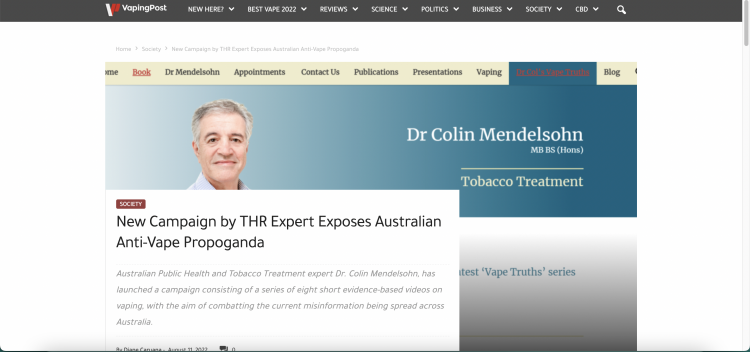
The "Dr Col's Vape Truths" video campaign, launched earlier, is an evidence-based initiative on vaping aimed at countering the rampant spread of misinformation by state health departments, particularly in Queensland, New South Wales, and Western Australia.
Mendelsohn announced the event on his website and described it as follows: "Dr. Col's Vape Truths event consists of eight short videos that aim to correct common misconceptions about electronic cigarettes. These videos are based on the Queensland Health Department's misleading and alarmist videos and cover key evidence, including:
The toxicity of vapor is far lower than that of cigarette smoke.
Compared to smoking, electronic cigarettes significantly reduce the risk of developing cancer.
Inhaling nicotine does not cause serious damage to the lungs.
Four mislabeled nicotine-free e-cigarettes were sold on the black market as unreliable disposable products, rather than from reputable companies.
There have never been any deaths caused by nicotine use.
When smokers switch to e-cigarettes, their breathing greatly improves.
Electronic cigarettes are not entirely risk-free, but they are much safer than deadly tobacco cigarettes.
Most of the chemicals present in steam are present in very low doses, and most pose little or no harm.
Nancy Loucas, the executive coordinator of CAPHRA (Coalition of Asia-Pacific Tobacco Harm Reduction Advocates) emphasized the timeliness of the campaign. "Fortunately, the inconvenient truth about e-cigarettes has now reached the laptops of Australians, debunking all the scare tactics that health agencies and officials have been selling against e-cigarettes.
Queensland, New South Wales, and Western Australia are investing significant public funds into a misleading anti-vaping campaign. This is leading to active discouragement of adult smokers in Australia from transitioning to less harmful nicotine alternatives. Dr. Col's Vape Truths offers valuable insight into Australia's misguided anti-vaping stance," she said.
Australian authorities adopt a destructive stance towards reducing the harm caused by tobacco (THR).
Activists from around the world have written a letter to the Australian Department of Health calling for an end to the ongoing attacks on the local e-cigarette industry. This action comes in response to a notice sent by the Western Australia Health Department to e-cigarette shop owners throughout the state, ordering them to cease operations within 14 days. The letter was sent on Wednesday, July 20th.
Seventeen global organizations of electronic cigarette users have signed a letter in support of e-cigarette users in Western Australia. Michael Randell, Director of the global e-cigarette advocacy group World Vapers Alliance, stated that such actions could lead to a public health disaster.
Electronic cigarettes have been a lifeline for over 80 million people trying to quit smoking. They have been recognized as the most successful smoking cessation tool to date, being approved in countries such as the United Kingdom, France, and New Zealand. Closing electronic cigarette stores not only drives users to seek their preferred products through the black market, but it also prevents many smokers from quitting traditional cigarettes as they would struggle to find alternatives on the market. By limiting the use of harm reduction tools while leaving traditional cigarettes on the market, the Western Australian government is opening the door to a public health disaster, said Randall.
This article is compiled from third-party information and is only intended for industry communication and learning purposes.
This article does not represent the views of 2FIRSTS, and 2FIRSTS is unable to confirm the authenticity and accuracy of its contents. The translation of this article is intended solely for exchange and research within the industry.
As the level of translation proficiency may be limited, the translated article may not completely match the original text. Please refer to the original text for accuracy.
2FIRSTS maintains full alignment with the Chinese government regarding any domestic, Hong Kong, Macao, Taiwan, and international issues and positions.
The compilation of information retains copyright to the original media and author. If there is any infringement, please contact for deletion.
Disclaimer
This article is provided solely for professional research, industry discussion, and informational purposes. Any references to brands, companies, products, technologies, or policies are made for factual reporting and analytical purposes only, and do not constitute endorsement, recommendation, promotion, or advertising by 2Firsts.
Nicotine-containing products, including but not limited to cigarettes, e-cigarettes, heated tobacco products, and nicotine pouches, carry significant health risks. Readers are responsible for complying with all applicable laws and regulations in their respective jurisdictions, including age restrictions and access limitations.
The information contained in this article should not be regarded as investment, legal, medical, regulatory, or commercial advice. While 2Firsts strives to ensure the accuracy and reliability of its content, it does not assume liability for any direct or indirect loss arising from errors, omissions, inaccuracies, or reliance on the information contained herein.
This article is not intended for individuals below the legal age for accessing tobacco or nicotine-related information in their jurisdiction.
Copyright Notice
This article is either original content produced by 2Firsts or content reproduced, translated, summarized, or adapted from third-party sources with attribution where applicable. The intellectual property rights of the original content remain with 2Firsts or the respective original rights holders.
No individual or organization may copy, reproduce, distribute, republish, modify, translate, or otherwise use this content without prior authorization. Any unauthorized use may result in legal action.
For copyright-related inquiries, corrections, or removal requests, please contact: info@2firsts.com.
AI-Assisted Translation and Editing Notice
Portions of this article may have been translated, edited, or reviewed with the assistance of artificial intelligence tools to improve efficiency and readability. Due to the limitations of AI-assisted translation and editing, discrepancies, omissions, or inaccuracies may exist when compared with the original source.
Where applicable, readers are advised to refer to the original source for the most complete and accurate information. If you identify any errors or believe that any content infringes upon your rights, please contact us at info@2firsts.com, and we will review and address the matter promptly.