BYD Exits E-cigarette Business With Investors Worry About ESG Appeal

Mar.17.2025
BYD Exits E-cigarette Business With Investors Worry About ESG Appeal
BYD is quitting the e-cigarette business, investors are worried about ESG, ACGA says it may be excluded.

Key points:


1. The Asian Corporate Governance Association (ACGA) has reported that the Chinese electric car manufacturer BYD has exited the electronic cigarette business.


2. Investors were concerned about how the electronic cigarette business will affect BYD's ESG (environmental, social, and governance) attractiveness. The new regulations from the European Securities and Markets Authority (ESMA) prohibited ESG funds from investing in the tobacco industry, which could result in BYD being excluded.


BYD did not issue a formal response, citing that the business segment had a relatively minor impact.


Nana Li, responsible for sustainable development and governance in the Asia-Pacific region of the Asian Corporate Governance Association, announced on LinkedIn that the BYD has ceased operations in the electronic cigarette business, Responsible Investor reported.


She said the dialogue began in 2023, with BYD engaging with 20 institutional investors from the ACGA, a group co-led by Li and Karine Hirn, chief sustainability officer at East Capital.


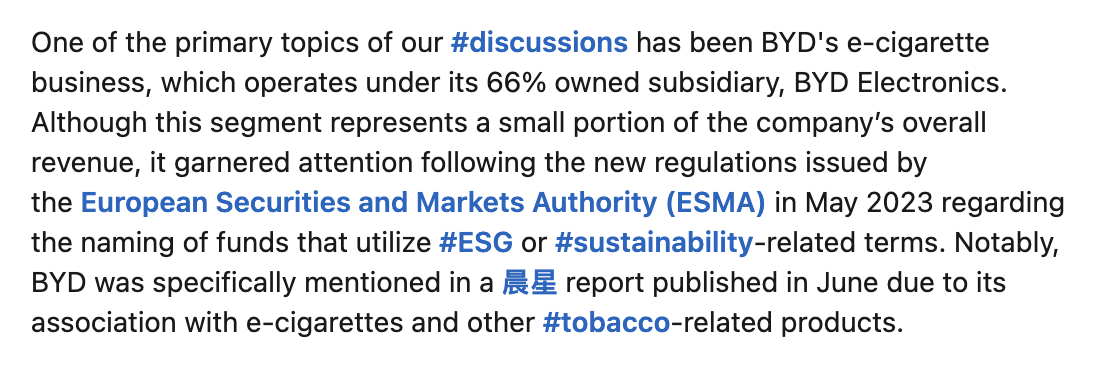
Li said that BYD's electronic cigarette business has always been one of the key topics of discussion, and this business is operated by its subsidiary BYD Electronics, of which she owns 66% of the shares. 


Investors' concern regarding this business lies in the fact that it could decrease BYD's attractiveness among investors interested in ESG issues. 


This problem is particularly important after the implementation of new regulations by the European Securities and Markets Authority (ESMA), in which funds that contain in their name terms related to ESG or other sustainability keywords are prohibited from investing in companies in the tobacco or arms industries.
 

BYD Exits E-cigarette Business With Investors Worry About ESG Appeal
Nana Li posted content | Image source: Linkedin


According to the report in June from investment research firm Morningstar, BYD is one of the top ten stocks in ESG funds with high exposure to financial risks, these stocks must be divested to comply with ESMA regulations. 


Data indicates that there are 94 ESG funds that hold BYD stocks, with a cumulative risk exposure of $835 million. Morningstar points out that BYD's tobacco business is one of the possible reasons that could lead to its exclusion according to admission rules.


In July, ACGA sent a letter to BYD explaining how ESMA rules would affect the investment capacity of European ESG funds in the company. 


Li announced that in October, ACGA learned that BYD had decided to withdraw from the electronic cigarette business, and BYD did not respond to the request for comments.


BYD Exits E-cigarette Business With Investors Worry About ESG Appeal
Nana Li posted the content | Image source: Linkedin


Li said: "Subsequently, we sought formal confirmation from BYD regarding this development. 


“However, the company has been hesitant to acknowledge it, citing the relatively minor impact of this business segment despite its significance to certain investors, who may need to divest their BYD shares under the new ESMA regulations if this change did not occur by the end of last year."
 

We welcome news tips, article submissions, interview requests, or comments on this piece.

Please contact us at info@2firsts.com, or reach out to Alan Zhao, CEO of 2Firsts, on LinkedIn


Notice

1.  This article is intended solely for professional research purposes related to industry, technology, and policy. Any references to brands or products are made purely for objective description and do not constitute any form of endorsement, recommendation, or promotion by 2Firsts.

2.  The use of nicotine-containing products — including, but not limited to, cigarettes, e-cigarettes, nicotine pouchand heated tobacco products — carries significant health risks. Users are responsible for complying with all applicable laws and regulations in their respective jurisdictions.

3.  This article is not intended to serve as the basis for any investment decisions or financial advice. 2Firsts assumes no direct or indirect liability for any inaccuracies or errors in the content.

4.  Access to this article is strictly prohibited for individuals below the legal age in their jurisdiction.


Copyright


This article is either an original work created by 2Firsts or a reproduction from third-party sources with proper attribution. All copyrights and usage rights belong to 2Firsts or the original content provider. Unauthorized reproduction, distribution, or any other form of unauthorized use by any individual or organization is strictly prohibited. Violators will be held legally accountable.

For copyright-related inquiries, please contact: info@2firsts.com


AI Assistance Disclaimer


This article may have been enhanced using AI tools to improve translation and editorial efficiency. However, due to technical limitations, inaccuracies may occur. Readers are encouraged to refer to the cited sources for the most accurate information.

We welcome any corrections or feedback. Please contact us at: info@2firsts.com

Smoore Wins Three Heated Device Supply Lots in China Tobacco Jiangsu’s Overseas Market Project Covering Japan, South Korea and Southeast Asia
China Tobacco Jiangsu Industrial Co., Ltd. (JSIC) has completed its 2026-2028 heated device procurement project, with Shenzhen Smoore Technology Limited securing final supply contracts for three lots: U1, C1 and C2. The project was launched through a public tender in June 2026 to support overseas markets and involved heated tobacco devices carrying JSIC’s “iRod” trademark. Candidate supplier results published on July 13 showed Smoore ranked first for the three awarded lots, while Shenzhen Yunxi Intelligent Technology Co., Ltd. and Shenzhen Bodi Technology Development Co., Ltd. participated in the bidding process.
Aug.03
Kuwait Tightens Tobacco and Nicotine Rules, Bans Under-21 Sales and Extends Public Smoking Restrictions to Vapes and Heated Tobacco
Kuwait has issued a comprehensive new regulatory framework covering tobacco, e-cigarettes, heated tobacco and other nicotine products. Ministerial Decision No. 237 of 2026, signed by Health Minister Ahmad Al-Awadhi, will take effect on January 1, 2027. The rules prohibit sales to people under 21 and ban sales through websites, apps, social media and delivery services. E-cigarettes and heated tobacco products will also be treated as smoking in public and enclosed places where smoking is prohibited. Nicotine pouches and other oral nicotine products not registered as medicines are banned.
Regulations
Aug.17 by 2Firsts Perspectives
Product | JT to Launch MEVIUS Tropical Option in Japan, Expanding Ploom Tobacco Stick Lineup to 32
Japan Tobacco (JT) will launch MEVIUS Tropical Option, a new tobacco stick for Ploom, nationwide in Japan from October 6, 2026. The capsule-format product combines mango-oriented sweetness with menthol cooling, adding a tropical flavor to the MEVIUS Ploom tobacco-stick lineup for the first time. Each pack contains 20 sticks and will launch at JPY 590. The product is compatible with all Ploom devices, and its addition will expand the Ploom tobacco-stick portfolio to 32 variants.
Sep.08
Australia-China Operation Dismantles Tobacco Smuggling Network: 112 Containers, 60 Arrests and A$92 Million in Illicit Tobacco
According to The Maritime Executive on August 19, 2026, the Australian Border Force (ABF) and China’s Anti-Smuggling Bureau of General Administration of China Customs worked together to dismantle an international illicit tobacco smuggling network targeting Australia. According to information released by ABF on August 20, sustained information sharing and cooperation led to investigations into 112 shipping containers, with 91 found to contain illicit tobacco. Authorities seized more than 60 million cigarettes and 60 kilograms of loose-leaf tobacco, representing more than A$92 million in unpaid duties. More than 60 people suspected of involvement in the network were arrested in China.
Aug.20
From a 2017 Launch to 48% of South Korea’s Heated Tobacco Market, KT&G Looks Back on a Decade of lil
KT&G announced on Aug. 13, 2026, that it has opened “lil Archive,” a brand exhibition space in Seoul showcasing the evolution, technology platforms and future direction of its heated tobacco brand lil since its launch in 2017. KT&G said lil now spans three major platforms — lil SOLID, lil HYBRID and lil AIBLE — with more than 30 dedicated consumables, and held a 48% share of South Korea's heated tobacco market in the second quarter of 2026. The opening comes as lil enters its 10th year, with KT&G continuing to position the brand for expansion beyond its domestic market.
Aug.14
Russia Adds Vapes to “Strategic Goods” List, Illegal Cross-Border Trade Faces Up to Five Years in Prison
Russia will place e-cigarettes and related nicotine products under its “strategic goods” framework from August 20, 2026. According to TVP World’s report published on August 19, the newly listed items include e-cigarettes, electronic smoking devices, vape liquids and nicotine salts. Individuals who illegally move these products across Russia’s customs border or its state border with other Eurasian Economic Union (EAEU) members could face up to five years in prison if shipment values exceed 100,000 rubles (about €1,000), provided all elements of a criminal offence are established.
Aug.20