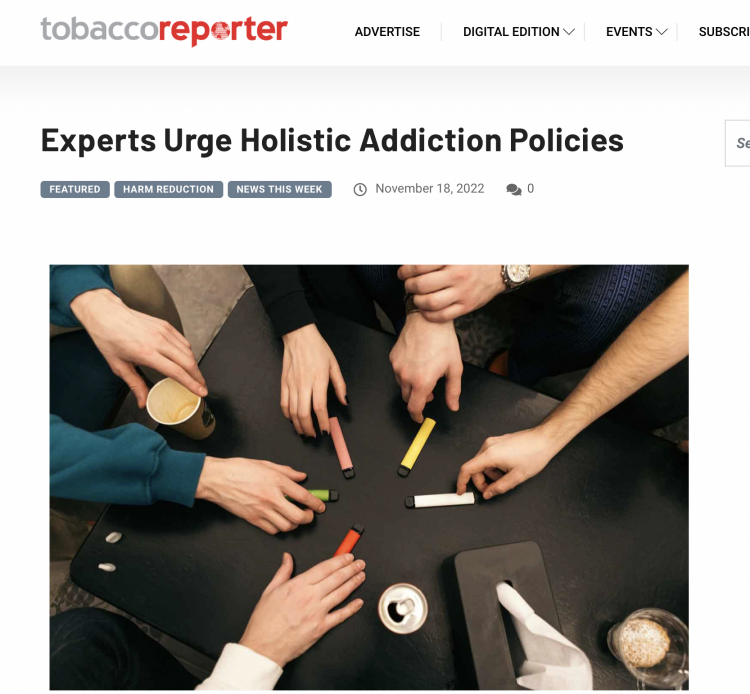
Policy-makers and experts in addiction held a meeting in Brussels on November 15th to discuss the best ways to address various addiction issues at the EU level, including alcohol, tobacco, gambling, and digital technology. The meeting focused on Czech Republic's presidency of the EU Council and consensus was reached that the priority should be on implementing a comprehensive, empathetic, and realistic approach to help those in need.
It is unrealistic to have a world without drugs, tobacco, and alcohol, and it may not be beneficial for people's mental health. Stringent regulation has little effect on addictive behavior," National Drug Coordinator Jindrich Voboril was quoted in a press release as saying. "What we can do effectively is to minimize the harm. Addiction policies should allow adults to have access to lower-risk addictive products and allow people to make their own choices.
The roundtable organized by the Rational Addiction Policy Institute also discussed views on addressing addiction issues and the role that EU institutions such as EMCDDA should play in this regard.
The European Parliament has sent a clear message in its report on the European Beating Cancer Plan, emphasizing the importance of practical, evidence-based policies. "The European Union Commission should listen to expert opinions and adopt a rational and science-based approach," stated Member of the European Parliament, Radka Maxova.
Viktor Mravcik, head of the science department at IRAP, presented the example of the Czech Republic, which has successfully implemented a comprehensive harm reduction approach to alcohol and tobacco dependence. In a subsequent discussion, Ales Rod, a member of the National Economic Advisory Council and head of the Economic and Market Analysis Center, spoke about his recent research on best practices in managing tobacco dependence policies in several member countries, including the Czech Republic, as well as Sweden.
If we recognize that a drug-free world is impossible, we should consider the impact of regulation. I also urge Sweden, which is about to take on the presidency of the EU Council, to address these issues as a priority and ultimately help Europeans overcome their addiction problems. After all, Sweden has done a lot in this regard," added Swedish psychologist and addiction expert Carl Fagerstrom.
Statement:
This article is compiled from third-party information and is intended for industry exchange and learning.
This article does not represent the views of 2FIRSTS and 2FIRSTS cannot confirm the truth or accuracy of the article’s content. The translation of this article is only for industry exchange and research purposes.
Due to limitations in translation skills, the translated article may not fully express the same meaning as the original. Please refer to the original article for accuracy.
2FIRSTS maintains complete alignment with the Chinese government regarding any domestic, Hong Kong, Macao, Taiwan or foreign-related expressions and positions.
The copyright for compiled information belongs to the original media and author. If there is any infringement, please contact us for deletion.
Disclaimer
This article is provided solely for professional research, industry discussion, and informational purposes. Any references to brands, companies, products, technologies, or policies are made for factual reporting and analytical purposes only, and do not constitute endorsement, recommendation, promotion, or advertising by 2Firsts.
Nicotine-containing products, including but not limited to cigarettes, e-cigarettes, heated tobacco products, and nicotine pouches, carry significant health risks. Readers are responsible for complying with all applicable laws and regulations in their respective jurisdictions, including age restrictions and access limitations.
The information contained in this article should not be regarded as investment, legal, medical, regulatory, or commercial advice. While 2Firsts strives to ensure the accuracy and reliability of its content, it does not assume liability for any direct or indirect loss arising from errors, omissions, inaccuracies, or reliance on the information contained herein.
This article is not intended for individuals below the legal age for accessing tobacco or nicotine-related information in their jurisdiction.
Copyright Notice
This article is either original content produced by 2Firsts or content reproduced, translated, summarized, or adapted from third-party sources with attribution where applicable. The intellectual property rights of the original content remain with 2Firsts or the respective original rights holders.
No individual or organization may copy, reproduce, distribute, republish, modify, translate, or otherwise use this content without prior authorization. Any unauthorized use may result in legal action.
For copyright-related inquiries, corrections, or removal requests, please contact: info@2firsts.com.
AI-Assisted Translation and Editing Notice
Portions of this article may have been translated, edited, or reviewed with the assistance of artificial intelligence tools to improve efficiency and readability. Due to the limitations of AI-assisted translation and editing, discrepancies, omissions, or inaccuracies may exist when compared with the original source.
Where applicable, readers are advised to refer to the original source for the most complete and accurate information. If you identify any errors or believe that any content infringes upon your rights, please contact us at info@2firsts.com, and we will review and address the matter promptly.