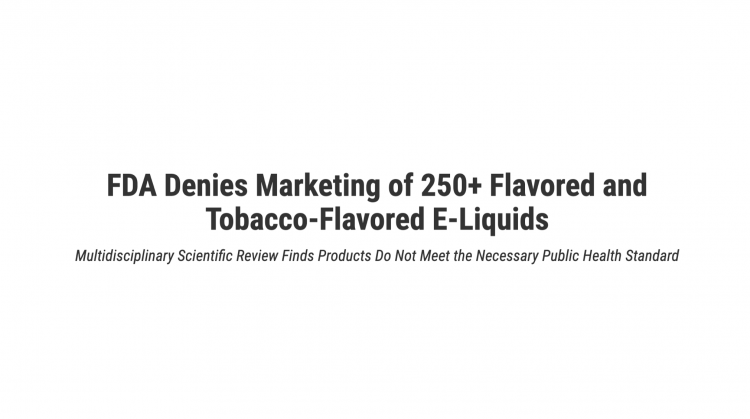
On May 18th, the United States Food and Drug Administration (FDA) issued a marketing denial order to the Mothers Milk WTA company for over 250 flavored and tobacco-flavored electronic cigarette oils. After an initial review, the FDA found that the company's application lacked evidence to demonstrate that their products could protect public health, and thus refused to approve them for sale.
According to Dr. Matthew Farrelly, the Director of the Scientific Office at the FDA's Center for Tobacco Products (CTP), strict scientific pre-market review is a crucial responsibility for ensuring the safety of new tobacco products. The FDA will continue to evaluate these applications based on public health standards, taking into account the risks and benefits of tobacco products for the public.
The pre-market tobacco product application (PMTA) review process is composed of multiple stages. If an application does not meet the requirements of a particular stage, the FDA may reject the application or ask for it to be resubmitted. During the final substantive review stage, the FDA assesses the scientific information and data included in the application to determine whether the marketing of the new product meets the public health standards set by the 2009 Family Smoking Prevention and Tobacco Control Act.
After undergoing a rigorous scientific review by the FDA, tobacco products that have received a marketing denial order cannot be sold, distributed, or marketed in the United States. Additionally, these products cannot be commercially transported across state lines or introduced to the market, and if already on the market, they must be taken off. Manufacturers, distributors, and retailers who sell, distribute, or promote these products will be in violation of the law and may face enforcement action.
As of now, the Food and Drug Administration (FDA) has received over 26 million applications for tobacco products to be marketed, with a majority of them being for electronic cigarettes. The FDA has indicated that they have made decisions regarding 99% of these applications which include over one million for non-tobacco nicotine products as well as those containing synthetic nicotine.
The FDA has authorized the sale or distribution of 23 tobacco-flavored e-cigarette products and devices, which are currently the only legally sold e-cigarette products in the United States.
The FDA has recently released several regulatory documents related to electronic cigarettes. On May 15th, the FDA issued a marketing refusal order to 10 companies for 6,500 flavored electronic cigarettes and e-liquid products. On May 17th, the FDA issued an "Import Alert 98-06" to multiple Chinese e-cigarette companies, stating that they will detain new tobacco products that have not been tested without market approval. This alert involves importers, manufacturers, and transporters of e-cigarette brands such as ELFBAR, EBDESIGN, and Esco Bar from China, South Korea, and the United States.
References:
The FDA has rejected the marketing of more than 250 e-liquids that are flavored or flavored with tobacco.
Disclaimer
This article is provided solely for professional research, industry discussion, and informational purposes. Any references to brands, companies, products, technologies, or policies are made for factual reporting and analytical purposes only, and do not constitute endorsement, recommendation, promotion, or advertising by 2Firsts.
Nicotine-containing products, including but not limited to cigarettes, e-cigarettes, heated tobacco products, and nicotine pouches, carry significant health risks. Readers are responsible for complying with all applicable laws and regulations in their respective jurisdictions, including age restrictions and access limitations.
The information contained in this article should not be regarded as investment, legal, medical, regulatory, or commercial advice. While 2Firsts strives to ensure the accuracy and reliability of its content, it does not assume liability for any direct or indirect loss arising from errors, omissions, inaccuracies, or reliance on the information contained herein.
This article is not intended for individuals below the legal age for accessing tobacco or nicotine-related information in their jurisdiction.
Copyright Notice
This article is either original content produced by 2Firsts or content reproduced, translated, summarized, or adapted from third-party sources with attribution where applicable. The intellectual property rights of the original content remain with 2Firsts or the respective original rights holders.
No individual or organization may copy, reproduce, distribute, republish, modify, translate, or otherwise use this content without prior authorization. Any unauthorized use may result in legal action.
For copyright-related inquiries, corrections, or removal requests, please contact: info@2firsts.com.
AI-Assisted Translation and Editing Notice
Portions of this article may have been translated, edited, or reviewed with the assistance of artificial intelligence tools to improve efficiency and readability. Due to the limitations of AI-assisted translation and editing, discrepancies, omissions, or inaccuracies may exist when compared with the original source.
Where applicable, readers are advised to refer to the original source for the most complete and accurate information. If you identify any errors or believe that any content infringes upon your rights, please contact us at info@2firsts.com, and we will review and address the matter promptly.