Key Points
FDA officials shared the following views during the roundtable discussion:
- Manufacturing consistency is a foundational prerequisite in PMTA reviews for determining whether ENDS products meet the “appropriate for the protection of public health” (APPH) standard, rather than a purely procedural compliance requirement.
- PMTA applicants are expected to establish and document comprehensive Quality Management Systems (QMS) that address both quality assurance (process controls) and quality control (product testing).
- Standard Operating Procedures (SOPs), Work Instructions (WIs), Certificates of Analysis (COAs), and batch records are considered core documents for assessing whether manufacturing processes are standardized, controlled, and reproducible.
- Effective control of nicotine quantity and robust stability studies are critical to ensuring consistent consumer exposure and supporting proposed product shelf-life claims.
- Common manufacturing deficiencies—such as incomplete procedures, missing acceptance criteria, and insufficient stability data—frequently limit FDA’s ability to complete substantive PMTA reviews.
2Firsts, February 11, 2026
U.S. Food and Drug Administration (FDA) officials on February 10, 2026 (U.S. Eastern Time) detailed specific manufacturing documentation and quality control requirements expected in premarket tobacco product applications (PMTAs) for electronic nicotine delivery systems (ENDS), emphasizing that manufacturing consistency is a foundational prerequisite for determining whether a product is appropriate for the protection of public health (APPH).
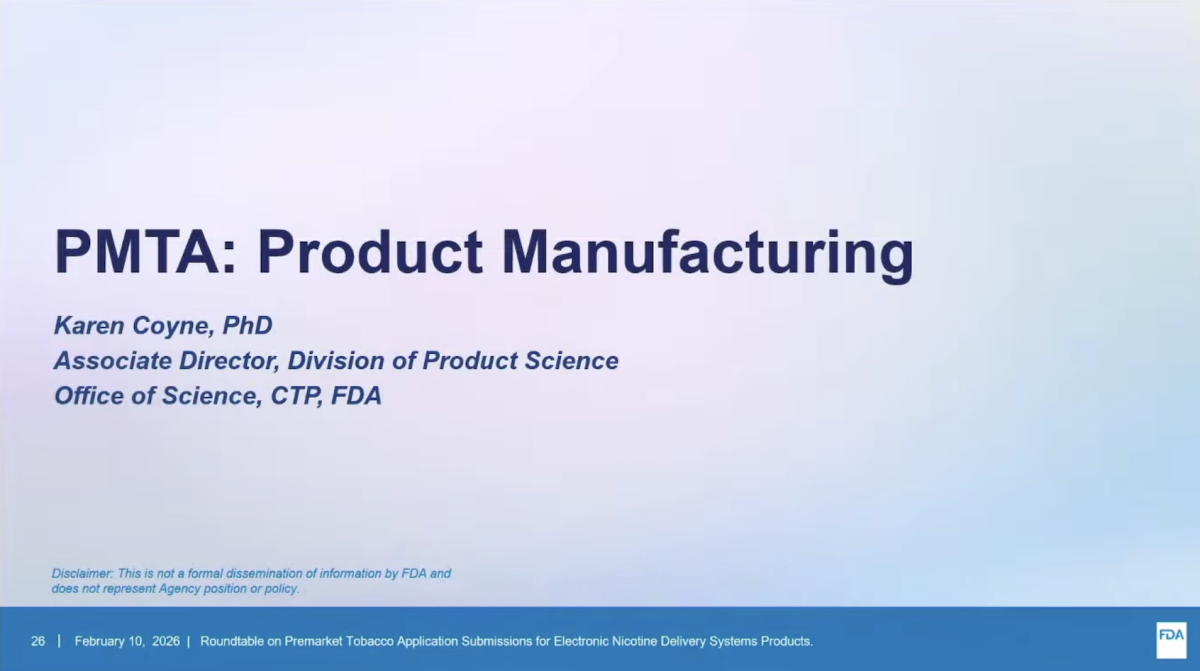
Speaking during the FDA’s roundtable on PMTA submissions for ENDS, Karen Coyne, PhD, Associate Director of the Division of Product Science in the Office of Science at FDA’s Center for Tobacco Products (CTP), said manufacturing requirements are not merely regulatory checkboxes, but central to ensuring product consistency and enabling FDA to evaluate public health impact.

Quality Management Systems as the Basis for Manufacturing Consistency
According to the presentation, FDA expects applicants to establish a comprehensive Quality Management System (QMS), which may be based on standards such as ISO 9001. The QMS should document quality procedures covering incoming inspection, in-process controls, finished product testing, nonconformance handling, corrective actions, and document control.
FDA noted that an effective QMS should address both quality assurance (QA), which is process-oriented and focused on defect prevention, and quality control (QC), which is product-oriented and focused on defect detection. Together, these elements allow reviewers to assess whether manufacturing operations are sufficiently controlled to ensure consistent products.
Four Core Manufacturing Documents in PMTA Submissions
FDA identified four critical categories of manufacturing documentation that serve as pillars of PMTA submissions:
- Standard Operating Procedures (SOPs): covering all critical manufacturing operations and defining who performs specific activities and when;
- Work Instructions (WIs): providing detailed, step-by-step guidance on how individual tasks are performed;
- Certificates of Analysis (COAs): demonstrating that supplied materials and manufactured components meet established specifications; and
- Batch Records: documenting complete production and control information for each manufacturing batch.
FDA indicated that these documents collectively enable reviewers to determine whether manufacturing processes are standardized, controlled, and reproducible.
Common Manufacturing Deficiencies Observed in Reviews
FDA also outlined recurring manufacturing-related deficiencies encountered during PMTA reviews that can limit the agency’s ability to complete a substantive evaluation.
According to the presentation, reviewers frequently encounter incomplete descriptions of manufacturing processes and procedures, including missing SOPs or WIs for nonconformance handling and personnel training, as well as absent examples of relevant forms and records. FDA also noted deficiencies in quality control, such as missing functional testing and insufficient performance verification, and incomplete descriptions of manufacturing steps where component sources are unclear or assembly processes are not fully documented.
With respect to QMS documentation, FDA observed that SOPs often lack sufficient detail or clarity; Work Instructions frequently fail to specify acceptance criteria for in-process checks; Certificates of Analysis may be missing target specifications with units, quantitative acceptance criteria, test data averages, or statistical parameters such as standard deviation or minimum and maximum values; and batch records commonly contain incomplete information, including missing steps or in-process test results.
Nicotine Quantity Specifications and Public Health Implications
FDA emphasized that applicants should define target nicotine quantity specifications for finished products, along with upper and lower limits and acceptance criteria. PMTA submissions should include in-process checks demonstrating that nicotine quantity remains within specifications at each manufacturing step and should show that target specifications, acceptance criteria, and labeling claims are met using manufacturing evidence such as batch release data.
FDA explained that inadequate control of nicotine quantity has direct public health implications. Consumers may receive inconsistent products and increase frequency of use; exposure to harmful and potentially harmful constituents (HPHCs) may be higher than anticipated; abuse liability may be affected if nicotine levels are elevated; and products used in abuse liability or other clinical and behavioral studies may not accurately represent real-world use.
Stability Studies and Shelf-Life Support
The presentation also addressed stability studies, which FDA described as essential for demonstrating product integrity over time. Stability studies are intended to show that products remain consistent throughout their shelf life and that key characteristics—including nicotine quantity, water activity, and pH—remain within acceptable ranges.
FDA specified that stability studies should include at least three timepoints—at the beginning, middle, and end of the shelf life—and should be conducted under intended storage conditions. The agency noted that accelerated studies are not appropriate for assessing microbial stability. If stability data do not support the shelf life proposed in a PMTA, FDA indicated that a marketing granted order may only be issued for the shelf life supported by the data.
For stability testing conducted by third-party laboratories using tobacco product master files (TPMFs), FDA stated that applicants should include a letter of authorization to reference the TPMF. FDA also emphasized that stability testing should rely on validated methods, noting that data generated using unvalidated test methods do not provide confidence that results are accurate, repeatable, or representative of the finished product.
Risk Analysis and Mitigation Measures
FDA indicated that applicants should conduct a failure mode and effects analysis (FMEA), or a comparable systematic risk analysis, to identify design and manufacturing risks and corresponding mitigations. Submissions should demonstrate that manufacturing steps did not introduce additional risks, and that identified risks were addressed through appropriate controls.
Examples of risk mitigation features discussed during the session included maximum puff duration limits, time-out functions providing automatic shutoff after specified use periods, temperature controls to prevent overheating, low-voltage cutoff features to protect batteries, and child-resistant packaging to mitigate accidental exposure.
Key Takeaways from the Session
The session concluded with four key takeaways emphasized by FDA: applicants should provide complete manufacturing process information, including SOPs and WIs covering all processing steps from sample receipt through shipment of finished products; demonstrate that nicotine quantity in finished products meets specifications; conduct sufficient chemical and microbial stability studies to support shelf-life claims; and provide evidence supporting the intended function of features designed to mitigate product risks.
The manufacturing controls panel included Bryan Burd of NEPA Wholesale Inc.; Karen Coyne, PhD; Colleen Rogers, PhD; and CDR Matthew Walters, PhD from FDA; Charles Melander of Streamline Vape Co. LLC; and Steve Pryzbyla, Esq of IKE Tech. The session was moderated by Todd Cecil, PhD of FDA.
The roundtable, which is limited to manufacturers with fewer than 350 employees, was held in a hybrid format.
2Firsts will continue to follow the discussions and report further developments.
(The cover image is a screenshot from the FDA’s livestream of the PMTA roundtable.)

Click here to read the full coverage