Key Points
- Proposed rule: FDA would require foreign tobacco manufacturers to register facilities and list products.
- Covered entities: Overseas OEM/ODM factories, contract manufacturers, specification developers, bulk product makers, repackagers and relabelers could be affected.
- Product scope: The rule covers FDA-regulated tobacco products, including e-cigarettes, e-liquids, HTPs, smokeless tobacco, cigars and waterpipe products.
- Regulatory impact: FDA could gain clearer visibility into product sources, specifications, compliance status and manufacturing entities.
- Key boundary: Registration and product listing would not equal FDA marketing authorization.
2FIRSTS
June 26, 2026
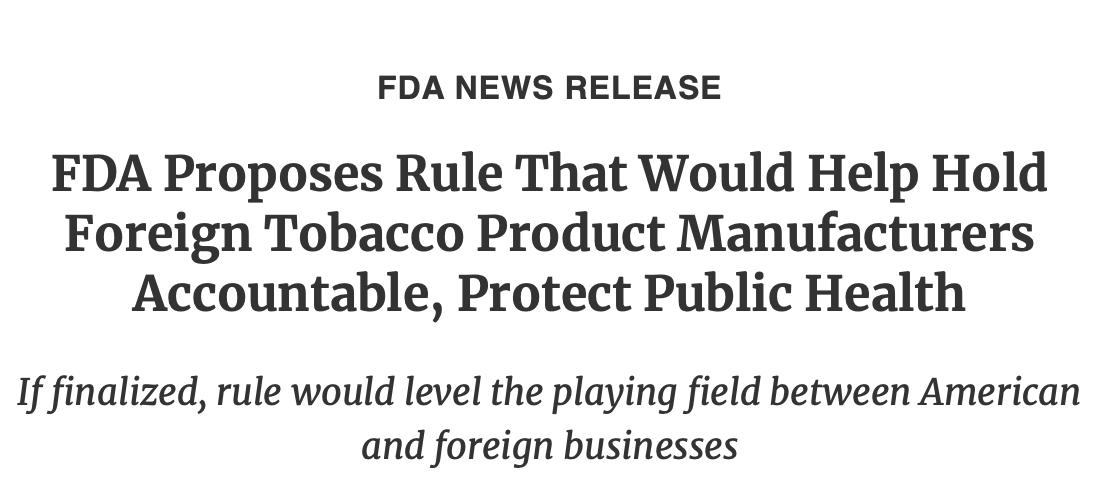
The U.S. Food and Drug Administration proposed a ruleon Friday that would require foreign tobacco manufacturers to register their facilities and list their products, a move aimed at expanding oversight of imported tobacco products and strengthening enforcement against unauthorized e-cigarettes.
The proposed rule, titled “Establishment Registration and Product Listing for Tobacco Products,” would set the format, content and procedures for tobacco product establishment registration and product listing. If finalized, it would apply to domestic and foreign establishments that manufacture, prepare, compound or process tobacco products.
Domestic tobacco manufacturers are already required under federal law to register their establishments and list their products with the FDA. Foreign manufacturers are not subject to the same requirements unless the agency implements them through regulation.
The FDA said the proposal would close that gap and give the agency a more complete picture of products manufactured for sale to American consumers and the facilities where they are made.
“All companies selling tobacco products in the United States should play by the same rules,” Bret Koplow, acting director of the FDA’s Center for Tobacco Products, said in the agency’s statement.
FDA announcement
The FDA said the proposal would help it identify illegal foreign tobacco products more efficiently, including unauthorized e-cigarettes, and support on-site inspections of manufacturing facilities outside the United States.
The agency has existing authority to take enforcement action against illegal tobacco products and has acted against products manufactured abroad, including recent seizures of unauthorized e-cigarettes. The proposed rule would expand the information available to the FDA before or after products enter the U.S. market.
In its announcement, the FDA said many unauthorized e-cigarettes are manufactured outside the United States, making the proposal a critical step for the agency’s efforts to protect public health.
If finalized, registered foreign establishments would become subject to FDA inspections under the Federal Food, Drug, and Cosmetic Act. The proposed rule says the agency currently inspects foreign establishments mainly to support premarket tobacco product application reviews.
What the proposal requires
Under the proposed rule, owners and operators of covered establishments would have to submit registration and product listing information to the FDA. Foreign establishments would need to register before any covered tobacco product manufactured, prepared, compounded or processed at the establishment is imported or offered for import into the United States.
Registration information would include the establishment’s name, address, contact information, website, owner and operator information, official correspondent and FDA-assigned identifiers where applicable.
Product listings would require detailed product-level information, including category, subcategory, package type, product quantity, nicotine concentration and source, characterizing flavors, product dimensions and relevant FDA-assigned identifiers. For electronic nicotine delivery systems, manufacturers would also have to provide specifications such as e-liquid volume, battery capacity, wattage and propylene glycol-to-vegetable glycerin ratios where applicable.
The proposal would generally require electronic submission through the FDA’s online system. Establishment registrations would have to be reviewed and updated annually, while product listings would have to be reviewed and updated twice a year, in June and December.
The rule would also require manufacturers to maintain historical files of consumer information, labeling and advertising materials. The FDA said those records would help it assess whether products are marketed with false or misleading claims, unauthorized modified-risk claims or other labeling and advertising violations.
Who could be covered
The proposed rule uses a broad definition of manufacturing activity and could apply to several types of companies in the tobacco and nicotine product supply chain.
Covered entities would include owners and operators of domestic and foreign establishments that manufacture, prepare, compound or process tobacco products regulated by the FDA. The proposal defines manufacturing activities to include assembling, processing, homogenizing, mixing, formulating, labeling or packaging.
For overseas supply chains, this means the proposal could cover physical product manufacturers, contract manufacturers, OEM and ODM factories, specification developers, bulk tobacco product manufacturers, and companies that repackage or relabel tobacco products.
A specification developer is an entity that controls the design and development of a tobacco product or creates product specifications. A third-party manufacturer includes a contract manufacturer that physically manufactures a tobacco product on behalf of another party or according to specifications set by another party.
A foreign factory would not avoid the proposal merely because it manufactures products for another company’s brand. If a specification developer designs a tobacco product and provides the specifications to a third-party manufacturer, both entities could fall within the manufacturing framework described in the proposal.
The rule could therefore be relevant to factories and supply-chain companies involved in producing finished e-cigarettes, e-liquids, closed-system pods or cartridges, heated tobacco products, smokeless tobacco products, waterpipe tobacco products, cigars, pipe tobacco products and other tobacco products intended for U.S. distribution.
It could also apply to manufacturers of certain components or parts, where those products are intended or reasonably expected to alter or affect a tobacco product’s performance, composition, constituents or characteristics, or to be used with or for human consumption of a tobacco product.
The proposal would not require registration and listing from every upstream supplier. The FDA says manufacturers of only raw materials, other than tobacco, used in manufacturing a component or part of a tobacco product would not be required to register or list their products. Common carriers involved only in the receipt, carriage, holding or delivery of tobacco products in the usual course of business would also not be required to register.
The FDA’s proposed product categories include cigarettes, smokeless tobacco, cigars, pipe tobacco products, waterpipe tobacco products, heated tobacco products, electronic nicotine delivery systems and other tobacco products regulated by the agency.
Potential impact
If finalized, the proposed rule would increase FDA visibility over foreign-made tobacco products entering the U.S. market.
The agency would have more structured information on foreign establishments, products, product specifications, labeling, advertising and regulatory identifiers. That could make it easier to connect imported products with their manufacturing source and determine whether products are listed or linked to relevant FDA submissions or marketing authorizations.
For imported e-cigarettes, the impact could be significant. The FDA said in its announcement that many unauthorized e-cigarettes are manufactured outside the United States. More detailed registration and product listing data could help the agency identify products that lack required authorization or that are marketed in violation of existing requirements.
The proposal could also increase documentation and data-management burdens for foreign manufacturers. Companies exporting products to the United States would need to maintain more consistent product master data, including SKU-level information, nicotine source, nicotine concentration, flavors, product dimensions, labeling, advertising and FDA submission identifiers where applicable.
The rule may also affect commercial relationships among overseas manufacturers, U.S. importers, brand owners and distributors. Companies may need clearer documentation of which entity controls product specifications, which establishment performs each manufacturing activity, and how each product corresponds to FDA regulatory records.
The proposal does not create a new pathway for unauthorized tobacco products to become legal. Registration and product listing would not equal FDA marketing authorization. Products subject to premarket review requirements would still need valid FDA authorization to be legally marketed in the United States.
In practical terms, the rule would give the FDA more information to identify products and establishments that may not comply with existing requirements.
Next steps
The FDA will accept public comments on the proposal through Sept. 14, 2026, according to the agency’s announcement. The agency will review the comments before deciding whether to finalize, modify or withdraw the rule.
Because the rule remains a proposal, the requirements are not yet final.
2Firsts will continue to monitor the rulemaking process and provide further reporting and analysis on its implications for global tobacco and nicotine product manufacturers.
Cover image taken from a screenshot of the related announcement on the FDA website.
Disclaimer
This article is provided solely for professional research, industry discussion, and informational purposes. Any references to brands, companies, products, technologies, or policies are made for factual reporting and analytical purposes only, and do not constitute endorsement, recommendation, promotion, or advertising by 2Firsts.
Nicotine-containing products, including but not limited to cigarettes, e-cigarettes, heated tobacco products, and nicotine pouches, carry significant health risks. Readers are responsible for complying with all applicable laws and regulations in their respective jurisdictions, including age restrictions and access limitations.
The information contained in this article should not be regarded as investment, legal, medical, regulatory, or commercial advice. While 2Firsts strives to ensure the accuracy and reliability of its content, it does not assume liability for any direct or indirect loss arising from errors, omissions, inaccuracies, or reliance on the information contained herein.
This article is not intended for individuals below the legal age for accessing tobacco or nicotine-related information in their jurisdiction.
Copyright Notice
This article is either original content produced by 2Firsts or content reproduced, translated, summarized, or adapted from third-party sources with attribution where applicable. The intellectual property rights of the original content remain with 2Firsts or the respective original rights holders.
No individual or organization may copy, reproduce, distribute, republish, modify, translate, or otherwise use this content without prior authorization. Any unauthorized use may result in legal action.
For copyright-related inquiries, corrections, or removal requests, please contact: info@2firsts.com.
AI-Assisted Translation and Editing Notice
Portions of this article may have been translated, edited, or reviewed with the assistance of artificial intelligence tools to improve efficiency and readability. Due to the limitations of AI-assisted translation and editing, discrepancies, omissions, or inaccuracies may exist when compared with the original source.
Where applicable, readers are advised to refer to the original source for the most complete and accurate information. If you identify any errors or believe that any content infringes upon your rights, please contact us at info@2firsts.com, and we will review and address the matter promptly.