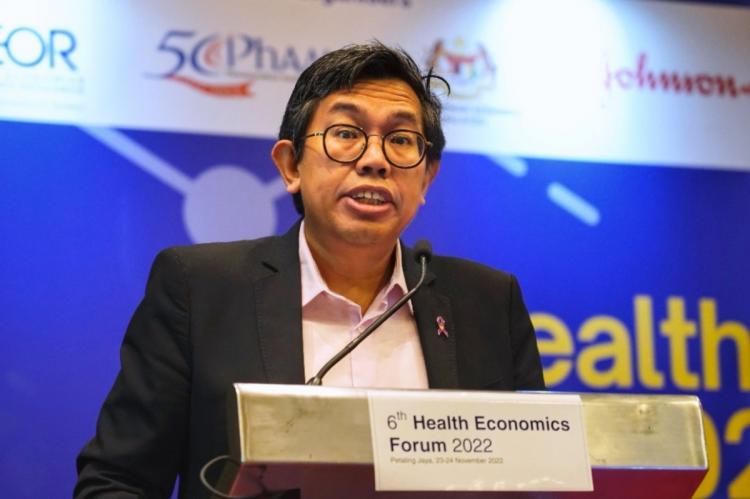
On November 28th, the Galen Centre for Health and Social Policy in Kuala Lumpur called on the government of Anwar Ibrahim to propose and pass the controversial tobacco control bill within the first 100 days of his tenure.
Azrul Mohd Khalib, CEO of Galen Center, has revealed that significant progress has been made on the proposed Control of Tobacco Product and Smoking Bill 2022 after undergoing several revisions suggested by the bipartisan committee of the 14th Parliament's Dewan Rakyat. The Bill proposes a ban on smoking and e-cigarette use for those born in or after 2007, also known as an intergenerational ban.
Azrul, speaking on the radio program "Health and Life: Doctors at Home" last Friday, told BFM host Tee Shiao Eek, "This is an obvious outcome because it clearly shows how different parties from different viewpoints and ideologies can collaborate to develop a multiparty bill - not even just a two-party bill - and then pass it through a vote. This has already been laid out on the table, the work has been completed.
This was an easy victory. In fact, you can submit it to parliament and vote on it at the next meeting. This is a clear example of how we can come together, work collaboratively, and create something beneficial.
In other proposed amendments, the Parliamentary Special Select Committee (PSSC) led by then-Health Minister Khairy Jamaluddin agreed to lift the ban on tobacco or electronic cigarette products for those born after January 1, 2007, but decided to maintain the ban on smoking or using e-cigarettes and purchasing such products for this group.
The 14th Parliament's PSSC has also agreed to reduce the maximum fine for GEG violators from 5,000 Malaysian Ringgit (approximately 7,923 dollars) to 500 Malaysian Ringgit (approximately 792 dollars), and may potentially offer community service.
Prior to the dissolution of parliament last month, Khairy, who was then serving in the government of Ismail Sabri Yaakob, failed to bring the tobacco bill to a second reading and debate. This was due to serious concerns raised by several Pakatan Harapan (PH) lawmakers and human rights advocates over the broad enforcement powers, economic impact, and infringement on personal liberties inherent in the bill.
Prime Minister Anwar's coalition government now holds a two-thirds majority in the Dewan Rakyat, with the addition of the Sabah branch of the United Malays National Organization (UMNO) to the coalition made up of the National Front (BN) and the Sarawak United People's Party (GPS) led by the People's Justice Party (PH).
Azrul further urges the next Health Minister to submit a Health White Paper to Parliament or release a document outlining reforms to the healthcare system for the next 15 years.
Khairy previously established a 13-member advisory committee for the "Health White Paper," co-chaired by former Health Minister Dr. S. Subramaniam and Axiata Group Chairman Shahril Ridza Ridzuan. However, there was no formation of a Health Reform Committee to oversee the implementation of recommendations outlined in the yet-to-be-released "Health White Paper.
According to Azrul, "We have put in a lot of effort, work, and contributions in considering the introduction of healthcare reform into the Malaysian healthcare system, which is stated in the white paper. Many individuals have contributed with their forward-thinking and aspirations, and most importantly, they witness the change that is needed, even earlier than the previous health minister, going back 20 years. We hope that the next minister, whoever she or he may be, will take out the white paper, present it to parliament or publicize it, so we can use the recommendations in it. It is meaningless that nobody has seen or referenced the document in this article, as it has not been made public.
In his manifesto for the 15th election, PH pledged to establish a Health Committee to oversee the implementation of the national healthcare reform plan in conjunction with the Ministry of Economic Planning, Finance, Health, and Education. The aim is to address systemic issues such as healthcare financing, decentralization of power, and the public-private partnership.
Azrul urges the PH-led coalition government not to reinvent the wheel in healthcare reform. He stated, "The proposals put forth by Kairi during his tenure stem from years of experience from those who have worked in the department. What is important for us is to recognize that regardless of who initiated these ideas in the past, we should be able to examine them and give them the attention and value they deserve. We need to do this now. If we start from scratch, we will be wasting time." Azrul suggests that the next Health Minister's first 100 days in office should focus on low-hanging fruit initiatives.
Finally, he said, "It's important to talk to people and listen to their voices. When taking office, you may have your own ideas, but I, honestly, will talk to people from the Ministry of Health, as well as other departments, and most importantly, talk to patients and patient groups. They can tell you what can be done during this time and what can be achieved.
Disclaimer
This article is provided solely for professional research, industry discussion, and informational purposes. Any references to brands, companies, products, technologies, or policies are made for factual reporting and analytical purposes only, and do not constitute endorsement, recommendation, promotion, or advertising by 2Firsts.
Nicotine-containing products, including but not limited to cigarettes, e-cigarettes, heated tobacco products, and nicotine pouches, carry significant health risks. Readers are responsible for complying with all applicable laws and regulations in their respective jurisdictions, including age restrictions and access limitations.
The information contained in this article should not be regarded as investment, legal, medical, regulatory, or commercial advice. While 2Firsts strives to ensure the accuracy and reliability of its content, it does not assume liability for any direct or indirect loss arising from errors, omissions, inaccuracies, or reliance on the information contained herein.
This article is not intended for individuals below the legal age for accessing tobacco or nicotine-related information in their jurisdiction.
Copyright Notice
This article is either original content produced by 2Firsts or content reproduced, translated, summarized, or adapted from third-party sources with attribution where applicable. The intellectual property rights of the original content remain with 2Firsts or the respective original rights holders.
No individual or organization may copy, reproduce, distribute, republish, modify, translate, or otherwise use this content without prior authorization. Any unauthorized use may result in legal action.
For copyright-related inquiries, corrections, or removal requests, please contact: info@2firsts.com.
AI-Assisted Translation and Editing Notice
Portions of this article may have been translated, edited, or reviewed with the assistance of artificial intelligence tools to improve efficiency and readability. Due to the limitations of AI-assisted translation and editing, discrepancies, omissions, or inaccuracies may exist when compared with the original source.
Where applicable, readers are advised to refer to the original source for the most complete and accurate information. If you identify any errors or believe that any content infringes upon your rights, please contact us at info@2firsts.com, and we will review and address the matter promptly.