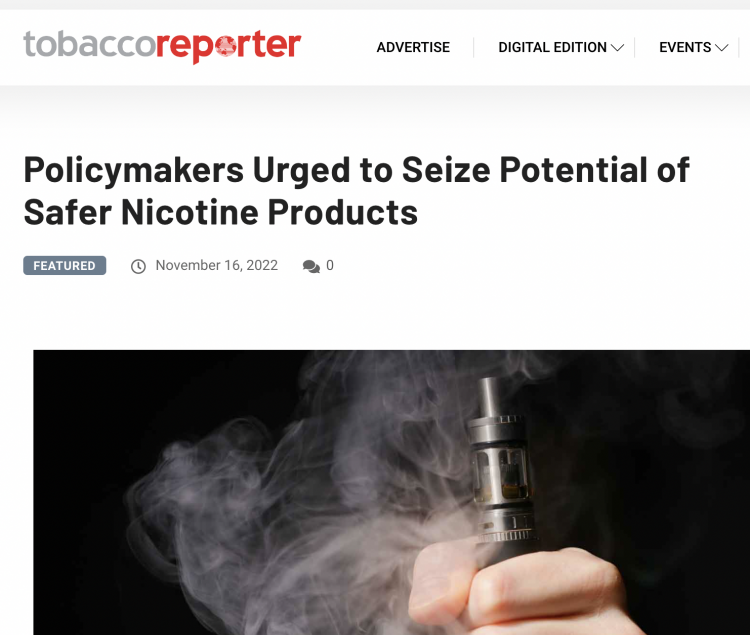
Knowledge-Action-Change (KAC) has released a publication titled "Global State of Tobacco Harm Reduction 2022: The Right Side of History." The Global State of Tobacco Harm Reduction (GSTHR) publication outlines the history of tobacco harm reduction and considers a strategy that can accelerate the end of smoking while significantly reducing global smoking-related deaths and illnesses in the future.
According to the report's author, the emergence of new, safer nicotine products is causing significant disruption to the use of nicotine, public health and tobacco control agencies, and the traditional tobacco industry. However, distrust and ideological opposition are hindering the widespread adoption of a strategy that could help the 1.1 billion adult smokers who have failed to quit with current tobacco control interventions.
Technology has helped make smoking one of the biggest health issues in the world," said Harry Shapiro, author of the book "The Right to Smoke," in a statement. "Now, technology innovations outside of the tobacco industry and public health fields have produced safer nicotine products, which millions of smokers have chosen to switch to. However, progress is being hindered. While disruption is not always comfortable, the genie is out of the bottle - these new technologies require new policies and new thinking.
Gerry Stimson, the head of the GSTHR project, stated that failing to understand and utilize the potential of reducing tobacco harm will result in millions of deaths each year and increasing disease burden with disproportionate effects on vulnerable countries and communities.
Tobacco control has made little progress, despite limited achievements. This means that many ideal goals of achieving a smoke-free world by 2030 or for the next generation are as unlikely to succeed as the ambition to achieve a drug-free world. Tobacco harm reduction presents a historic opportunity that we cannot afford to let slip away.
Following the 2018 report entitled "Smoke-Free, Flame-Free" and the 2020 report entitled "Burning Issues," "The History of Right" is the third report in the biennial GSTHR series. The GSTHR project was funded by the Smoke-Free World Foundation.
Statement:
This article has been compiled from third-party information and is intended solely for professional industry exchange and learning.
This article does not represent the views of 2FIRSTS and 2FIRSTS is unable to confirm the truthfulness and accuracy of the content. The translation of this article is only for industry communication and research purposes.
Due to limitations in our translation abilities, the translated article may not fully reflect the original text. Please refer to the original article for accuracy.
2FIRSTS maintains complete alignment with the Chinese government on any domestic, Hong Kong, Macau, Taiwan, or foreign-related statements and positions.
The copyright of the compiled information belongs to the original media and author. If there is any infringement, please contact us for deletion.
Disclaimer
This article is provided solely for professional research, industry discussion, and informational purposes. Any references to brands, companies, products, technologies, or policies are made for factual reporting and analytical purposes only, and do not constitute endorsement, recommendation, promotion, or advertising by 2Firsts.
Nicotine-containing products, including but not limited to cigarettes, e-cigarettes, heated tobacco products, and nicotine pouches, carry significant health risks. Readers are responsible for complying with all applicable laws and regulations in their respective jurisdictions, including age restrictions and access limitations.
The information contained in this article should not be regarded as investment, legal, medical, regulatory, or commercial advice. While 2Firsts strives to ensure the accuracy and reliability of its content, it does not assume liability for any direct or indirect loss arising from errors, omissions, inaccuracies, or reliance on the information contained herein.
This article is not intended for individuals below the legal age for accessing tobacco or nicotine-related information in their jurisdiction.
Copyright Notice
This article is either original content produced by 2Firsts or content reproduced, translated, summarized, or adapted from third-party sources with attribution where applicable. The intellectual property rights of the original content remain with 2Firsts or the respective original rights holders.
No individual or organization may copy, reproduce, distribute, republish, modify, translate, or otherwise use this content without prior authorization. Any unauthorized use may result in legal action.
For copyright-related inquiries, corrections, or removal requests, please contact: info@2firsts.com.
AI-Assisted Translation and Editing Notice
Portions of this article may have been translated, edited, or reviewed with the assistance of artificial intelligence tools to improve efficiency and readability. Due to the limitations of AI-assisted translation and editing, discrepancies, omissions, or inaccuracies may exist when compared with the original source.
Where applicable, readers are advised to refer to the original source for the most complete and accurate information. If you identify any errors or believe that any content infringes upon your rights, please contact us at info@2firsts.com, and we will review and address the matter promptly.