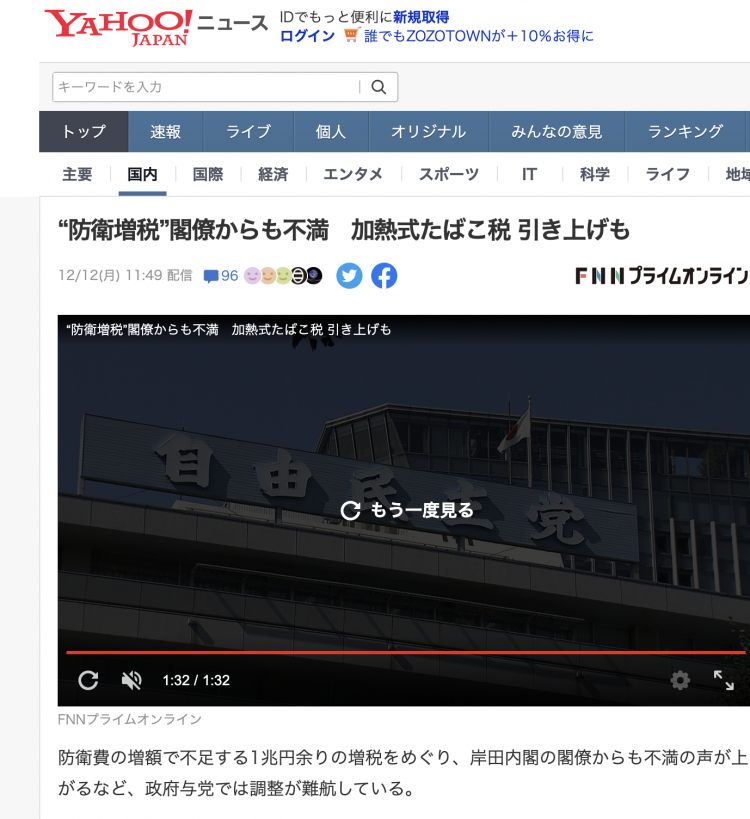
Government Struggles to Increase Taxes for Defense Spending

Dec.12.2022
Government Struggles to Increase Taxes for Defense Spending
Increasing defense spending causes difficulty coordinating tax increases. Government considers raising tax on heated non-burning cigarettes.

Due to an increase in defense spending, the government and ruling party are faced with difficulties in coordinating tax increases, which fall short of 1 trillion yen.


Koki Kadowaki, a political correspondent from Fuji Television, will report the latest updates from the parliamentary press room. A senior government official stated, "The Prime Minister is determined to increase the defense budget." Minister of Economy and Security, Kouichi Hagiuda, expressed his dissatisfaction on Twitter, stating, "I cannot comprehend the true intention behind the Prime Minister's statement about raising salary concerns at this time.


Moreover, voices within the party have begun to express opposition to the sequencing of increasing taxes before detailing defense capabilities. Chief Cabinet Secretary Matsuno stated, "I am aware of Minister Takashi's remarks on social media. We have had various discussions with Cabinet members, but I do not wish to respond." In addition, the government is considering gradually raising taxes on "heated non-combustible cigarettes" and other products starting in 2024, while also considering measures to alleviate the burden on small and medium-sized enterprises.


Opposition to tax hikes within the party runs deep, and coordination has proven difficult. Facing challenges in coordinating tax increases due to rising defense spending, the government and ruling party have struggled to increase tax revenue by less than 1 trillion yen. Fuji TV political reporter Mendo Yuki will report on the latest developments from inside the parliament building.


According to a senior government official, "the Prime Minister is determined to increase the defense budget." However, the Minister of Economic Security, Takashi Takamichi, expressed dissatisfaction on Twitter, stating, "I don't understand the true intention behind the Prime Minister's statement to cool down the mentality of raising salaries at this time." There are also voices within the party saying that "increasing taxes before explaining the contents of defense capability is not reasonable." Cabinet Secretary Matsuno said, "I am aware of Minister Takamichi's comments on social media. We have had various discussions with Cabinet Ministers, but I do not want to answer.


In addition, the government is considering raising taxes on "heated tobacco products" and other items, gradually increasing tax revenue from 2024, while also considering measures to ease the burden on small and medium-sized enterprises. However, opposition within the party to tax hikes is deeply entrenched, and there are significant coordination difficulties.


2FIRSTS will continue to report on this issue and further updates will be available on the "2FIRSTS APP." Scan the QR code below to download the app.


Disclaimer

This article is provided solely for professional research, industry discussion, and informational purposes. Any references to brands, companies, products, technologies, or policies are made for factual reporting and analytical purposes only, and do not constitute endorsement, recommendation, promotion, or advertising by 2Firsts.

Nicotine-containing products, including but not limited to cigarettes, e-cigarettes, heated tobacco products, and nicotine pouches, carry significant health risks. Readers are responsible for complying with all applicable laws and regulations in their respective jurisdictions, including age restrictions and access limitations.

The information contained in this article should not be regarded as investment, legal, medical, regulatory, or commercial advice. While 2Firsts strives to ensure the accuracy and reliability of its content, it does not assume liability for any direct or indirect loss arising from errors, omissions, inaccuracies, or reliance on the information contained herein.

This article is not intended for individuals below the legal age for accessing tobacco or nicotine-related information in their jurisdiction.


Copyright Notice

This article is either original content produced by 2Firsts or content reproduced, translated, summarized, or adapted from third-party sources with attribution where applicable. The intellectual property rights of the original content remain with 2Firsts or the respective original rights holders.

No individual or organization may copy, reproduce, distribute, republish, modify, translate, or otherwise use this content without prior authorization. Any unauthorized use may result in legal action.

For copyright-related inquiries, corrections, or removal requests, please contact: info@2firsts.com.


AI-Assisted Translation and Editing Notice

Portions of this article may have been translated, edited, or reviewed with the assistance of artificial intelligence tools to improve efficiency and readability. Due to the limitations of AI-assisted translation and editing, discrepancies, omissions, or inaccuracies may exist when compared with the original source.

Where applicable, readers are advised to refer to the original source for the most complete and accurate information. If you identify any errors or believe that any content infringes upon your rights, please contact us at info@2firsts.com, and we will review and address the matter promptly.

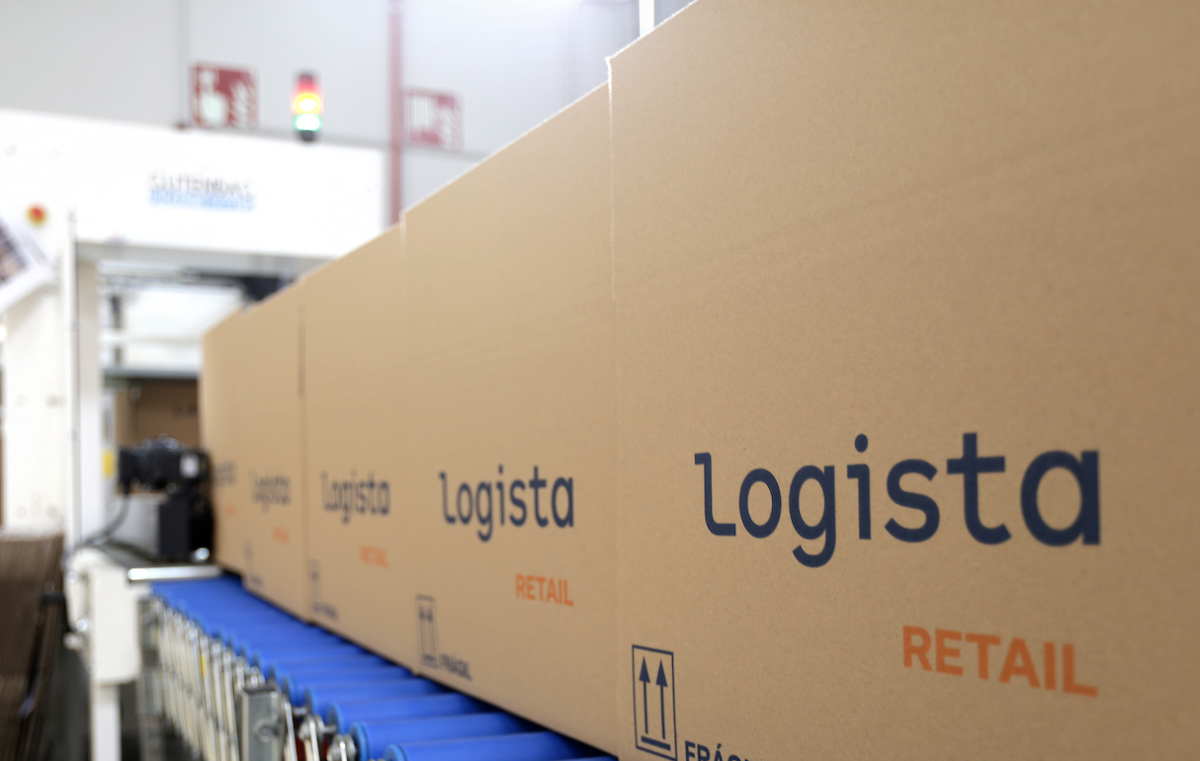
How Large Is France’s Off-Channel Tobacco Market? Logista Says It Has Become Structural, While the Official Estimate Is 17.7% and Some Industry Studies Put It Above 50%
Logista France says tobacco consumption outside France’s official tobacconist network has become a large and structural market phenomenon, but official and industry estimates differ sharply. France’s TAFE study estimates that 17.7% of tobacco consumption escaped domestic taxation in 2023, with most of that volume attributed to cross-border purchasing rather than street sales. Some industry studies use broader off-channel definitions and put the figure above 50%. Meanwhile, French Customs seized 547.94 tonnes of tobacco in 2025, up 12%, showing continued pressure from illicit trade.
Sep.04
Snowplus Enters Japan’s FamilyMart Network With Zero-Nicotine NEO Line and Kishidan Campaign
Snowplus distributor H&S said the zero-nicotine, zero-tar NEO vaping line will begin rolling out across FamilyMart stores in Japan from September 14, 2026, excluding some locations. The DASH line will also be sold at selected FamilyMart stores in southern Kyushu and Okinawa. Snowplus simultaneously named Japanese rock band Kishidan as a brand ambassador, combining convenience-store distribution with a broader consumer marketing push in Japan.
Sep.15
Smoke-Free Business Hits 42% of Q2 Net Revenue as PMI’s First TNFD Report Covers Single-Use Electronics, Critical Raw Materials and IQOS Repairs
Philip Morris International has published its first report aligned with the Taskforce on Nature-related Financial Disclosures, bringing its electronics supply chain and the use and end-of-life stages of smoke-free devices and consumables into its nature-related assessment. PMI said its smoke-free business accounted for about 42% of total net revenues in the second quarter of 2026. The report says non-circular electronic products, particularly single-use items, can increase consumption of limited natural resources and also details an IQOS repair pilot. A 2040 circularity scenario tests assumptions including a 50% reduction in product waste-related costs, 10% raw-material savings and a 25% substitution rate for refurbished products versus new products.
Sep.23
Russia’s Vape Device Labeling Regime Enters Force: Registration Starts in September, Mandatory Coding in December
Russia's digital labeling regime for reusable e-cigarettes and similar personal vaping devices entered its first mandatory phase in September 2026. From September 1, manufacturers, importers and other market participants must register with the national Chestny ZNAK tracking system. From December 1, newly manufactured and imported covered devices will be required to carry digital identification codes and be reported as entering circulation. Russia has also issued new operational guidance for imports, marking the transition from a voluntary pilot to phased mandatory implementation.
Sep.15
Kantar Study Finds More Than 93% of Vape Products in Ukraine Fail Regulatory Requirements
According to Interfax-Ukraine, a study conducted by market research firm Kantar Ukraine at the request of major tobacco companies found that more than 93% of vape products in Ukraine did not fully comply with regulatory requirements. The research examined product categories, brand distribution and consumer purchasing channels, showing that pod systems and disposable vapes represent major segments of the market, while offline retail remains the dominant purchasing channel. The findings highlight ongoing compliance challenges in Ukraine’s vape market.
Aug.26
Philip Morris Romania Executive on Smoke-Free Strategy: How IQOS Spaces Are Moving Beyond Retail to Consumer Connection
In an interview with Romanian marketing publication IQads, Marek Gębski, Director of Smoke-Free Products at Philip Morris Romania, said IQOS experience spaces are evolving from traditional retail locations into platforms for consumer engagement and brand connection. Through locations such as IQOS Boutique Victoriei, PMI aims to use design, culture and consumer experiences to strengthen communication with adult consumers about smoke-free products. The interview highlights how tobacco companies are expanding smoke-free strategies beyond products toward experiential marketing and consumer relationships.
Aug.11