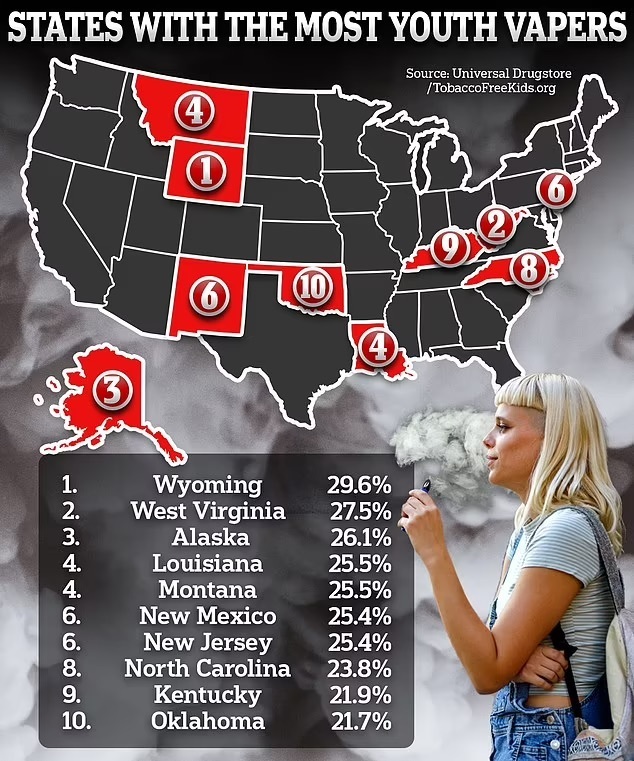
According to a report by the Daily Mail on August 4th, researchers in the United States conducted a thorough analysis of data provided by the organization "Campaign for Tobacco-Free Kids." Based on a survey conducted in 2023, Wyoming has the highest rate of e-cigarette use among youth in the United States, with nearly one-third of adolescents in the state reporting e-cigarette use in the past year, despite the state's ban on selling e-cigarettes to those under 21. Following Wyoming are West Virginia and Alaska.
A report indicates that the e-cigarette usage rate in California is the lowest at 6%. This is primarily due to the strict regulations implemented by Governor Gavin Newsom, who recently banned the sale of flavored e-cigarettes to individuals of all age groups. According to California law, the legal age to purchase e-cigarettes is 21.
According to the latest data from the Journal of the American Medical Association (JAMA), there are over 2 million adolescent smokers under the age of 18 who regularly use e-cigarettes, while the number of adult smokers reaches 17 million.
Researchers say:
Teen e-cigarette usage in Wyoming is the highest in the nation, reaching 30%. The state has implemented several laws aimed at reducing e-cigarette use, such as prohibiting the sale or distribution of e-cigarette products to those under 21, and requiring child-resistant packaging for e-cigarettes. However, the smoking rate remains the highest in the country.
In addition to these laws, child care facilities in the state also prohibit the use of e-cigarettes, and individuals purchasing tobacco products are required to pay a 15% tax. However, the majority of the state is rural with a smaller population, which may contribute to the high rates of e-cigarette use among adolescents. Approximately 80% of Wyoming residents live in rural areas, with much of the land used for agriculture and national parks. This also makes enforcing e-cigarette regulations more challenging, as rural areas often have limited access to resources about the dangers of e-cigarettes.
In West Virginia, the youth e-cigarette usage rate is 27.5%, ranking second highest in the country. In 2022, the state had the highest adult smoking rate in the U.S. at 25%. E-cigarettes are often promoted as a healthier alternative to smoking and used as a tool for quitting, which may contribute to the high e-cigarette usage rate in the state.
In Alaska, 26% of teenagers use e-cigarettes, ranking third in the country. Last year, Alaska Senate President Gary Stevens proposed a bill to impose a tax on e-cigarette products for the first time in the state. In 2022, he also proposed raising the minimum age to purchase tobacco products and e-cigarettes from 19 to 21, but this was vetoed by Governor Mike Dunleavy. Like Wyoming, the vast rural areas of Alaska also make it difficult to regulate teenage e-cigarette use.
In terms of adult e-cigarette usage rates, a recent study by JAMA found that Oklahoma ranks first.
It has been reported that the U.S. Food and Drug Administration (FDA) has prohibited the sale of unapproved flavored nicotine products, including ordering the withdrawal of all Juul brand products in June of this year. However, in July, the FDA has temporarily delayed this decision for further review. Other brands such as Puff Bar have also received warnings about selling flavored e-cigarette devices.
We welcome news tips, article submissions, interview requests, or comments on this piece.
Please contact us at info@2firsts.com, or reach out to Alan Zhao, CEO of 2Firsts, on LinkedIn
Notice
1. This article is intended solely for professional research purposes related to industry, technology, and policy. Any references to brands or products are made purely for objective description and do not constitute any form of endorsement, recommendation, or promotion by 2Firsts.
2. The use of nicotine-containing products — including, but not limited to, cigarettes, e-cigarettes, nicotine pouchand heated tobacco products — carries significant health risks. Users are responsible for complying with all applicable laws and regulations in their respective jurisdictions.
3. This article is not intended to serve as the basis for any investment decisions or financial advice. 2Firsts assumes no direct or indirect liability for any inaccuracies or errors in the content.
4. Access to this article is strictly prohibited for individuals below the legal age in their jurisdiction.
Copyright
This article is either an original work created by 2Firsts or a reproduction from third-party sources with proper attribution. All copyrights and usage rights belong to 2Firsts or the original content provider. Unauthorized reproduction, distribution, or any other form of unauthorized use by any individual or organization is strictly prohibited. Violators will be held legally accountable.
For copyright-related inquiries, please contact: info@2firsts.com
AI Assistance Disclaimer
This article may have been enhanced using AI tools to improve translation and editorial efficiency. However, due to technical limitations, inaccuracies may occur. Readers are encouraged to refer to the cited sources for the most accurate information.
We welcome any corrections or feedback. Please contact us at: info@2firsts.com