ITC Terminates Certain Claims in Patent Infringement Investigation

Regulations by 2FIRSTS.ai
Jul.31.2024
ITC Terminates Certain Claims in Patent Infringement Investigation
The US International Trade Commission (ITC) issued a notice on July 30 regarding a patent infringement investigation.

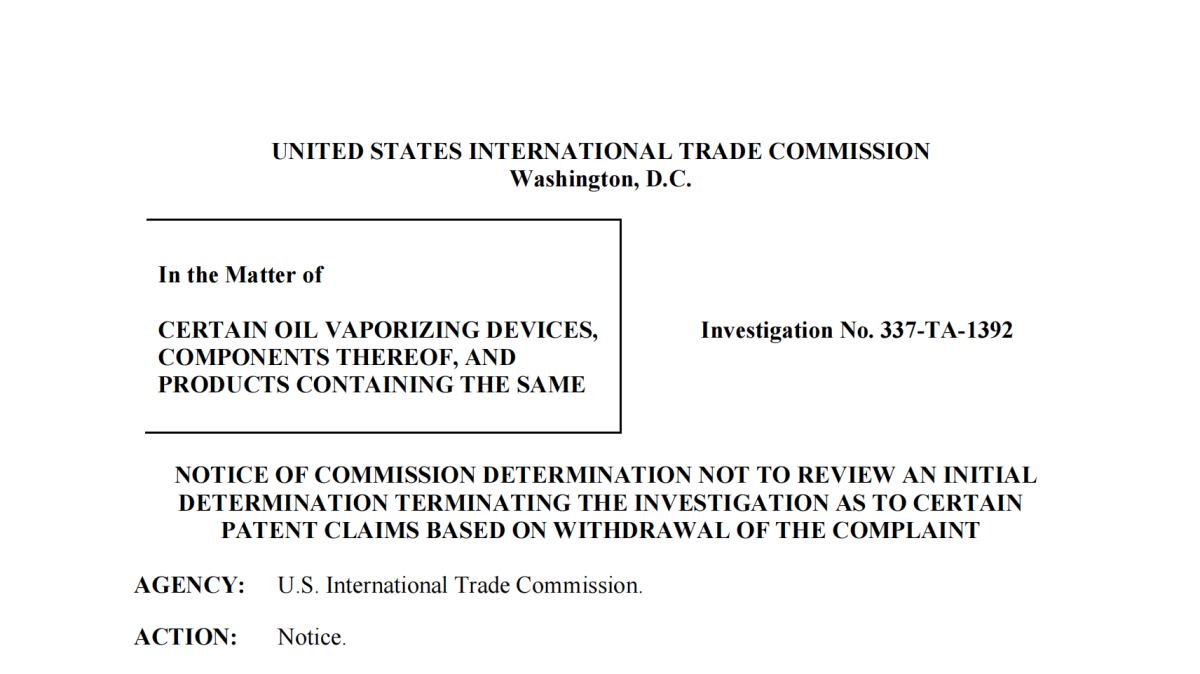
On July 30, the United States International Trade Commission (ITC) issued a notice regarding a patent infringement investigation case with the number 337-TA-1392.


The case was initially launched by the American e-cigarette company PAX Labs, accusing several companies of infringing on its patents in the United States. At the core of the case is the issue of patent rights regarding certain oil vaporization devices and their components, as well as products containing these devices. The companies being sued include STIIIZY IP LLC, ALD Group Ltd., ALD (Hong Kong) Holdings Ltd., and STIIIZY Inc.


These patents include multiple patents, including patent number 11,766,527 (referred to as the "527 patent"). The notice indicates that the ITC has ultimately agreed to PAX Labs' request for partial termination of the investigation, officially terminating the investigation of claims 4 and 21 of the "527 patent".


During the investigation, PAX Labs filed a motion on July 3 to partially terminate the investigation, specifically requesting the withdrawal of allegations against claims 4 and 21 of the "527 patent". PAX Labs then submitted an amended motion, stating that both parties had no further agreements regarding the investigation and the respondent company did not oppose this.


The administrative judge of the ITC made a preliminary decision on July 11th agreeing to PAX Labs' request to partially terminate the investigation. After reviewing this preliminary decision, the ITC decided not to conduct a review and adopted this decision.


The decision by the ITC was based on legal grounds outlined in Section 337 of the Tariff Act of 1930 and Part 210 of the ITC rules and procedures. The notice was signed by ITC Secretary Lisa R. Barton, marking the conclusion of the investigation phase related to those specific patent claims.


We welcome news tips, article submissions, interview requests, or comments on this piece.

Please contact us at info@2firsts.com, or reach out to Alan Zhao, CEO of 2Firsts, on LinkedIn


Notice

1.  This article is intended solely for professional research purposes related to industry, technology, and policy. Any references to brands or products are made purely for objective description and do not constitute any form of endorsement, recommendation, or promotion by 2Firsts.

2.  The use of nicotine-containing products — including, but not limited to, cigarettes, e-cigarettes, nicotine pouchand heated tobacco products — carries significant health risks. Users are responsible for complying with all applicable laws and regulations in their respective jurisdictions.

3.  This article is not intended to serve as the basis for any investment decisions or financial advice. 2Firsts assumes no direct or indirect liability for any inaccuracies or errors in the content.

4.  Access to this article is strictly prohibited for individuals below the legal age in their jurisdiction.


Copyright


This article is either an original work created by 2Firsts or a reproduction from third-party sources with proper attribution. All copyrights and usage rights belong to 2Firsts or the original content provider. Unauthorized reproduction, distribution, or any other form of unauthorized use by any individual or organization is strictly prohibited. Violators will be held legally accountable.

For copyright-related inquiries, please contact: info@2firsts.com


AI Assistance Disclaimer


This article may have been enhanced using AI tools to improve translation and editorial efficiency. However, due to technical limitations, inaccuracies may occur. Readers are encouraged to refer to the cited sources for the most accurate information.

We welcome any corrections or feedback. Please contact us at: info@2firsts.com

China Tobacco Yunnan files patent for cellulose-free nicotine pouch scaffold to replace microcrystalline cellulose
China Tobacco Yunnan Industrial Co., Ltd. has filed a patent application for a cellulose-free scaffold material for nicotine pouches, proposing a combination of bioceramic material, polydextrose and sugar alcohols to replace conventional microcrystalline cellulose and cellulose derivatives. The filing aims to address issues including powdery mouthfeel, residue and limited release control, while also reducing reliance on existing cellulose-based patent portfolios. In patent examples, one fast-release formulation reached a nicotine release rate of 50% at 10 minutes and more than 90% at 20 minutes.
Sep.02
Product | JNR Launches Crown Shisha 100K for International Wholesale, Pairing 58ml Capacity With Triple-Mesh DTL Design
JNR released the Crown Shisha 100K on August 14, 2026, positioning the ultra-high-capacity disposable around a direct-to-lung (DTL) e-shisha experience. The device combines a 58ml e-liquid capacity, triple 1.0Ω mesh coils and a 1,300mAh rechargeable battery, with JNR claiming up to 100,000 puffs. Adjustable airflow, battery and e-liquid status displays, a leather-style exterior and a shisha-inspired sound effect further differentiate the product. JNR is currently promoting the device through international wholesale and distribution channels, while a specific first retail market has not been disclosed.
Aug.31
South Korea Constitutional Court Upholds Volume-Based E-Liquid Tax, With Challenged Rates at KRW 370 and KRW 628 per Milliliter
South Korea's Constitutional Court has upheld fixed taxes on nicotine-containing e-cigarette liquids based on solution volume, ruling that challenged provisions imposing KRW 370 per milliliter in individual consumption tax and KRW 628 per milliliter in tobacco consumption tax do not violate the Constitution. The cases stemmed from historical disputes involving importers that reported nicotine as being extracted from tobacco stems rather than leaves. South Korea has since broadened its tobacco definition to include synthetic nicotine, while current tax laws provide reduced rates for certain products not derived from tobacco.
Sep.18
CCPIT Says Trade Friction Index for China-Related Electronics Sector Remains High, With Vape Products Among Areas of Focus
China Council for the Promotion of International Trade (CCPIT) held its July regular press conference on July 31, 2026, releasing the May 2026 Global Economic and Trade Friction Index. CCPIT spokesperson Yang Fan said the global trade friction index stood at 95 in May, remaining at a medium-to-high level. By industry, the electronics sector recorded the highest trade friction index among 13 monitored industries. In China-related trade frictions, the index stood at 93, with electronics products including drones, chips and vape products among areas where friction remained elevated.
Aug.03
Product | SKE Launches FRESA PRO in the U.S., Introducing Fresh Lock Technology for E-Liquid Management in High-Capacity Vapes
Shenzhen SKE Technology has launched the FRESA PRO in the United States, a high-capacity rechargeable disposable vape featuring Fresh Lock electromagnetic valve supply control technology. The device combines a claimed capacity of up to 40,000 puffs, dual mesh coils, dual output modes and a transparent tank design. The launch reflects the high-capacity disposable vape segment’s shift from puff-count competition toward improved e-liquid management and device-level experience.
Aug.03
U.S. Fifth Circuit Vacates NicQuid Vape MDO, Says FDA Comparative-Efficacy Standard Violated APA Procedures
According to VitalLaw on August 27, 2026, the U.S. Court of Appeals for the Fifth Circuit vacated an FDA marketing denial order (MDO) against NicQuid LLC, ruling that the agency’s comparative-efficacy standard for electronic nicotine delivery system (ENDS) applications had become a substantive rule requiring notice-and-comment rulemaking under the Administrative Procedure Act (APA). The court did not reject FDA’s authority to compare the public health benefits and risks of flavored vapes, but held that the agency could not establish a broadly binding standard through informal adjudications. The case was remanded to FDA for further proceedings.
Aug.28