On May 17th, 2FIRSTS learned from the official website of the Hong Kong Cargo Logistics Association that the Hong Kong Customs has established a set of "super-enhanced" electronic cigarette transportation measures for land and air transit security. The measures require freight companies/operators to register with customs, comply with strict safety standards (such as using customs-approved electronic locks and GPS tracking systems to trace routes and locations, installing CCTV cameras, etc.), assess risks by reporting cargo information (the quantity and contents declared when departing must match the cargo information upon arrival at the Hong Kong airport), use designated driving routes (trucks are not allowed to wander) and be monitored by customs in real-time throughout the entire process. Once the cargo passes customs clearance, it must be directly delivered to the airport air cargo terminal (not stopped at freight consolidators or warehouses for transshipment).
Regarding the transportation of goods by sea and air, the cargo will undergo aviation security checks at the Hong Kong International Airport Logistics Park in Dongguan before being transported by sea to the Hong Kong International Airport. The entire shipping process follows the safety transportation standards established by the Civil Aviation Administration and is subject to customs regulation.
Translation: The following is the original text:
The Transport and Logistics Bureau recently proposed amending regulations to allow alternative smoking products to be transported through Hong Kong via land, air, or sea routes. The Hong Kong Freight Forwarding and Logistics Association believes that such amendments not only demonstrate the government's efforts to restore Hong Kong's international aviation hub status, but also practically safeguard the industry's survival space.
Mr. Liu Haoran, chairman of the association, emphasized that "even if drugs (are completely prohibited), there will still be cases of smuggling. Therefore, the illegal act of smuggling and the legitimate freight operations required by the government are two completely different categories, which should not be confused and misunderstood to make the public believe that transporting alternative smoking products is unsafe.
The association has learned that the Hong Kong Customs has instituted a set of "ultra-enhanced" measures for the safe land and air transport of electronic cigarettes. Freight companies and operators are required to register with Customs and comply with strict safety standards, such as using Customs-approved electronic locks and GPS tracking systems to trace routes and locations, installing closed-circuit televisions, conducting risk assessments based on the reported quantity and content of goods upon departure, following designated driving routes and allowing Customs to monitor the entire process in real-time. After passing customs control, the goods must be directly transported to the airport for air cargo (not to be sent to freight consolidation warehouses or be packaged for consolidation en route).
In terms of sea-air transportation, the goods will undergo aviation security checks at the Hong Kong International Airport Logistics Park in Dongguan, before being transported by sea to the Hong Kong International Airport. The entire transfer process is carried out in accordance with the safety transportation standards set by the Civil Aviation Authority, and is subject to customs supervision and regulations.
Chairman Liu stated, "We believe that these measures will effectively prevent the risk of electronic cigarettes entering Hong Kong. Under the proposed system, customs can effectively monitor the transportation process from the source and conduct timely inspections of operators. The government has also increased the maximum penalty for importing alternative tobacco products to a fine of HKD 2 million and seven years imprisonment, which will have a positive impact on public health and establish a smoke-free Hong Kong.
The proposed amendments by the Transport and Logistics Bureau are not in violation of the original intentions. Chairman Liu stated, "Initially, the government did not completely ban the transportation of alternative smoking products. The law still allows for 'empty' transportation of electronic cigarettes (i.e. transferring electronic cigarettes to another plane within the restricted area upon arrival at Hong Kong airport). We have found that there are many misleading claims in the community that the government's proposed amendments contradict the original intention of a complete ban on transporting alternative smoking products. This is utterly false!
Chairman Liu added that as a shipping center and international aviation hub under the national "14th Five-Year Plan," the true demand for freight lies in the transfer of electronic cigarettes via land and air. Prior to the implementation of the Revised Smoking (Public Health) Ordinance in 2021, 95% of electronic cigarettes were transported by land from Guangdong to Hong Kong and then shipped worldwide using Hong Kong's well-established air transportation services. This is a hard-earned advantage for Hong Kong. Facing a persistent decline in air export volumes that severely impact the industry's survival and economy, the association fully supports the government's acceleration of legislation to allow for safe transportation of electronic cigarettes through multimodal transportation (land-air, sea-air, air-air) and refuses to weaken itself. We must reverse this trend; otherwise, the Hong Kong freight logistics industry will follow the same path as the shipping industry and never return, which will be a disappointment to our country's expectations.
The Hong Kong Association of Freight Forwarding and Logistics (HAFFA) was founded in 1966 and boasts over 320 members from a variety of local and international cargo companies of different sizes. The association seeks to establish consensus and guidelines within the industry, provide training courses, and improve the professionalism and standard of Hong Kong's cargo and logistics industry.
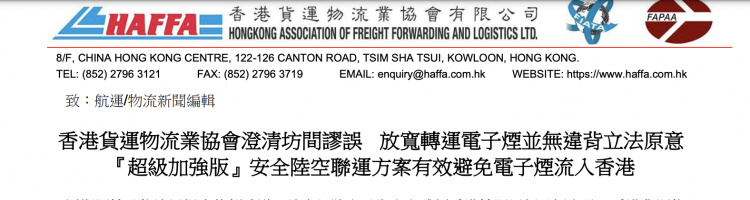
Image source: Official website of the Hong Kong Freight & Logistics Association.
References:
The Hong Kong Association of Freight Forwarding and Logistics clarifies that the relaxed regulations on the transshipment of electronic cigarettes do not violate the original legislative intent. The implementation of an enhanced cross-border transportation plan effectively prevents the influx of e-cigarettes into Hong Kong.
Disclaimer
This article is provided solely for professional research, industry discussion, and informational purposes. Any references to brands, companies, products, technologies, or policies are made for factual reporting and analytical purposes only, and do not constitute endorsement, recommendation, promotion, or advertising by 2Firsts.
Nicotine-containing products, including but not limited to cigarettes, e-cigarettes, heated tobacco products, and nicotine pouches, carry significant health risks. Readers are responsible for complying with all applicable laws and regulations in their respective jurisdictions, including age restrictions and access limitations.
The information contained in this article should not be regarded as investment, legal, medical, regulatory, or commercial advice. While 2Firsts strives to ensure the accuracy and reliability of its content, it does not assume liability for any direct or indirect loss arising from errors, omissions, inaccuracies, or reliance on the information contained herein.
This article is not intended for individuals below the legal age for accessing tobacco or nicotine-related information in their jurisdiction.
Copyright Notice
This article is either original content produced by 2Firsts or content reproduced, translated, summarized, or adapted from third-party sources with attribution where applicable. The intellectual property rights of the original content remain with 2Firsts or the respective original rights holders.
No individual or organization may copy, reproduce, distribute, republish, modify, translate, or otherwise use this content without prior authorization. Any unauthorized use may result in legal action.
For copyright-related inquiries, corrections, or removal requests, please contact: info@2firsts.com.
AI-Assisted Translation and Editing Notice
Portions of this article may have been translated, edited, or reviewed with the assistance of artificial intelligence tools to improve efficiency and readability. Due to the limitations of AI-assisted translation and editing, discrepancies, omissions, or inaccuracies may exist when compared with the original source.
Where applicable, readers are advised to refer to the original source for the most complete and accurate information. If you identify any errors or believe that any content infringes upon your rights, please contact us at info@2firsts.com, and we will review and address the matter promptly.