Indian Customs Seize $320,000 Worth of Foreign E-cigarettes

Dec.16.2024
Indian Customs Seize $320,000 Worth of Foreign E-cigarettes
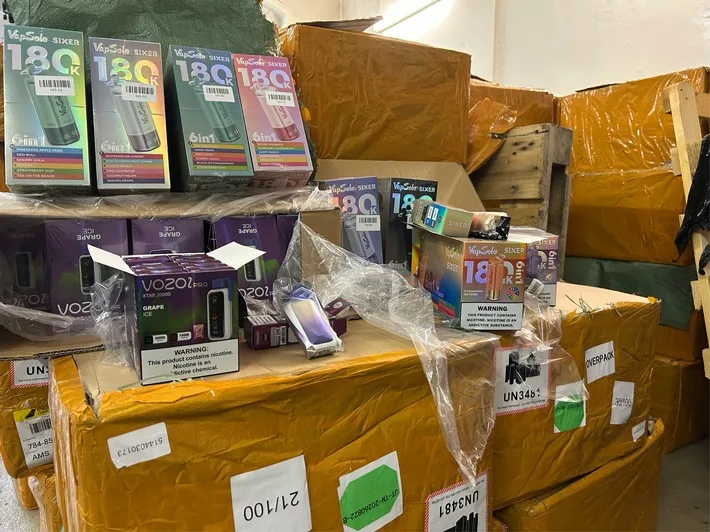
Indian customs and ICP officials seized a major shipment of foreign-made e-cigarettes worth $320,000 in a coordinated operation.

According to The Times of India on December 15th, the Indian customs (Preventive) team, along with Integrated Check Post (ICP) officials, seized a batch of foreign-produced e-cigarettes in a major operation. The seized e-cigarettes are estimated to be worth 27.5 million Rupees (around 320,000 US dollars).


Patna Customs (Preventive) Commissioner Yashovardhan Pathak stated that this is one of the largest batches of e-cigarettes seized in a coordinated operation by the customs department nationwide.


After receiving reliable intelligence, the customs team intercepted a train and seized 6,598 e-cigarettes originating from China, estimated to be worth 27.5 million rupees (or $320,000).


We welcome news tips, article submissions, interview requests, or comments on this piece.

Please contact us at info@2firsts.com, or reach out to Alan Zhao, CEO of 2Firsts, on LinkedIn


Notice

1.  This article is intended solely for professional research purposes related to industry, technology, and policy. Any references to brands or products are made purely for objective description and do not constitute any form of endorsement, recommendation, or promotion by 2Firsts.

2.  The use of nicotine-containing products — including, but not limited to, cigarettes, e-cigarettes, nicotine pouchand heated tobacco products — carries significant health risks. Users are responsible for complying with all applicable laws and regulations in their respective jurisdictions.

3.  This article is not intended to serve as the basis for any investment decisions or financial advice. 2Firsts assumes no direct or indirect liability for any inaccuracies or errors in the content.

4.  Access to this article is strictly prohibited for individuals below the legal age in their jurisdiction.


Copyright


This article is either an original work created by 2Firsts or a reproduction from third-party sources with proper attribution. All copyrights and usage rights belong to 2Firsts or the original content provider. Unauthorized reproduction, distribution, or any other form of unauthorized use by any individual or organization is strictly prohibited. Violators will be held legally accountable.

For copyright-related inquiries, please contact: info@2firsts.com


AI Assistance Disclaimer


This article may have been enhanced using AI tools to improve translation and editorial efficiency. However, due to technical limitations, inaccuracies may occur. Readers are encouraged to refer to the cited sources for the most accurate information.

We welcome any corrections or feedback. Please contact us at: info@2firsts.com

Can hookah go institutional? A hookah company seeking to go public makes its case with capital, technology and regulation
2Firsts explored whether hookah can evolve into a more mature and governable category by interviewing Dubai-based hookah company AIR. AIR argues that strong margins, OOKA’s closed-system model and the prospect of differentiated regulation could support that shift. The larger question is whether this is simply AIR’s capital-markets narrative, or an early sign that competition, regulation and category boundaries in hookah are beginning to change.
Apr.02
Exclusive|Logistics Operators Warn of Possible New U.S. Border Crackdown on Illicit Vapes
Recent inspections and cargo disruption have led some logistics operators in the China-U.S. vape trade to see early signs of another U.S. border crackdown on illicit e-cigarettes. With late April to early May viewed as a key risk window, the market is watching closely. The bigger question is not only whether enforcement will tighten, but whether it can be sustained.
Special Report
Apr.09
Austria to Tighten Sales Rules for Nicotine Pouches and E-Liquids From April 1
Austria will introduce new sales rules for nicotine products from April 1, 2026. Under a reform of the tobacco law passed in December 2025, nicotine pouches will in future be sold only through tobacco shops, while e-liquids will be sold only through tobacco shops and licensed specialist stores. Other points of sale will no longer be permitted to sell these products.
Mar.30 by 2FIRSTS.ai
Argentina Issues Resolution 549/2026 to Regulate Vapes, Heated Tobacco and Nicotine Pouches
Argentina’s government has created a comprehensive regulatory framework for nicotine products, including vapes, heated tobacco and nicotine pouches, through Resolution 549/2026 published in the Official Gazette. The new regulation ends the previous prohibitive framework and establishes rules to organize the market by requiring traceability, quality standards and mandatory registration for all manufacturers and retailers operating in the country.
May.06 by 2FIRSTS.ai
 Zyn Emerges as MAGA Cultural Symbol Amid FDA Policy Shift
Zyn Emerges as MAGA Cultural Symbol Amid FDA Policy Shift
According to The Wall Street Journal, nicotine pouch brand Zyn has rapidly gained popularity across the Trump administration and conservative political circles, including among U.S. Health Secretary Robert F. Kennedy Jr.
Business
May.20
The new regulations on nicotine in Argentina are creating caution, expectations, and doubts about the market, according to a local reference in harm reduction for smoking.
The new Argentine framework for tobacco and nicotine marks a shift from prohibition towards registration, traceability, and health surveillance. Juan Facundo Teme told 2Firsts that adult consumers and some of the commercial sector are cautiously optimistic, although concerns remain about flavors, registration costs, and market access.
May.11