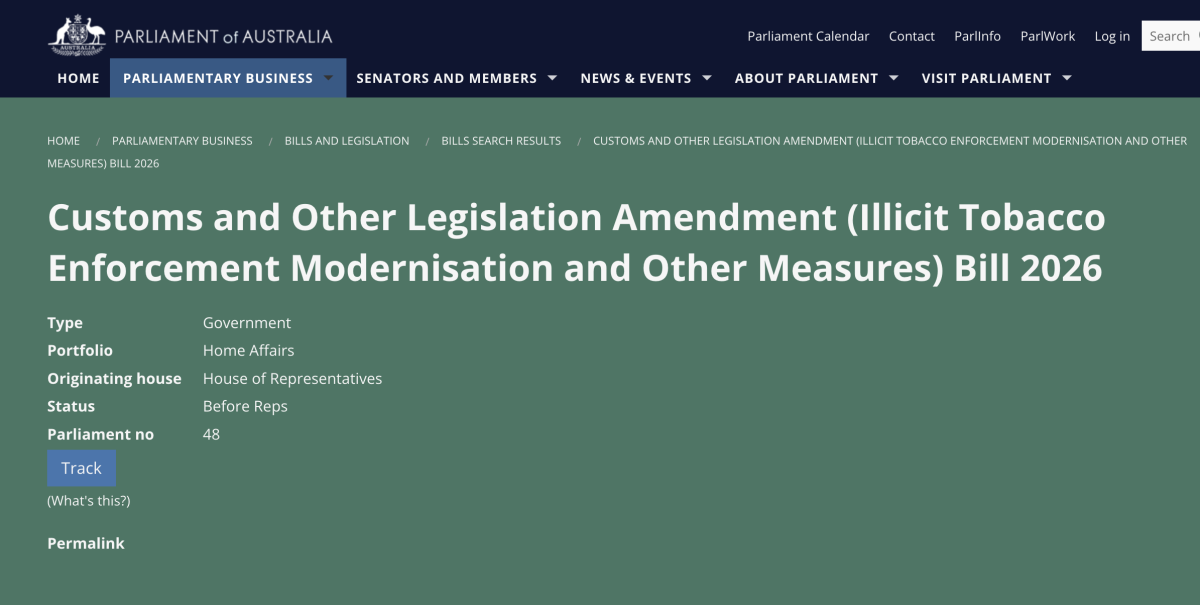
The Australian government has mandated that purchasing e-cigarettes requires a prescription from a general practitioner. This policy aims to regulate e-cigarettes through medical channels to ensure their safe and proper use. However, for e-cigarette companies, promoting their products through medical channels is not easy. This has resulted in a very limited variety of e-cigarette products in the compliant market in Australia, sparking widespread controversy and discussion.
Recently, 2FIRSTS interviewed Australian smoking cessation expert Dr. Colin Mendelsohn, hoping to explore the current status, challenges, and future development direction of Australia's e-cigarette policies from his perspective.

Dr. Colin stated that Australia's prescription purchasing model for e-cigarettes has hindered legal purchases, leading consumers to turn to the black market and triggering a series of crimes. He pointed out that current regulations are tantamount to a ban, and history has shown that enforcement and border control are ineffective in reducing the supply of illegal e-cigarettes.
He believes that e-cigarettes, nicotine pouches, snus, and heated tobacco should be classified as adult consumer products and sold through age-verified retail outlets, without requiring a prescription, and should be as easily accessible as traditional cigarettes.
Dr. Colin suggested that Australia should classify nicotine e-liquid as a consumer product, regulated by the Australian Competition and Consumer Commission (ACCC), rather than the Therapeutic Goods Administration (TGA).
The following is the content of the exclusive interview:
2FIRSTS: What is your opinion on the current development of the e-cigarette market in Australia? How has the recent strict regulation of e-cigarettes in Australia directly impacted the market?
Dr. Colin:
The prescription-only model for e-cigarettes in Australia has largely failed. Vapers are required to obtain a nicotine prescription from a doctor and purchase e-liquids and vaping hardware from pharmacies. However, 90% of vapers have rejected this legal pathway, with few doctors willing to write prescriptions. Smokers do not view themselves as needing medical attention, and pharmacies offer a limited range of products at higher costs, further deterring legal purchases.
As a result, most vapers turn to the black market, controlled by criminal networks. This market freely sells to young people, resulting in high rates of youth vaping. A turf war between rival criminal groups has led to firebombings of tobacco and vape shops, homicides, extortion, and intimidation. Vapes have now become the second-largest illicit drug market in Australia, after cannabis.
The regulations have inadvertently increased teen vaping, as the black market has made it easier for young people to access vapes. Vape shops are not allowed to sell e-liquid or vaping devices, causing many to close. The manufacturing industry is also winding down.
The current regulations amount to prohibition and history has shown that further law enforcement interventions and border control have little chance of significantly reducing the supply of illegal vapes.
2FIRSTS: In your opinion, what are the issues with Australia's current e-cigarette regulations?
Dr. Colin:
The classification of vaping products as medicines is a fundamental problem, creating barriers for adult smokers wishing to quit. Most vapers purchase from the black market, which sells unregulated products, increasing user risk and facilitating youth access. The black market makes it easier, not harder, for youth to access vapes and has led to a rapid increase in youth vaping.
2FIRSTS: You mentioned earlier that the "prescription e-cigarette model is a failure." Do you still hold this view?
Dr. Colin:
The prescription-only model is a barrier to legal access for adults, resulting in a thriving black market controlled by criminal gangs. It has also increased youth vaping, as young people can easily access black market vapes. The model makes the safer alternative harder to access than deadly cigarettes.
2FIRSTS: In the context of harm reduction in tobacco use, how do you believe e-cigarettes play a role in assisting smokers with the process of quitting?
Dr. Colin:
Vaping is an effective quitting aid, more effective than nicotine replacement therapy and at least as effective as varenicline. It is especially useful for smokers who miss the hand-to-mouth and sensory aspects of smoking. Vaping is a valuable aid for smokers who are unable to quit with other methods. Vaping is the most popular quitting aid in Australia and has the potential to reduce population smoking rates more than any other intervention.
2FIRSTS: How do you assess the difference in health risks between e-cigarettes and traditional tobacco products?
A comprehensive systematic review by the England government in 2022 concluded that “Vaping is “at least 95% less harmful” than smoking, and that “vaping poses only a small fraction of the risks of smoking”.
Most harmful toxins in smoke are absent from vapor or present at much lower concentrations. Biomarkers of toxins and carcinogens in vapers are substantially lower, and health improvements are significant. The risk of cancer from vaping is estimated to be less than 0.5% of the risk from smoking. After 15 years of vaping in numerous countries, there have been no deaths and serious health effects are extremely rare.
2FIRSTS: How do you think the government should strike a balance between public health and regulation of the e-cigarette market?
Dr. Colin:
To balance public health and market regulation, Australia needs to make nicotine vapes accessible for adult smokers while restricting youth access. Regulations should minimise barriers for adult smokers by allowing sale as adult-only products from licensed retail outlets, supporting a wide range of products and flavors, limiting advertising to smokers, and applying low, risk-proportionate taxation.
Strategies to reduce youth access include strict age verification at the time of sale, severe fines, and loss of licenses for sales to youth. Advertising should be restricted and regulated to prevent marketing from appealing to adolescents. Public and youth education should frame vaping as a smoking cessation tool and not for young people or non-smokers. Flavor names appealing to young people should be banned, and packaging should be simple and devoid of bright colors and youth-appealing images. Honest and accurate education on vaping risks should be provided, and mandatory CCTV at points of sale should ensure compliance.
2FIRSTS: What support should the government provide to consumers of e-cigarettes, especially smokers seeking help to quit smoking?
Dr. Colin:
The government should provide accurate information about the relative risks of vaping compared to smoking, encouraging adult smokers to switch if unable to quit with other methods. Practical advice on how to switch and support for vape shops, which offer expert advice and improve quit rates, is essential.
2FIRSTS: You are calling on the government to provide safer alternatives for smokers, including e-cigarettes. Can you share some specific suggestions or plans?
Dr. Colin:
E-cigarettes, nicotine pouches, snus, and heated tobacco products should all be made available as adult consumer products sold from licensed retail outlets with strict age verification, similar to tobacco or alcohol. These products should not require a prescription and should be at least as accessible as combustible cigarettes. Different smokers respond to different treatments, so a diverse range of products is necessary.
2FIRSTS: In your opinion, how should Australia adjust its e-cigarette regulations to more effectively promote public health?
Dr. Colin:
Australia should classify nicotine e-liquid as a consumer product and regulate it by the Australian Competition and Consumer Commission, not the medicines regulator, the Therapeutic Goods Administration. Regulations should balance legal access for adult smokers with restrictions for youth. A tightly regulated consumer model with licensed retail outlets and strict age-of-sale verification is preferred. Vaping products should be at least as accessible as cigarettes, and regulations should reflect the lower risks of vaping.
2FIRSTS: What is your prediction for the future development of the e-cigarette market in Australia?
Dr. Colin:
Under current regulations, the black market will continue to dominate, providing easy access for young people to unregulated and more harmful products. Adult smoking rates will decline slowly, criminal activity will persist, and more smokers will die prematurely.
2FIRSTS: Comparison of Australia's e-cigarette regulatory policies with other countries? What international experiences are worth learning from?
Dr. Colin:
Australia's prescription-only model is out-of-step with other Western countries, which regulate vaping products as adult consumer products. Where data are available, this model has led to accelerated declines in smoking and generally lower youth vaping rates.
Australia should look to New Zealand for guidance. New Zealand and Australia have similar tobacco control policies and similar demographics. However, since New Zealand legalised and regulated vaping in 2020, the adult smoking rate declined by 43% from 2020-2023, over twice as fast as in Australia. The decline in smoking has been particularly impressive for the Indigenous Māori population and the most disadvantaged populations. Youth vaping rates had increased prior to regulation and have now started to decline. There is no significant black market in New Zealand and the government collects substantial tax revenue.
About the Interviewee
Dr. Colin Mendelsohn the Founding Chairman of the Australian Tobacco Harm Reduction Association (ATHRA). This physician-founded organization is a health promotion charity focused on raising public awareness about the risk-reducing potential of alternatives to combustible tobacco.
With over 40 years of experience as an expert in tobacco treatment and harm reduction, Dr. Colin Mendelsohn has served as an Associate Professor in the School of Public Health and Community Medicine at the University of New South Wales. Additionally, he was a key member of the Expert Advisory Group for the Royal Australian College of General Practitioners' National Smoking Cessation Guidelines. In this role, he has provided valuable insights and guidance for the development and updating of cessation guidelines, helping doctors and healthcare professionals more effectively support smokers in quitting.
We welcome news tips, article submissions, interview requests, or comments on this piece.
Please contact us at info@2firsts.com, or reach out to Alan Zhao, CEO of 2Firsts, on LinkedIn
Notice
1. This article is intended solely for professional research purposes related to industry, technology, and policy. Any references to brands or products are made purely for objective description and do not constitute any form of endorsement, recommendation, or promotion by 2Firsts.
2. The use of nicotine-containing products — including, but not limited to, cigarettes, e-cigarettes, nicotine pouchand heated tobacco products — carries significant health risks. Users are responsible for complying with all applicable laws and regulations in their respective jurisdictions.
3. This article is not intended to serve as the basis for any investment decisions or financial advice. 2Firsts assumes no direct or indirect liability for any inaccuracies or errors in the content.
4. Access to this article is strictly prohibited for individuals below the legal age in their jurisdiction.
Copyright
This article is either an original work created by 2Firsts or a reproduction from third-party sources with proper attribution. All copyrights and usage rights belong to 2Firsts or the original content provider. Unauthorized reproduction, distribution, or any other form of unauthorized use by any individual or organization is strictly prohibited. Violators will be held legally accountable.
For copyright-related inquiries, please contact: info@2firsts.com
AI Assistance Disclaimer
This article may have been enhanced using AI tools to improve translation and editorial efficiency. However, due to technical limitations, inaccuracies may occur. Readers are encouraged to refer to the cited sources for the most accurate information.
We welcome any corrections or feedback. Please contact us at: info@2firsts.com