Investigation into Global E-Cigarette Liquid Leak Incident

Dec.07.2022
Investigation into Global E-Cigarette Liquid Leak Incident
Indonesian police investigate liquid leaks from Iran, suspected to be used in producing electronic cigarette liquids, posing harm to society.

The Polda Metro Jaya police are investigating a liquid leak that originated from Iran and was distributed to various locations across Europe and Indonesia. The liquid is reported to be primarily used for electronic cigarette liquids.


On June 12th, 2022, Jaya Kombes Mukti Juharsa, the director of pharmaceuticals at Metro, stated at a press conference that "these liquids are intended for use in electronic cigarettes.


Evidence suggests that the liquid spillage incident is the first case of its kind in Indonesia. Muty stated that these liquids pose a danger to society, particularly to young people.


The narcotics division of Jakarta's Metro Jaya Police have released information about the spread of a new type of drug that includes liquid e-cigarette substances.


According to Muti, on November 27th, the ChaYa Drug Administration of Borda Metro conducted a drug investigation using a liquid form of methamphetamine as a base. Evidence suggests that this liquid is a new type of drug. This new form is being used to produce MDMA (multimetal oxide) drugs or liquids.


The fluid is being transported from Iran to various parts of Europe. According to reports, the liquid originates from a new substance found in Indonesia.


2FIRSTS will continue to keep track of this topic and update the latest information on the "2FIRSTSAPP". Scan the QR code below to download the app.


Disclaimer

This article is provided solely for professional research, industry discussion, and informational purposes. Any references to brands, companies, products, technologies, or policies are made for factual reporting and analytical purposes only, and do not constitute endorsement, recommendation, promotion, or advertising by 2Firsts.

Nicotine-containing products, including but not limited to cigarettes, e-cigarettes, heated tobacco products, and nicotine pouches, carry significant health risks. Readers are responsible for complying with all applicable laws and regulations in their respective jurisdictions, including age restrictions and access limitations.

The information contained in this article should not be regarded as investment, legal, medical, regulatory, or commercial advice. While 2Firsts strives to ensure the accuracy and reliability of its content, it does not assume liability for any direct or indirect loss arising from errors, omissions, inaccuracies, or reliance on the information contained herein.

This article is not intended for individuals below the legal age for accessing tobacco or nicotine-related information in their jurisdiction.


Copyright Notice

This article is either original content produced by 2Firsts or content reproduced, translated, summarized, or adapted from third-party sources with attribution where applicable. The intellectual property rights of the original content remain with 2Firsts or the respective original rights holders.

No individual or organization may copy, reproduce, distribute, republish, modify, translate, or otherwise use this content without prior authorization. Any unauthorized use may result in legal action.

For copyright-related inquiries, corrections, or removal requests, please contact: info@2firsts.com.


AI-Assisted Translation and Editing Notice

Portions of this article may have been translated, edited, or reviewed with the assistance of artificial intelligence tools to improve efficiency and readability. Due to the limitations of AI-assisted translation and editing, discrepancies, omissions, or inaccuracies may exist when compared with the original source.

Where applicable, readers are advised to refer to the original source for the most complete and accurate information. If you identify any errors or believe that any content infringes upon your rights, please contact us at info@2firsts.com, and we will review and address the matter promptly.

South Korea's Synthetic Nicotine Tax Take Estimated at Just 1.3% of Forecast as Imports Plunge Nearly 97%
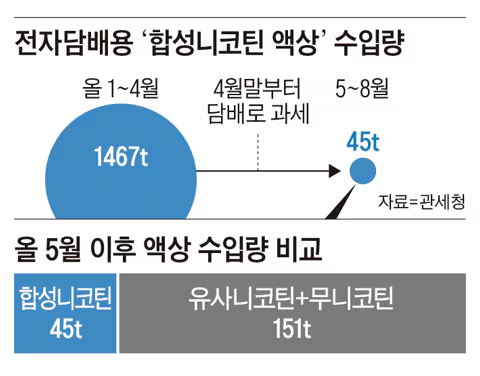
After synthetic nicotine was placed under tobacco regulation on April 24, 2026, South Korea’s tax collections from synthetic-nicotine vaping products fell far short of government projections. The Chosun Ilbo reported on November 18 that Ministry of Health and Welfare data showed national health promotion charges on synthetic-nicotine liquid e-cigarettes totaled 765 million won from April 24 through September. Using statutory rates, the newspaper estimated combined major taxes and charges at about 2.622 billion won—on a monthly basis roughly 1.3% of an earlier forecast after temporary tax reductions. Customs data showed synthetic-nicotine imports dropped from about 1,467 metric tons in January–April to 45 metric tons in May–August, a nearly 97% decline. Imports of nicotine-analog and nicotine-free liquids totaled 151 metric tons in May–August, exceeding synthetic-nicotine imports in the same period, though both categories were also below January–April volumes.
Regulations
Nov.19
Japan's Heated Tobacco Use Rises From 0.1% to 14.9% Over a Decade as Growth Extends Beyond Cigarette Switching
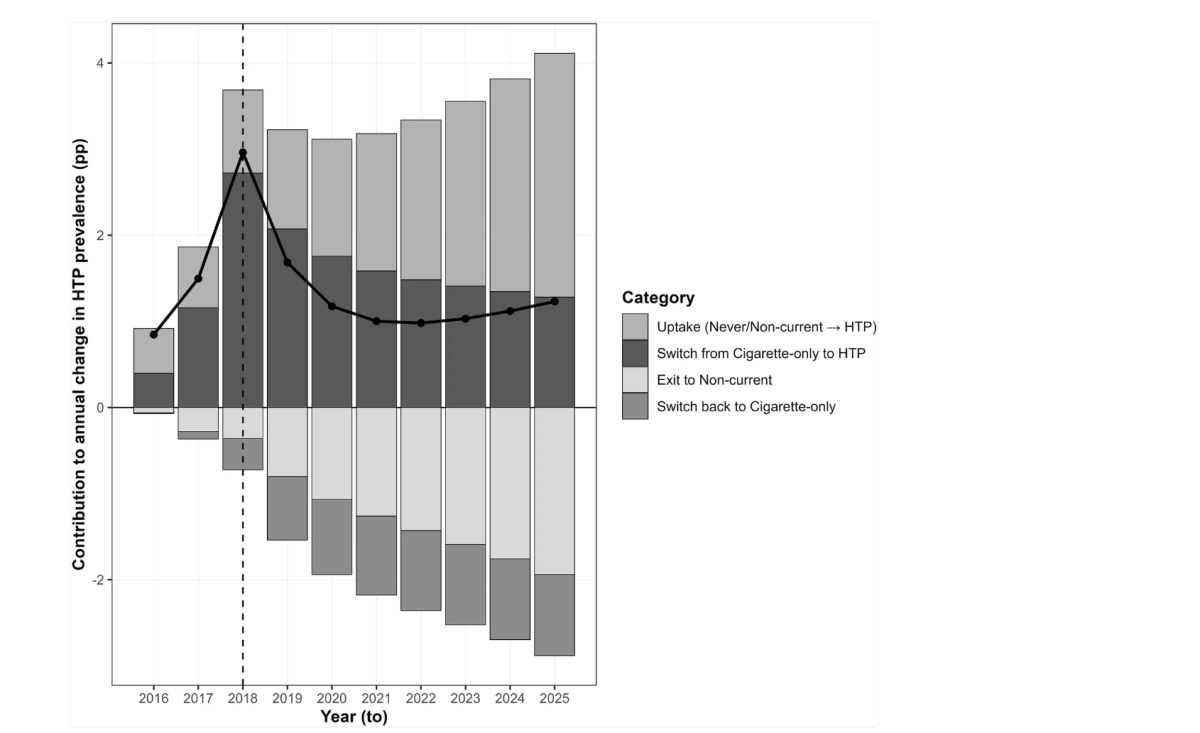
A decade-long study published in The Lancet Regional Health – Western Pacific found that heated tobacco product use in Japan increased from 0.1% in 2015 to 14.9% in 2025, although growth slowed after 2018. Switching from conventional cigarettes remained an important source of HTP uptake, while the contribution from previously non-current users increased. Approximately 56% of HTP users also smoked conventional cigarettes in 2025. Separate industry data show that Japan's heated tobacco sales reached 73.4 billion units in fiscal 2025, approaching conventional cigarette sales of 78.2 billion units.
SCIENCE
Nov.10
FDA Revises Import Alert 98-07 Rules, Bringing May Enforcement Priorities Into Unauthorized ENDS Detentions
The U.S. Food and Drug Administration has revised the rules under Import Alert 98-07 to incorporate its May 2026 enforcement-priority policy for certain electronic nicotine delivery systems marketed without premarket authorization. The alert continues to allow detention without physical examination, or DWPE, for ENDS lacking required marketing authorization, while directing field divisions to apply the May risk-based framework. When necessary, detention or refusal decisions must also undergo review by the FDA's Center for Tobacco Products. Products including PACHA and Vuse Pro have already emerged as industry examples of the May policy, although enforcement discretion does not constitute FDA marketing authorization.
News
Sep.28 by 2Firsts Perspectives
Special Report | Russia Places Four JTI Businesses Under Temporary Management, a First for Tobacco Majors
Russia has placed shares in four Japan Tobacco International businesses under temporary management, the first such move involving a major global tobacco manufacturer, according to Interfax. JTI held 35.8% of Russia's tobacco market by volume in the first nine months of 2026. While British American Tobacco and Imperial Brands have exited Russia, Philip Morris International continues operating there. As the market changes and diplomatic efforts continue, could international tobacco companies that left Russia eventually return?
Nov.06
DATA|UK Retail Research Group IGD Says Convenience Tobacco and Vape Sales Fell 10.6%, With 15.4% Market Share Versus Alcohol's 15.1%; Top Rank at Risk in 2027
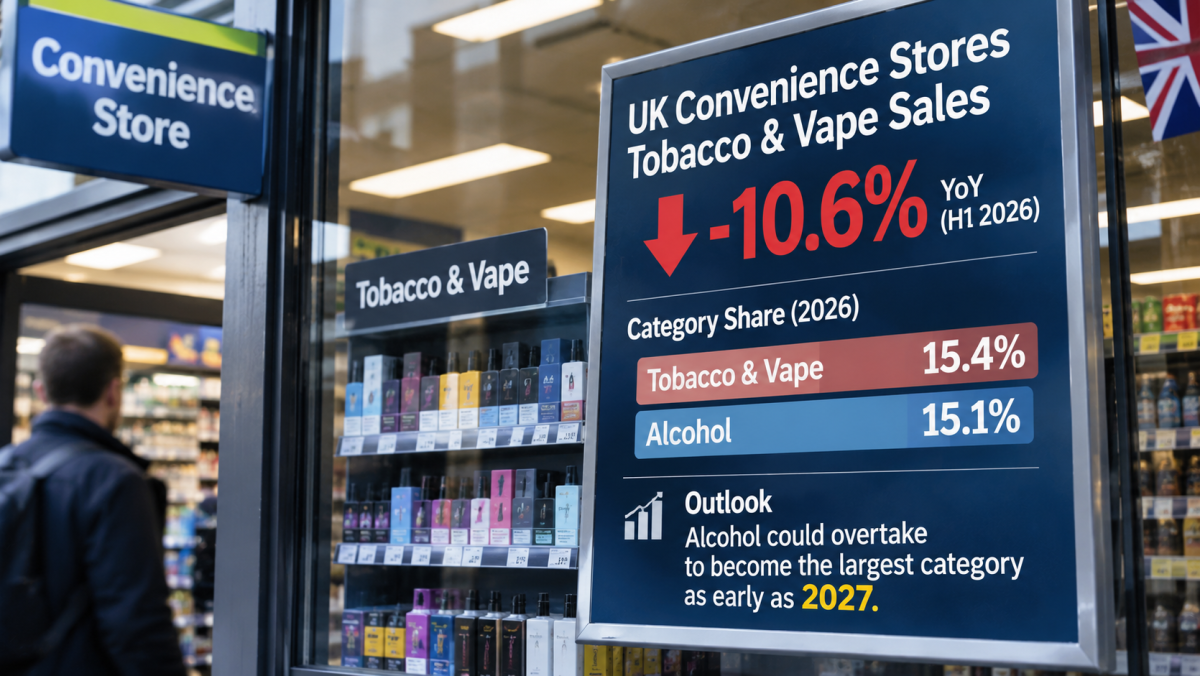
Combined tobacco and vaping sales in UK convenience stores fell 10.6% year over year in the first half of 2026, making the category a major drag on channel performance, according to retail research organization IGD. Total convenience sales declined 1.2%, while sales excluding tobacco and vaping increased 0.7%. IGD's 2026 category-share figures show tobacco and vaping accounting for 15.4% of convenience sales, compared with 15.1% for alcohol. The organization forecasts alcohol could overtake tobacco and vaping as the largest category by sales value as early as 2027 if current trends continue. IGD expects the convenience market to increase from £48.6 billion in 2026 to £54.9 billion in 2031, a 2.5% compound annual growth rate, or 3.4% excluding tobacco and vaping.
DATA
Nov.11
Russia's Vape Ban Decisions Reach 17 Regions With 39 More Considering Laws, Putting Over 3,000 St. Petersburg Retail Outlets in Focus
Russia's regional vape retail restrictions are expanding. State Duma Speaker Vyacheslav Volodin said on November 7 that 17 regions had adopted decisions to ban vape sales, while another 39 were preparing or considering similar legislation. On November 12, lawmakers in Leningrad Oblast and the Republic of Karelia adopted bans scheduled to begin on March 1, 2027. A day earlier, St. Petersburg unanimously approved a five-year ban proposal in its first reading. The city has 615 specialist vape shops and more than 2,400 other retail outlets selling vaping products alongside other goods. Under Federal Law No. 186-FZ, enacted in June 2026, Russian regions may prohibit retail sales of electronic nicotine delivery systems and related liquids between March 2027 and March 2032. The legislation also restricts licensed suppliers from delivering covered products to retail premises in regions where bans apply.
Regulations
Nov.13