Key Takeaways
- Japan’s transport ministry said major Japanese airlines reported 429 in-flight smoking incidents in 2025, the highest level since 2004.
- The figure was 6.60 times higher than the low of 65 cases recorded in 2019.
- The government said the spread of heated tobacco products was one of the key factors behind the increase.
- Under the revised Civil Aeronautics Act of 2004, smoking in aircraft lavatories is treated as an act that endangers safety, and failure to follow the captain’s orders can result in a fine of up to JPY 500,000, or about USD 3,100, as stated in the source.
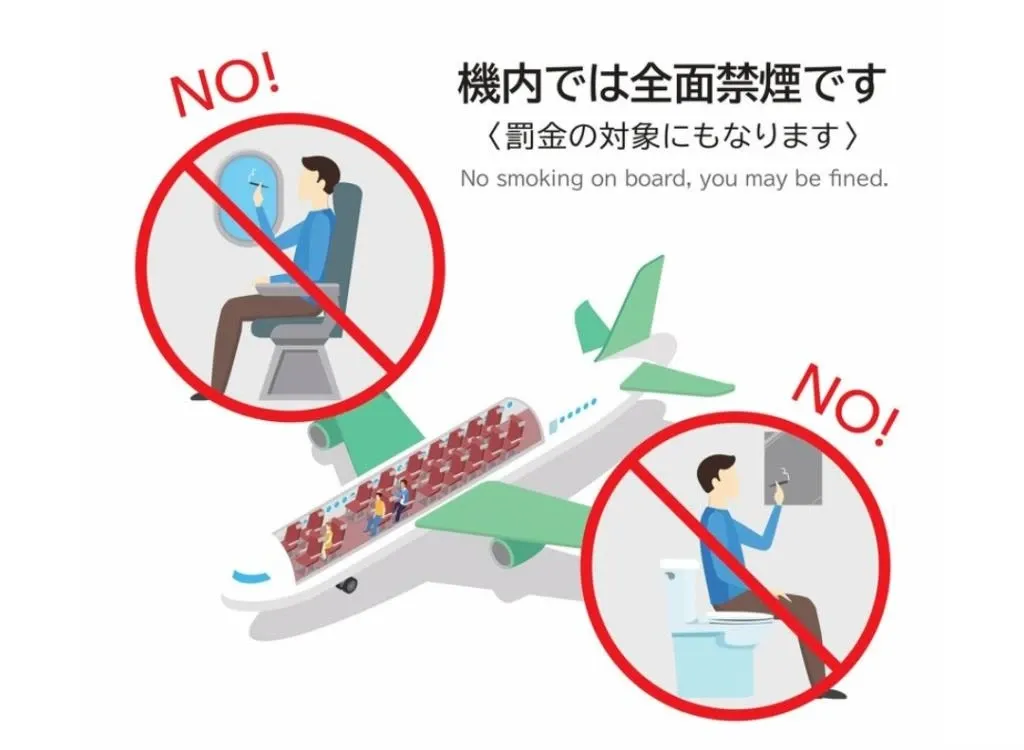
- Japan plans to work with airlines through posters and in-flight videos to warn passengers about fire risks.
2Firsts, April 14, 2026
According to MGRonline, Japan’s Ministry of Land, Infrastructure, Transport and Tourism said on Monday that major Japanese airlines reported 429 cases of passengers smoking on domestic and international flights in 2025, the highest level in 20 years.
In-flight smoking cases rose to 429 in 2025
The report said the figure was the highest since comparable data collection began in 2004 and was 6.60 times higher than the record low of 65 cases in 2019. The Japanese government said the spread of heated tobacco products was one of the key factors behind the increase.
Japan plans a broader campaign with airlines
The government said it plans to work with airlines to raise public awareness of the risk of fires on aircraft. Japan’s transport ministry and airlines have already been urging passengers not to smoke on planes through posters and in-flight videos.
Smoking on aircraft can trigger fines of up to JPY 500,000
Under the revised Civil Aeronautics Act of 2004, smoking in aircraft lavatories is classified as an act that endangers safety. Passengers who fail to comply with a captain’s order can be fined up to JPY 500,000, or about USD 3,100, as stated in the source.
The report also said that smoking in seats or aisles may also be punishable if passengers fail to follow instructions from the captain or cabin crew.
E-cigarettes and heated tobacco were added to the guidance in 2020
Japan added e-cigarettes and heated tobacco products to revised government guidance in 2020 because the aerosol they produce may activate smoke detectors.
According to ministry and related agency data, annual smoking incident reports are collected from Japanese airlines operating aircraft with more than 100 passenger seats or with a maximum takeoff weight exceeding 50,000 kilograms. Although the number of reporting airlines fluctuates as new carriers enter the market, in-flight smoking cases stood at 359 in 2004, fell to 185 in 2007, and dropped below 100 for the first time in 2018, at 76 cases.
Heated tobacco now accounts for more than 40.00% of sales in Japan
The report said use of heated tobacco products in Japan has increased over the past decade and now accounts for more than 40.00% of total tobacco sales. As a result, reports of smoking on aircraft have been rising since 2020.
An official from the ministry’s Aviation Safety Office said the statistics do not distinguish between conventional cigarettes, e-cigarettes, and heated tobacco products, but said that “there may be less guilt associated with the latter.”
Hidehiko Yoshida, secretary-general of the Scheduled Airlines Association of Japan, said the group would work to understand the situation and cooperate with airlines and the government on necessary measures.
Image source: MGRonline
We welcome news tips, article submissions, interview requests, or comments on this piece.
Please contact us at info@2firsts.com, or reach out to Alan Zhao, CEO of 2Firsts, on LinkedIn
Notice
1. This article is intended solely for professional research purposes related to industry, technology, and policy. Any references to brands or products are made purely for objective description and do not constitute any form of endorsement, recommendation, or promotion by 2Firsts.
2. The use of nicotine-containing products — including, but not limited to, cigarettes, e-cigarettes, nicotine pouchand heated tobacco products — carries significant health risks. Users are responsible for complying with all applicable laws and regulations in their respective jurisdictions.
3. This article is not intended to serve as the basis for any investment decisions or financial advice. 2Firsts assumes no direct or indirect liability for any inaccuracies or errors in the content.
4. Access to this article is strictly prohibited for individuals below the legal age in their jurisdiction.
Copyright
This article is either an original work created by 2Firsts or a reproduction from third-party sources with proper attribution. All copyrights and usage rights belong to 2Firsts or the original content provider. Unauthorized reproduction, distribution, or any other form of unauthorized use by any individual or organization is strictly prohibited. Violators will be held legally accountable.
For copyright-related inquiries, please contact: info@2firsts.com
AI Assistance Disclaimer
This article may have been enhanced using AI tools to improve translation and editorial efficiency. However, due to technical limitations, inaccuracies may occur. Readers are encouraged to refer to the cited sources for the most accurate information.
We welcome any corrections or feedback. Please contact us at: info@2firsts.com