FDA Wins Default Entry in Case Against E-Cigarette Distributor, to Seek Permanent Injunction

Apr.09
FDA Wins Default Entry in Case Against E-Cigarette Distributor, to Seek Permanent Injunction
The U.S. Food and Drug Administration (FDA) has made procedural progress in its lawsuit against North Carolina-based e-cigarette distributor Dream Distro LLC and its owner. A federal district judge granted the government’s request for entry of default after the defendants failed to respond to the complaint within 21 days of service. The government will next seek a default judgment, including a permanent injunction.

Key Points at a Glance

  • U.S. District Judge James C. Dever III approved the government’s request for entry of default against Dream Distro LLC and its owner, Faisal A. Alhadrami, on April 7.
  • Court records show that the defendants failed to respond to the complaint within 21 days after being served.
  • The U.S. government will next file a motion for default judgment, seeking a permanent injunction and potentially other relief.
  • The FDA’s lawsuit, filed in September 2025, alleges that Dream Distro and Alhadrami were warned to stop distributing e-cigarettes that lacked premarket authorization.
  • Brands mentioned in the complaint include Lost Vape Orion Bar, Geek Bar, Flair Plus, and CLVRBAR, all reportedly manufactured in China.

2Firsts, April 9, 2026

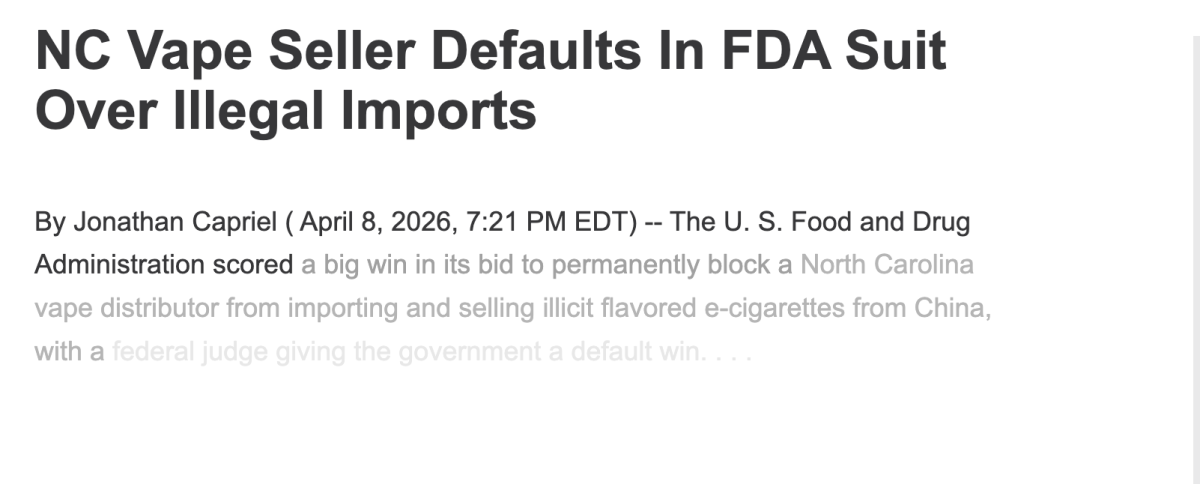
According to Law360, the U.S. Food and Drug Administration (FDA) has secured a significant procedural victory in its effort to permanently block a North Carolina-based e-cigarette distributor from importing and selling illegal flavored e-cigarettes from China, after a federal judge granted the government’s request for entry of default.

Court Grants Default Entry Against Dream Distro and Its Owner

U.S. District Judge James C. Dever III approved the government’s request for entry of default against defendants Dream Distro LLC and its owner, Faisal A. Alhadrami, on April 2. Court records indicate that both defendants failed to respond within 21 days after being served with the complaint.

According to reports, the U.S. government will next move for a default judgment, seeking a permanent injunction and possibly additional remedies.

Government Seeks Permanent Ban on Sale of Unauthorized E-Cigarettes

In its complaint filed in September 2025, the government alleges that the FDA had previously warned Dream Distro and Alhadrami to cease distributing e-cigarettes that had not received premarket authorization, as such products are illegal to sell in the United States.

The government is asking the court to permanently prohibit the defendants and all their employees from continuing to sell these unauthorized e-cigarette products.

Case Involves Multiple China-Manufactured Flavored E-Cigarette Brands

The report notes that the FDA has intensified enforcement actions in recent years against companies selling unauthorized e-cigarettes, with a particular focus on products that appeal to youth. Regulators have especially targeted flavored e-cigarettes manufactured overseas.

The lawsuit states that the defendants sold brands including Lost Vape Orion Bar, Geek Bar, Flair Plus, and CLVRBAR, all of which are manufactured in China.

Image source: Law360

We welcome news tips, article submissions, interview requests, or comments on this piece.

Please contact us at info@2firsts.com, or reach out to Alan Zhao, CEO of 2Firsts, on LinkedIn


Notice

1.  This article is intended solely for professional research purposes related to industry, technology, and policy. Any references to brands or products are made purely for objective description and do not constitute any form of endorsement, recommendation, or promotion by 2Firsts.

2.  The use of nicotine-containing products — including, but not limited to, cigarettes, e-cigarettes, nicotine pouchand heated tobacco products — carries significant health risks. Users are responsible for complying with all applicable laws and regulations in their respective jurisdictions.

3.  This article is not intended to serve as the basis for any investment decisions or financial advice. 2Firsts assumes no direct or indirect liability for any inaccuracies or errors in the content.

4.  Access to this article is strictly prohibited for individuals below the legal age in their jurisdiction.


Copyright


This article is either an original work created by 2Firsts or a reproduction from third-party sources with proper attribution. All copyrights and usage rights belong to 2Firsts or the original content provider. Unauthorized reproduction, distribution, or any other form of unauthorized use by any individual or organization is strictly prohibited. Violators will be held legally accountable.

For copyright-related inquiries, please contact: info@2firsts.com


AI Assistance Disclaimer


This article may have been enhanced using AI tools to improve translation and editorial efficiency. However, due to technical limitations, inaccuracies may occur. Readers are encouraged to refer to the cited sources for the most accurate information.

We welcome any corrections or feedback. Please contact us at: info@2firsts.com

Product | PMI Launches TEREA Black Mint Pearl in Japan, Adding First Capsule Variant to Black Range With Nationwide Rollout From October 19
Philip Morris Japan (PMJ) launched TEREA Black Mint Pearl on October 15, 2026, introducing the first capsule-equipped heated tobacco stick in the TEREA Black range for IQOS ILUMA devices. The product combines a strong menthol profile with a crushable mint capsule and is priced at ¥640 per 20-stick pack, including tax. Sales began at four IQOS stores and selected retail partners on October 15, with distribution expanding to convenience stores and other tobacco retailers nationwide from October 19. The launch brings Japan's TEREA portfolio to 28 variants, including 21 menthol-related products, or 75% of the range.
product
Oct.16 by 2Firsts Perspectives
Reynolds Seeks to Join Altria Lawsuit Challenging FDA PMTA Rule and Calculation of 180-Day Deadline
Three R.J. Reynolds companies are seeking to intervene in a lawsuit filed by Altria subsidiaries Helix Innovations and NJOY challenging the FDA's 2021 PMTA final rule. The companies dispute how the agency uses Acceptance and Filing reviews and completeness determinations to establish when the Tobacco Control Act's 180-day decision period begins. Reynolds has also linked prolonged PMTA reviews to competition from unauthorized vaping products. The FDA, meanwhile, has been accelerating reviews and reducing its backlog.
Sep.14
Juul Sublicense Reshapes Vuse Alto Patent Bill as Court Ends R.J. Reynolds’ 5.25% Royalty Obligation to Altria
According to Law360 on August 31, 2026, a federal judge in North Carolina ruled that a patent sublicense between R.J. Reynolds Vapor Co. and Juul Labs Inc. relieves Reynolds of its obligation to continue paying royalties to Altria Client Services LLC over Vuse Alto. A jury had previously found that Vuse Alto infringed three Altria patents and awarded approximately $95.2 million in past damages, after which Reynolds was ordered to pay an ongoing royalty equal to 5.25% of positive net sales. The new ruling finds that a valid sublicense can eliminate future infringement, potentially ending what Altria described as hundreds of millions of dollars in future royalties.
Sep.01
Cochrane 2026 Update Adds Nine Trials, Keeps High-Certainty Finding That Nicotine E-Cigarettes Improve Quit Rates Over NRT
Cochrane’s 2026 update of its living review on electronic cigarettes for smoking cessation included 80 randomized controlled trials involving 29,861 adult smokers, with nine trials added in this update. The review retained its high-certainty conclusion that nicotine e-cigarettes increase smoking cessation rates compared with nicotine replacement therapy. In absolute terms, about 10 in 100 people using nicotine e-cigarettes may quit smoking for at least six months, compared with about 6 in 100 using NRT. The review found no clear difference in serious adverse event rates between the two groups, while longer-term safety and the relative effectiveness of newer device types remain less certain.
Sep.07
Elf Bar Vape Explosion and Amputation Claim Spurs Coverage Suit, U.S. Insurer MUSIC Seeks Ruling It Owes No Duty to Defend or Indemnify Distributor i5
Mesa Underwriters Specialty Insurance Company has asked a federal court in Washington to declare that it has no duty to defend or indemnify vape distributor i5 Distribution in a product liability case involving an Elf Bar BC5000. The plaintiff alleges that the disposable vape caught fire and exploded in his pocket, causing severe burns and ultimately requiring an above-the-knee amputation of his left leg. MUSIC is relying on a tobacco, nicotine or nicotine replacement products exclusion and a premises limitation endorsement. The court has not ruled on the coverage dispute.
News
Sep.10
Special Report | From New York to Washington: How FDA’s Tobacco Center Is Reworking Product Review
FDA’s Center for Tobacco Products is reshaping how it approaches tobacco product review. Based on 2Firsts’ on-site reporting in New York and Washington, this report traces CTP’s emerging direction: stronger links between PMTA and tobacco harm reduction, more category-specific review, greater emphasis on decision-relevant science, more predictable timelines and expanded use of sPMTA for product modifications. CTP also acknowledged major constraints, including just nine PMTA review teams, persistent backlogs and limits on hiring capacity.
Regulations
Oct.08