Key Points:
·Investment and contribution: JTI has been deeply rooted in Romania for over 30 years, with a total investment exceeding 300 million euros, creating 1500 job positions. In just the year 2024, they paid 13 billion euros in taxes.
·Market visit: Company executive Lucine Ovumyan recently visited Romania and was interviewed by a local TV station.
·Policy concerns: She warned that the proposed Tobacco Tax Directive by the EU Commission (which could lead to a 59% tax increase over the next three years) could stimulate illegal trade.
·Appeal: Emphasizing the need to maintain a balanced tax policy, promote constructive dialogue, and safeguard sustainable growth, innovation, and fair competition.
In a report by Antena3 on September 2, 2025, it was stated that Japan Tobacco International (JTI) has been recruiting over 200 highly skilled young people in Romania in recent months.
The company has created thousands of job opportunities in recent years and has contributed over 1 billion euros in tax revenue to the national budget.
But it is the new tax regulations, including those at the European level, that are causing concern for investors. The company executive Lucine Ovumyan was interviewed by local television station Antena 3's Sergiu Cora.
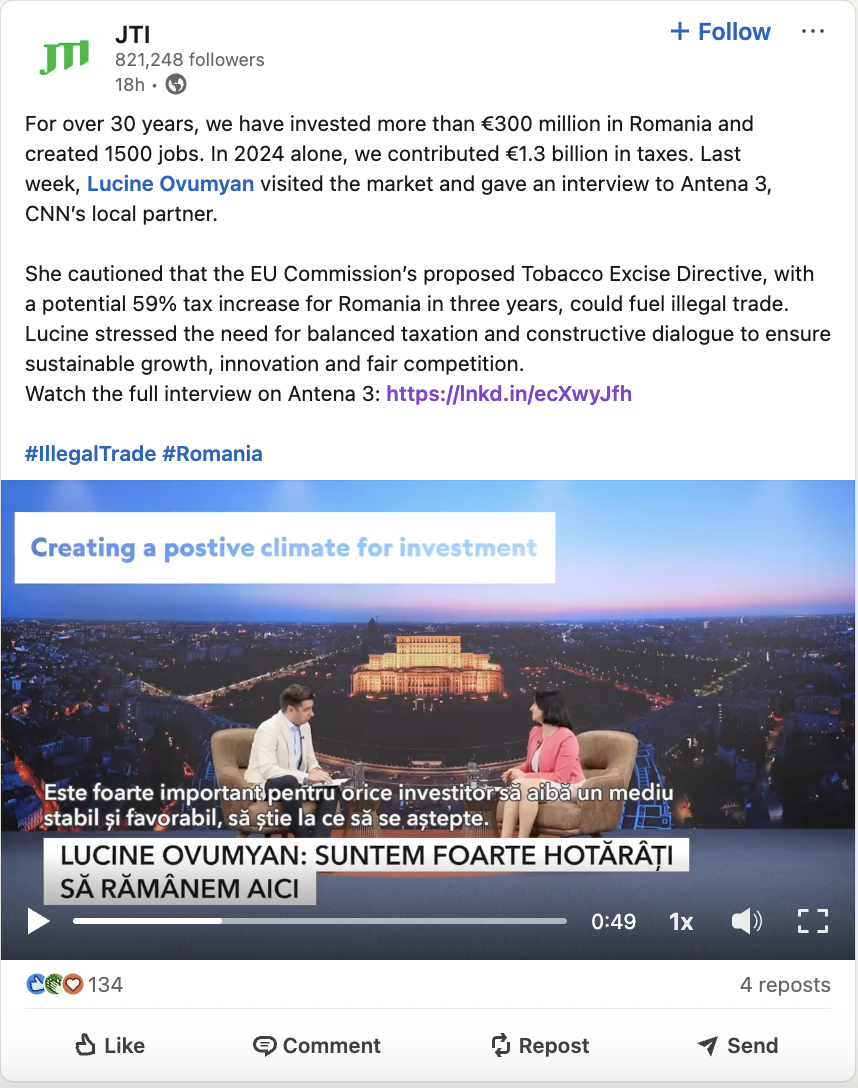
The following is the interview content.
Sergiu Cora: Thank you for being here. I would like to ask you a question: How much does your company contribute to the Romanian economy in terms of tax revenue, employment, and supply chain?
Lucine Ovumyan: Our company has been operating in Romania for over 30 years. We have both production facilities and commercial entities here. Since then, we have invested over 3 billion euros in the local economy, and we will continue to maintain these investments. In addition, we have invested approximately 33 million to 34 million euros in community projects in areas such as culture, education, emergency relief, and social inclusion. We have over 1,500 employees, and this number is constantly growing. We recently hired 200 highly skilled IT experts in Romania who will support our global operations. We are determined to stay in Romania, achieve success, and continue to invest in the local market. In terms of our contribution to the national budget, it is mainly through consumption taxes. For example, in 2024, we contributed 1.3 billion euros to the national budget. I believe this is a significant amount, and the more successful our business is here, the more our contribution and investment in the local economy will be.
Sergiu Cora: What role can your company play in Romania's economic transformation and innovation agenda? We are all aware of Romania's economic situation.
Lucine Ovumyan: We consider ourselves to be a modern innovative company, investing billions of dollars in the development of new alternative products with the potential to reduce risks and serve as substitutes for traditional products. Romania undoubtedly has enormous potential in this aspect. It is renowned not only for its excellent talent but also for its balanced approach to innovation, which is crucial. In my opinion, the future looks very promising. For example, we have recently hired around 200 IT experts and technicians and established a hub here to support our global operations. What is important? It is crucial to maintain a positive, friendly, and stable investment environment. We particularly focus on tax policies. If the government can implement the correct and balanced strategies, then companies will undoubtedly have significant opportunities to continue their performance and growth here.
Sergiu Cora: What are the key factors influencing your company's long-term investment decisions in Romania? I would like you to provide some data on tobacco smuggling. For any investor, having a stable and favorable environment, as well as understanding future development directions, is crucial. For us, as a high-tax industry and one of the highest taxed industries, fiscal stability is paramount. When it comes to authorities, how does your company collaborate with the Romanian government to support economic development and align with national priorities?
Lucine Ovumyan: Overall, our cooperation has been very positive. Our joint efforts in reducing smuggling activities have been successful, as evidenced by the decrease in their numbers. I hope that we can continue to have productive partnerships with the new government. We have common interests in many aspects. For example, in order to ensure that law enforcement agencies are able to perform their duties to the best of their abilities, we provide them with information support, train customs officials, and offer daily reports and assistance to help them carry out their work more effectively. We share common interests and have collaborated effectively in this regard.
Sergiu Cora: Let's talk about European regulations. What is your company's opinion on the recent proposal by the European Commission to amend the Tobacco Excise Tax Directive?
Lucine Ovumyan: This proposal was announced several months ago. We carefully analyzed it, and our overall conclusion is that the proposed tax rates are too high. What does this mean for Romania? If Romania were to implement the current draft directive, tobacco consumption tax would increase by 59% within three years. That is a huge number. As we have discussed before, this means that smuggling will also increase, as not paying taxes and keeping all profits in the pockets of criminals becomes more attractive. Why are the proposed standards so high? Because in some Western European countries, this number is already much higher. But no one has considered that, for example, in France, smuggling holds a 48.5% market share. In the Netherlands, this number is 44%. Does Romania want to go down this path? We have already had a negative experience of 36%. I firmly believe that allowing crime rates to rise to such levels is not in the national interest. Therefore, a balanced and fair tax system is crucial. I want to give you some incredible figures. Governments around the world lose about 500 billion euros annually due to tobacco smuggling. If we get closer to the EU, the estimate is about 150 billion euros annually. I am referring to the KPMG report for 2024. The tax revenue losses are enormous. If we get closer to Romania, we are talking about losing 5 billion euros in tax revenue annually - which could have been paid if there was no smuggling. I believe, clearly, that the government and the business sector need to take more collective action to address this crucial issue.
The cover photo is of Lucine Ovumyan, source: antena3.
We welcome news tips, article submissions, interview requests, or comments on this piece.
Please contact us at info@2firsts.com, or reach out to Alan Zhao, CEO of 2Firsts, on LinkedIn
Notice
1. This article is intended solely for professional research purposes related to industry, technology, and policy. Any references to brands or products are made purely for objective description and do not constitute any form of endorsement, recommendation, or promotion by 2Firsts.
2. The use of nicotine-containing products — including, but not limited to, cigarettes, e-cigarettes, nicotine pouchand heated tobacco products — carries significant health risks. Users are responsible for complying with all applicable laws and regulations in their respective jurisdictions.
3. This article is not intended to serve as the basis for any investment decisions or financial advice. 2Firsts assumes no direct or indirect liability for any inaccuracies or errors in the content.
4. Access to this article is strictly prohibited for individuals below the legal age in their jurisdiction.
Copyright
This article is either an original work created by 2Firsts or a reproduction from third-party sources with proper attribution. All copyrights and usage rights belong to 2Firsts or the original content provider. Unauthorized reproduction, distribution, or any other form of unauthorized use by any individual or organization is strictly prohibited. Violators will be held legally accountable.
For copyright-related inquiries, please contact: info@2firsts.com
AI Assistance Disclaimer
This article may have been enhanced using AI tools to improve translation and editorial efficiency. However, due to technical limitations, inaccuracies may occur. Readers are encouraged to refer to the cited sources for the most accurate information.
We welcome any corrections or feedback. Please contact us at: info@2firsts.com