Virginia Seeks to Dismiss E-Cigarette Ban Challenge, Citing Lack of Legal Standing

Dec.10.2025
Virginia Seeks to Dismiss E-Cigarette Ban Challenge, Citing Lack of Legal Standing
The Virginia Attorney General and tax commissioner have urged a federal court to dismiss a lawsuit challenging the state’s ban on unapproved e-cigarettes, arguing that the companies behind the suit lack legal standing since their products are federally illegal. The state contends the plaintiffs, Novo Distro Inc. and Tobacco Hut and Vape Fairfax Inc., have no lawful right to sell unapproved vapes and cannot show irreparable harm.

Key points


  • Parties: Plaintiffs – Novo Distro Inc. and Tobacco Hut and Vape Fairfax Inc.; Defendants – Virginia Attorney General and Tax Commissioner
  • Issue: Challenge to Virginia’s ban on unapproved and flavored e-cigarettes
  • State argument: Plaintiffs lack standing; unapproved products illegal under federal law; state retains authority to regulate
  • Plaintiffs’ claim: Ban conflicts with federal law and benefits Big Tobacco
  • Legal status: State invokes sovereign immunity and seeks dismissal


2Firsts, December 10, 2025 – According to Law360, Virginia’s Attorney General Jason S. Miyares and the state’s tax commissioner have asked a federal court to reject a bid to block enforcement of the state’s ban on unapproved e-cigarettes, arguing that the companies leading the lawsuit lack standing because their products are illegal under federal law.


In a brief filed Thursday, the state argued that Novo Distro Inc. and Tobacco Hut and Vape Fairfax Inc. have no legally recognized right to sell unapproved products, and thus cannot show they have suffered an injury or irreparable harm sufficient for an injunction.


The companies sued in October, claiming Virginia’s flavored vape ban is preempted by federal law and the result of Big Tobacco lobbying aimed at squeezing out smaller retailers.


Virginia moved to dismiss the case in November, asserting that neither the Federal Food, Drug, and Cosmetic Act (FDCA) nor the Tobacco Control Act preempts state authority to regulate tobacco sales. The state argued it could legally prohibit all e-cigarette sales if it chose.


The defendants further contended that the FDA’s temporary non-enforcement policy does not imply federal opposition to state action but reflects limited agency resources.


They also invoked sovereign immunity, arguing that Virginia has not consented to be sued in federal court and that no ongoing violation of federal law is alleged.


Responding to claims that the ban unfairly benefits large tobacco companies, the state said the statute applies equally to all firms, requiring FDA approval for any product sold.


“Plaintiffs would prefer a laxer standard allowing them to sell more profitable flavored products without providing scientific evidence,” the state argued. “It is not arbitrary for the Commonwealth to conclude that banning unapproved e-cigarettes benefits public health.”


Plaintiffs’ attorney Stewart R. Pollock of Moran Reeves & Conn PC stated: “This law unfairly favors Big Tobacco and restricts small businesses from competing by limiting vape sales to a narrow list of pre-approved products.”


Image source: Law360


We welcome news tips, article submissions, interview requests, or comments on this piece.

Please contact us at info@2firsts.com, or reach out to Alan Zhao, CEO of 2Firsts, on LinkedIn


Notice

1.  This article is intended solely for professional research purposes related to industry, technology, and policy. Any references to brands or products are made purely for objective description and do not constitute any form of endorsement, recommendation, or promotion by 2Firsts.

2.  The use of nicotine-containing products — including, but not limited to, cigarettes, e-cigarettes, nicotine pouchand heated tobacco products — carries significant health risks. Users are responsible for complying with all applicable laws and regulations in their respective jurisdictions.

3.  This article is not intended to serve as the basis for any investment decisions or financial advice. 2Firsts assumes no direct or indirect liability for any inaccuracies or errors in the content.

4.  Access to this article is strictly prohibited for individuals below the legal age in their jurisdiction.


Copyright


This article is either an original work created by 2Firsts or a reproduction from third-party sources with proper attribution. All copyrights and usage rights belong to 2Firsts or the original content provider. Unauthorized reproduction, distribution, or any other form of unauthorized use by any individual or organization is strictly prohibited. Violators will be held legally accountable.

For copyright-related inquiries, please contact: info@2firsts.com


AI Assistance Disclaimer


This article may have been enhanced using AI tools to improve translation and editorial efficiency. However, due to technical limitations, inaccuracies may occur. Readers are encouraged to refer to the cited sources for the most accurate information.

We welcome any corrections or feedback. Please contact us at: info@2firsts.com

Special Report|AIR H1 Revenue Rises 3.7% as Shisha Volumes Fall 9%, Testing Its Shift Beyond Traditional Hookah
AIR’s first half-year results as a listed company offer a new test of how far a traditional hookah business can transform. H1 2026 revenue rose 3.7%, even as Flavored Shisha Molasses shipments fell 9%, with pricing and mix supporting growth. Traditional shisha still generates almost all revenue, while OOKA, Crown Switch, Greentank and U.S. regulatory spending point to accelerating diversification. The next test is whether those investments can become a second business of meaningful scale and profitability.
Capital Markets
Aug.21
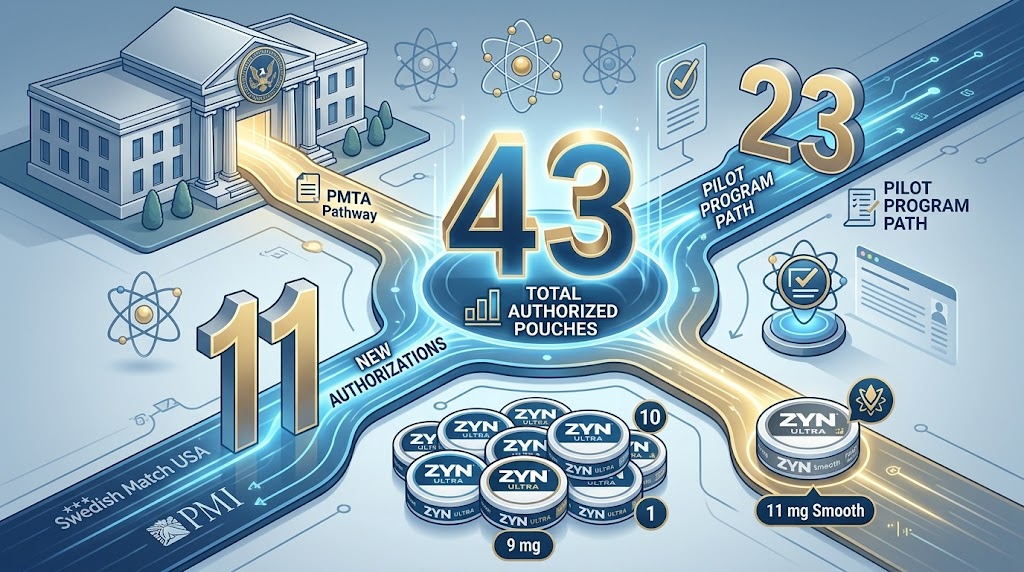
FDA Grants PMTA Authorization to 11 ZYN ULTRA Nicotine Pouches, Bringing Total Authorized Pouches to 43
The U.S. Food and Drug Administration authorized 11 ZYN ULTRA nicotine pouch products made by Swedish Match USA through the premarket tobacco product application pathway on August 21, 2026. Ten of the authorized products have a labeled nicotine content of 9 mg, while ZYN ULTRA Smooth was authorized at 11 mg. The reviews were conducted through FDA’s nicotine pouch PMTA pilot program. FDA has now authorized 43 nicotine pouch products, including 23 through the pilot.
Aug.24
Australia Adds 6-Methylnicotine to Schedule 9 Prohibited Substances, Effective October 1
Australia's Therapeutic Goods Administration published a final decision on September 25 to classify 6-methylnicotine as a Schedule 9 prohibited substance under the Poisons Standard, effective October 1, 2026. TGA said the chemical has been reported in e-cigarette liquids sold in Australia and marketed as nicotine-free or nicotine alternatives, while evidence also indicates its use in preparations such as oral pouches. The government originally proposed a Schedule 7 classification but ultimately adopted the stricter Schedule 9 designation, citing acute toxicity, dependence risk, use in unapproved consumer products and misleading marketing.
News
Sep.29 by 2Firsts Perspectives
Smoore Seeks to Toss CCELL Price-Fixing Claim as Court Weighs Vertical Distribution Versus Horizontal Conspiracy
Smoore and four authorized U.S. CCELL distributors are asking a California federal court to permanently dismiss a core antitrust claim brought by direct purchasers. Plaintiffs allege that Smoore coordinated minimum wholesale prices, customer allocation and limits on price competition among distributors, amounting to a per se unlawful horizontal conspiracy. The defendants say the alleged conduct reflects ordinary vertical relationships between a manufacturer and its distributors. The court previously dismissed a similar claim, and the latest dispute centers on whether the second amended complaint adds sufficient facts to establish a horizontal agreement.
Sep.14
Imperial Brands Acquires Helwit Owner Yoik Group for SEK 515 Million, More Than Doubling Swedish Nicotine Pouch Share
Imperial Brands has agreed to acquire 100% of Swedish modern oral nicotine company Yoik Group AB for an initial SEK515 million, equivalent to about US$53.9 million, plus a deferred payment linked to performance over the next two years. Yoik owns nicotine pouch brand Helwit, which held about 3.4% of Sweden’s modern oral nicotine market over the past 12 months. Imperial says the acquisition will more than double its existing share of the Swedish market. Helwit is also sold elsewhere in the Nordics, through European online channels and in selected UK retail outlets.
Sep.08
As Regulators Focus on Nicotine Pouch Child Safety, Safeguard Pursues an External Packaging Route
As regulators pay closer attention to child safety in nicotine pouches, manufacturers face a practical challenge: how to strengthen child-resistant packaging without unnecessarily reworking products, production lines and regulatory submissions already in place. In a written interview with 2Firsts, Chemular detailed Safeguard’s external packaging approach, its customer-specific testing requirements and possible PMTA pathways. The model remains early-stage, but it offers a new way to think about an increasingly important regulatory and manufacturing issue.
Industry Insight
Sep.19