Jinjia Group: Restrictions Lifted on Controller, Investigation and Detention on Director

Regulations by 2FIRSTS, edited by Sophia
May.06.2024
Jinjia Group: Restrictions Lifted on Controller, Investigation and Detention on Director
Recent announcements from Jinjia Corporation (002191) reveal lifted restrictions on Qiao Luyu but investigation and detention of Li Dehua.

Recently, listed company Jinjia Group (002191) on the Shenzhen Stock Exchange has issued a series of announcements. Firstly, the disciplinary commission in Enyang District, Bazhong City has lifted the detention measures against Qiao Luyu. Secondly, the company's director and deputy general manager, Li Dehua, has been placed under investigation and detained.


According to relevant documents issued by the Supervision Committee of Enyang District, Bazhong City, the actual controller and chairman of the company, Qiao Luyu, is under investigation and has been placed under detention. On April 27, 2024, the company received a notice from the Supervision Committee of Enyang District, Bazhong City, lifting the detention of Qiao Luyu (Enjianjie Lutong [2024] No. 2), indicating that the Supervision Committee of Enyang District, Bazhong City has lifted the detention measures against Qiao Luyu. Currently, Qiao Luyu is able to carry out his duties as the chairman and legal representative of the company as normal, and the company's director and general manager, Hou Xudong, no longer acts on behalf of the company's chairman and legal representative.
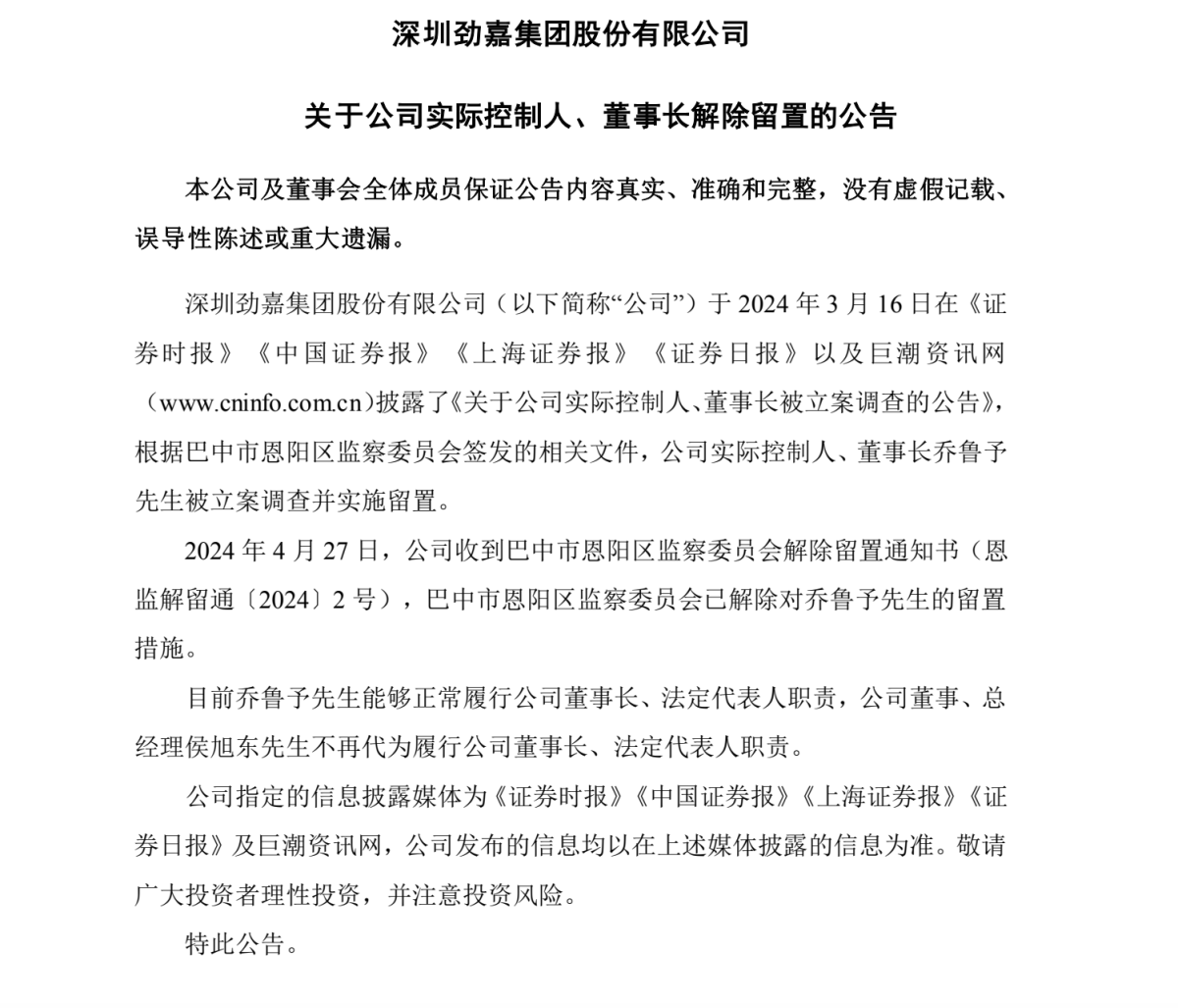
 

Jinjia Group: Restrictions Lifted on Controller, Investigation and Detention on Director
Announcement | Image source: Jincare Group


On May 1st, the company received a notification from the Jinzhou District Supervisory Committee in Dalian City regarding the investigation and detention of the company's director and deputy general manager, Li Dehua.
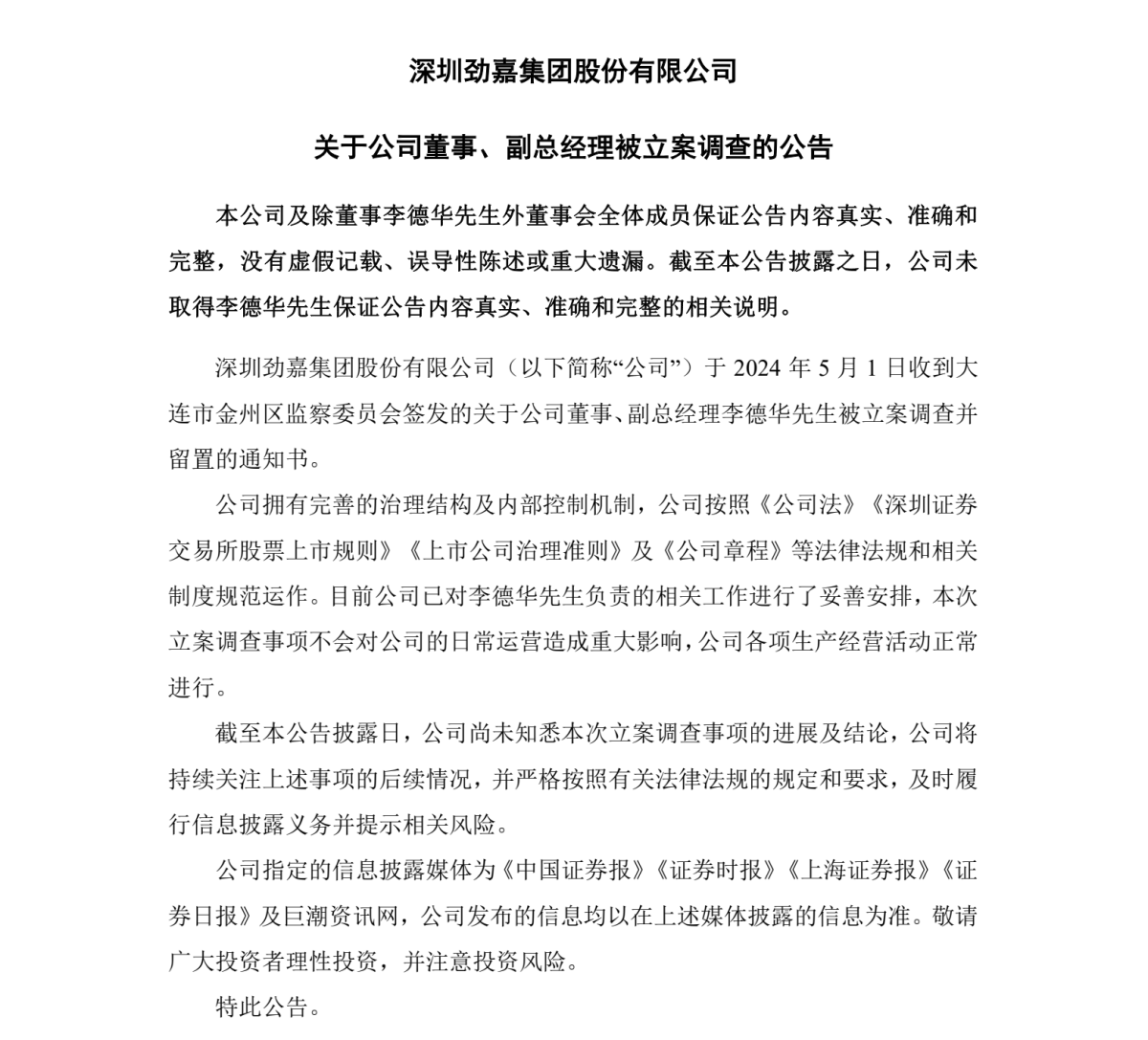
 

Jinjia Group: Restrictions Lifted on Controller, Investigation and Detention on Director
Announcement | Image Source: Jincar Group


Jiangjia Group stated that the company has a sound governance structure and internal control mechanism, operating in compliance with laws, regulations, and rules such as the Company Law, the Shenzhen Stock Exchange Listing Rules, the Corporate Governance Guidelines for Listed Companies, and the company's articles of association. The company has already made proper arrangements for the work related to Li Dehua, and the ongoing investigation will not have a significant impact on the company's daily operations. All production and operational activities of the company are proceeding as usual.


Jinjia Corporation stated that as of the date of this announcement, the company is not aware of the progress and conclusion of the investigation. The company will continue to monitor the developments of the investigation and adhere to relevant laws and regulations, fulfill its disclosure obligations in a timely manner, and alert of any related risks.


According to the 2023 annual report of Jinjia Group, Li Dehua was born in 1968, is of Chinese nationality, does not have permanent residency abroad, has a high school education, and has been employed by Jinjia Group since 1996. He currently serves as a director, executive deputy general manager, and general manager of the production and marketing branch of the company, as well as holding other positions such as executive director of Shenzhen Qianhai Blueberry Culture Communication Co., Ltd. In 2023, Li Dehua received a total pre-tax compensation of 2.361 million yuan from the company.


We welcome news tips, article submissions, interview requests, or comments on this piece.

Please contact us at info@2firsts.com, or reach out to Alan Zhao, CEO of 2Firsts, on LinkedIn


Notice

1.  This article is intended solely for professional research purposes related to industry, technology, and policy. Any references to brands or products are made purely for objective description and do not constitute any form of endorsement, recommendation, or promotion by 2Firsts.

2.  The use of nicotine-containing products — including, but not limited to, cigarettes, e-cigarettes, nicotine pouchand heated tobacco products — carries significant health risks. Users are responsible for complying with all applicable laws and regulations in their respective jurisdictions.

3.  This article is not intended to serve as the basis for any investment decisions or financial advice. 2Firsts assumes no direct or indirect liability for any inaccuracies or errors in the content.

4.  Access to this article is strictly prohibited for individuals below the legal age in their jurisdiction.


Copyright


This article is either an original work created by 2Firsts or a reproduction from third-party sources with proper attribution. All copyrights and usage rights belong to 2Firsts or the original content provider. Unauthorized reproduction, distribution, or any other form of unauthorized use by any individual or organization is strictly prohibited. Violators will be held legally accountable.

For copyright-related inquiries, please contact: info@2firsts.com


AI Assistance Disclaimer


This article may have been enhanced using AI tools to improve translation and editorial efficiency. However, due to technical limitations, inaccuracies may occur. Readers are encouraged to refer to the cited sources for the most accurate information.

We welcome any corrections or feedback. Please contact us at: info@2firsts.com

New Zealand Associate Health Minister Casey Costello Warns on Illicit Cigarettes as Legal Tobacco Sales Halve Over Decade
New Zealand Associate Health Minister Casey Costello said legal tobacco sales in the country have fallen by more than half over the past decade, with sales declining more than 20% in 2025 compared with the previous year. She warned that the decline may not fully reflect lower smoking rates, as increased availability of illicit cigarettes could also be contributing. The government said it would continue strengthening tobacco and vape retail enforcement while monitoring the impact of illicit tobacco on public health and tax revenue.
Aug.26
Arizona Turns to a 50% Retail Vape Tax as Tobacco Tax Revenue Falls 47% From 2008
Arizona's First Things First is pushing for an excise tax equal to 50% of the retail price of vaping products, estimating that the measure could generate about $100 million annually. The agency says its tobacco-tax revenue has fallen 47% from 2008 levels. Arizona has attempted to broaden its nicotine tax base in each of the past two years: a 2025 bill proposed a 50% wholesale-price tax, while a 2026 measure shifted to a 50% retail-price tax covering alternative nicotine products and vapor products. Separately, the state enacted HB 4001 this year to establish a new licensing and sales framework for alternative nicotine products.
Sep.21
China’s HTP Exports Fell 14.3% in H1 2026 as Russia and Belarus Accounted for 76% Lead
In H1 2026, China’s HS 24041100 exports stood at $1.32 million, down 14.3% YoY, with volume falling 17.2% to 55.33 tons. Market distribution shifted drastically amid overall export drops. Exports to Russia and Belarus totaled $1 million, taking 76.0% of all shipments versus 29.5% in H1 2025. Belarus became the top destination with export value jumping 177.5%, while the Philippines, Singapore and Indonesia’s combined share slumped from 49.3% to 11.2%.Domestically, Yunnan led exporter registrations; Jiangsu and Shanghai were key suppliers, yet Anhui and Sichuan had no exports. Heavy concentration means order or declaration changes for Russia/Belarus greatly affect national aggregate data. The data shows customs entry points (not end markets), covering tobacco consumables only, excluding heating equipment and the complete HTP supply chain.
Aug.11
Imperial Brands Acquires Helwit Owner Yoik Group for SEK 515 Million, More Than Doubling Swedish Nicotine Pouch Share
Imperial Brands has agreed to acquire 100% of Swedish modern oral nicotine company Yoik Group AB for an initial SEK515 million, equivalent to about US$53.9 million, plus a deferred payment linked to performance over the next two years. Yoik owns nicotine pouch brand Helwit, which held about 3.4% of Sweden’s modern oral nicotine market over the past 12 months. Imperial says the acquisition will more than double its existing share of the Swedish market. Helwit is also sold elsewhere in the Nordics, through European online channels and in selected UK retail outlets.
Sep.08
Nicotine Pouches Gain Ground in U.S. Convenience Stores as Vape Unit Sales Fall 14%
According to convenience retail publication CStore Decisions, U.S. convenience store tobacco categories are undergoing a structural shift. Based on Circana OmniMarket Total U.S. Convenience data for the 52 weeks ending June 14, 2026, cigarettes remained the largest category with $50.8 billion in sales, but unit sales declined 5.3%. Electronic smoking devices and vaping products also declined, while modern oral nicotine products continued to grow, with nicotine pouch sales rising 29% in dollars and 17% in units. Retailers said changing consumer preferences are reshaping tobacco product assortments at convenience stores.
Regulations
Aug.07
South Korea Fully Reviews Nicotine-Analog and Nicotine-Free Vape Liquid Imports, With Over 99% From China and Chinese Supply-Chain Documents Under Scrutiny
Korea Customs Service has tightened import controls on nicotine-analog and nicotine-free e-cigarette liquids, placing the products under 100% document review and subjecting all e-cigarette liquid import declarations to pre-clearance ingredient analysis. As of September 20, 2026, South Korea had imported about 15 metric tons of nicotine-analog liquids, 99.99% from China, and about 316 metric tons of nicotine-free liquids, including roughly 315 metric tons, or 99.7%, from China. The measures follow South Korea's April expansion of its tobacco definition to include synthetic nicotine products and include new checks on Chinese manufacturing, transaction and export documentation.
Sep.24