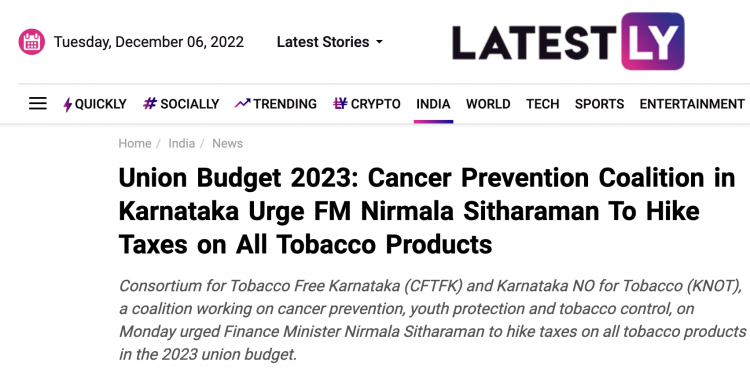
The Karnataka State Tobacco Control Board (KSTCB) and the Campaign for Tobacco-Free Kids (CTFK) have come together to form an alliance dedicated to cancer prevention, youth protection, and tobacco control. On Monday, they urged Finance Minister Nirmala Sitharaman to increase taxes on all tobacco products in India and to include this initiative in the 2023 budget.
They also sent a letter to the members of parliament in Karnataka, urging them to take measures to increase taxes on tobacco products such as cigarettes, bidis, and chewing tobacco.
Currently, cigarettes only carry a total tax burden of 53%, compared to 22% for roll-your-own tobacco and 60% for smokeless tobacco. "We recommend that the federal government increase taxes on tobacco products in the 2023-24 budget, as tobacco products have become more affordable in recent years.
This is one of the most powerful but underutilized tools for controlling tobacco use. Increasing taxes threefold could potentially double revenue and halve tobacco consumption. It's a great opportunity to levy additional taxes on tobacco to reduce affordability and decrease consumption," stated a member of the Karnataka government's Tobacco Control Senior Committee.
Since the introduction of the Goods and Services Tax regime, tobacco taxes have not seen a significant increase. However, in the 2022-23 budget, the government could have raised the consumption tax on tobacco products and used the additional revenue to improve public health and establish alternative livelihoods for those who depend on tobacco. Increasing tobacco taxes is necessary to keep young people and vulnerable groups away from tobacco. Therefore, we demand that the government increase tobacco taxes, said renowned economist and former director of the Institute for Social and Economic Change, Professor RS Deshpande.
A recent report by the parliamentary standing committee on health and family welfare has noted that tobacco is the leading cause of cancer and that nearly 50% of cancer cases in India are attributed to it. The report, titled "Cancer Care Programme and Management: Prevention, Diagnosis, Research and Affordability of Cancer Treatment," highlights the importance of curtailing the use of tobacco, which the committee believes typically begins during adolescence when young people are not yet fully capable of making rational decisions. The report underscores the need for prevention measures to help reduce the burden of cancer.
According to the report, tobacco products in India have the lowest costs, so it recommends increasing taxes on all tobacco products. This not only prevents easy accessibility but also generates additional revenue as taxes can be used for prevention plans. "The convenor of the Smokeless Tobacco Karnataka Alliance, AS JChander, said.
2FIRSTS will continue to track and report on this topic, with future updates available on the "2FIRSTSAPP". Scan the QR code below to download the app.
Disclaimer
This article is provided solely for professional research, industry discussion, and informational purposes. Any references to brands, companies, products, technologies, or policies are made for factual reporting and analytical purposes only, and do not constitute endorsement, recommendation, promotion, or advertising by 2Firsts.
Nicotine-containing products, including but not limited to cigarettes, e-cigarettes, heated tobacco products, and nicotine pouches, carry significant health risks. Readers are responsible for complying with all applicable laws and regulations in their respective jurisdictions, including age restrictions and access limitations.
The information contained in this article should not be regarded as investment, legal, medical, regulatory, or commercial advice. While 2Firsts strives to ensure the accuracy and reliability of its content, it does not assume liability for any direct or indirect loss arising from errors, omissions, inaccuracies, or reliance on the information contained herein.
This article is not intended for individuals below the legal age for accessing tobacco or nicotine-related information in their jurisdiction.
Copyright Notice
This article is either original content produced by 2Firsts or content reproduced, translated, summarized, or adapted from third-party sources with attribution where applicable. The intellectual property rights of the original content remain with 2Firsts or the respective original rights holders.
No individual or organization may copy, reproduce, distribute, republish, modify, translate, or otherwise use this content without prior authorization. Any unauthorized use may result in legal action.
For copyright-related inquiries, corrections, or removal requests, please contact: info@2firsts.com.
AI-Assisted Translation and Editing Notice
Portions of this article may have been translated, edited, or reviewed with the assistance of artificial intelligence tools to improve efficiency and readability. Due to the limitations of AI-assisted translation and editing, discrepancies, omissions, or inaccuracies may exist when compared with the original source.
Where applicable, readers are advised to refer to the original source for the most complete and accurate information. If you identify any errors or believe that any content infringes upon your rights, please contact us at info@2firsts.com, and we will review and address the matter promptly.