KT&G Donates 6 Million South Korean Won to Incheon Charity

News by 2FIRSTS.ai
Dec.01.2023
KT&G Donates 6 Million South Korean Won to Incheon Charity
KT&G donates 6 million won to Incheon Social Welfare Mutual Aid Association in a ceremony attended by coal sharing service and university students.

According to a report from Kihoilbo on November 30, KT&G has donated 6 million Korean won to the Incheon Social Welfare Co-op. The donation ceremony took place in Mangjoo-dong, Nandong-gu, Incheon, in collaboration with the Coal Sharing Service. Representatives from KT&G and students from Jajang University Medical School participated in the event.


We welcome news tips, article submissions, interview requests, or comments on this piece.

Please contact us at info@2firsts.com, or reach out to Alan Zhao, CEO of 2Firsts, on LinkedIn


Notice

1.  This article is intended solely for professional research purposes related to industry, technology, and policy. Any references to brands or products are made purely for objective description and do not constitute any form of endorsement, recommendation, or promotion by 2Firsts.

2.  The use of nicotine-containing products — including, but not limited to, cigarettes, e-cigarettes, nicotine pouchand heated tobacco products — carries significant health risks. Users are responsible for complying with all applicable laws and regulations in their respective jurisdictions.

3.  This article is not intended to serve as the basis for any investment decisions or financial advice. 2Firsts assumes no direct or indirect liability for any inaccuracies or errors in the content.

4.  Access to this article is strictly prohibited for individuals below the legal age in their jurisdiction.


Copyright


This article is either an original work created by 2Firsts or a reproduction from third-party sources with proper attribution. All copyrights and usage rights belong to 2Firsts or the original content provider. Unauthorized reproduction, distribution, or any other form of unauthorized use by any individual or organization is strictly prohibited. Violators will be held legally accountable.

For copyright-related inquiries, please contact: info@2firsts.com


AI Assistance Disclaimer


This article may have been enhanced using AI tools to improve translation and editorial efficiency. However, due to technical limitations, inaccuracies may occur. Readers are encouraged to refer to the cited sources for the most accurate information.

We welcome any corrections or feedback. Please contact us at: info@2firsts.com

AIR Q3 Sales Rise 11%, but New Products Generate Just $2.1 Million in Nine Months as U.S. Vape Push Awaits FDA Review
AIR Global PLC (NASDAQ: AIIR), a producer of flavored shisha tobacco and next-generation nicotine products, reported an 11.1% increase in third-quarter 2026 revenue to $99.8 million and a 7.7% rise in adjusted EBITDA to $30.9 million. Revenue for the first nine months increased 6.0% to $306.7 million, but the company posted a $74.2 million net loss, affected by listing-related expenses and other costs. Its New Growth Categories (NGC) business generated $2.1 million in nine-month revenue and an adjusted EBITDA loss of $10.8 million. AIR maintained its 2026 revenue growth guidance of 4%–6%, while lowering its capital expenditure outlook and raising its year-end leverage forecast from approximately 2.1 times to 2.5 times. The company has submitted a U.S. PMTA for its Crown Switch pod vape, with future contributions from new products dependent on regulatory progress and commercialization.
Capital Markets
Nov.13
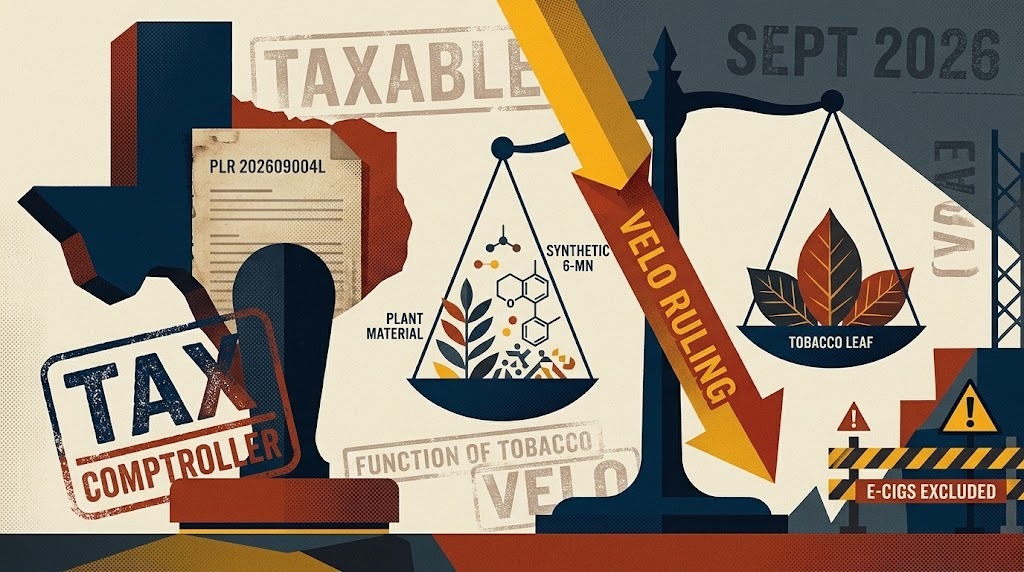
Texas Extends Tobacco Tax Interpretation to a 6-Methylnicotine Product, Citing VELO Ruling
The Texas Comptroller of Public Accounts ruled in September 2026 that a combustible product made with non-tobacco plant material and 6-methylnicotine (6-MN), a synthetic nicotine analog, qualifies as a taxable tobacco product. The applicant said the product contained neither tobacco leaf nor measurable conventional nicotine. The determination applies reasoning from a May Texas Supreme Court decision involving VELO nicotine pouches, finding that the plant material and 6-MN together perform the functions of tobacco in a conventional smoking product. The ruling carries applicable tax, licensing and reporting obligations but is limited to the facts submitted by the taxpayer. It does not establish a blanket tax classification for all 6-MN products or extend the same conclusion to e-cigarettes.
Regulations
Nov.06
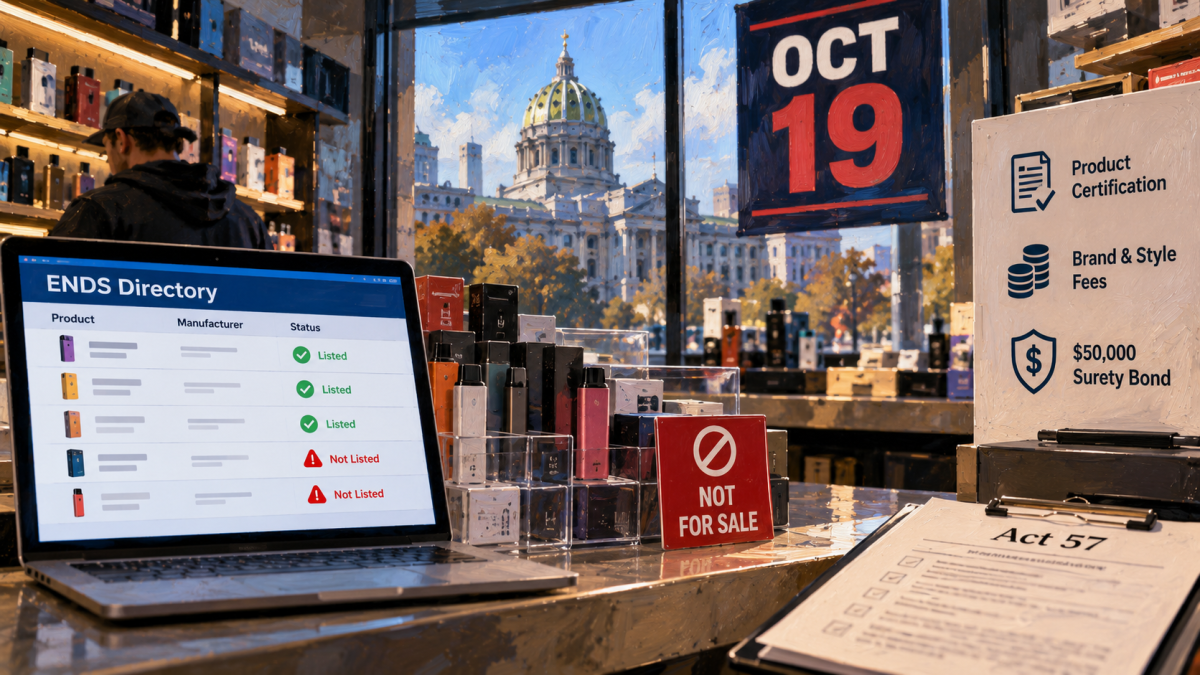
Pennsylvania Vape Directory Enforcement Starts Oct. 19, Barring Retail Sales of Unlisted Products
Pennsylvania's Act 57 vape directory regime will reach the end of its 120-day inventory transition period on Oct. 19. Nicotine-containing e-cigarettes intended for retail sale in the state that are not listed on the Attorney General's ENDS directory will then be barred from retail sale and treated as contraband subject to seizure, forfeiture and destruction. Manufacturers face annual product certification, brand- and style-based fees and a minimum $50,000 surety bond, while retailers and wholesalers must source through licensed channels and monitor the directory.
Regulations
Oct.08
Philippines Mandates Safety Certification for Nicotine Pouches, Gives Industry 12 Months to Comply
The Philippines Department of Trade and Industry has placed nicotine pouches under mandatory product certification through Department Administrative Order No. 26-07, Series of 2026. Nicotine pouches must obtain a Philippine Standard, or PS, license before they can be manufactured, imported, packed, distributed or sold in the country. The regime requires testing for nicotine content, pH and water activity, while packaging must disclose nicotine strength, ingredients, allergens, batch information, the PS certification mark and prescribed health warnings. Existing market participants have a 12-month transition period to comply.
Regulations
Oct.12
North Carolina Tightens Vape Product Directory Enforcement, Expands State and Local Powers as Violators Face Fines, Product Seizures and License Suspension or Revocation
North Carolina has expanded enforcement of its vapor product directory rules, authorizing more state and local law enforcement participation and establishing a task force led by the State Bureau of Investigation. The legislation requires at least one unannounced compliance inspection annually for retailers, distributors and wholesalers handling covered products. Penalties effective October 1, 2026, include civil fines of $500–$750 for a first violation and $1,000–$1,500 for repeated violations within 12 months, along with potential license suspension or revocation. Manufacturers may face penalties of $10,000 per unlisted product. The measures strengthen the product directory system established in 2024.
Regulations
Oct.28
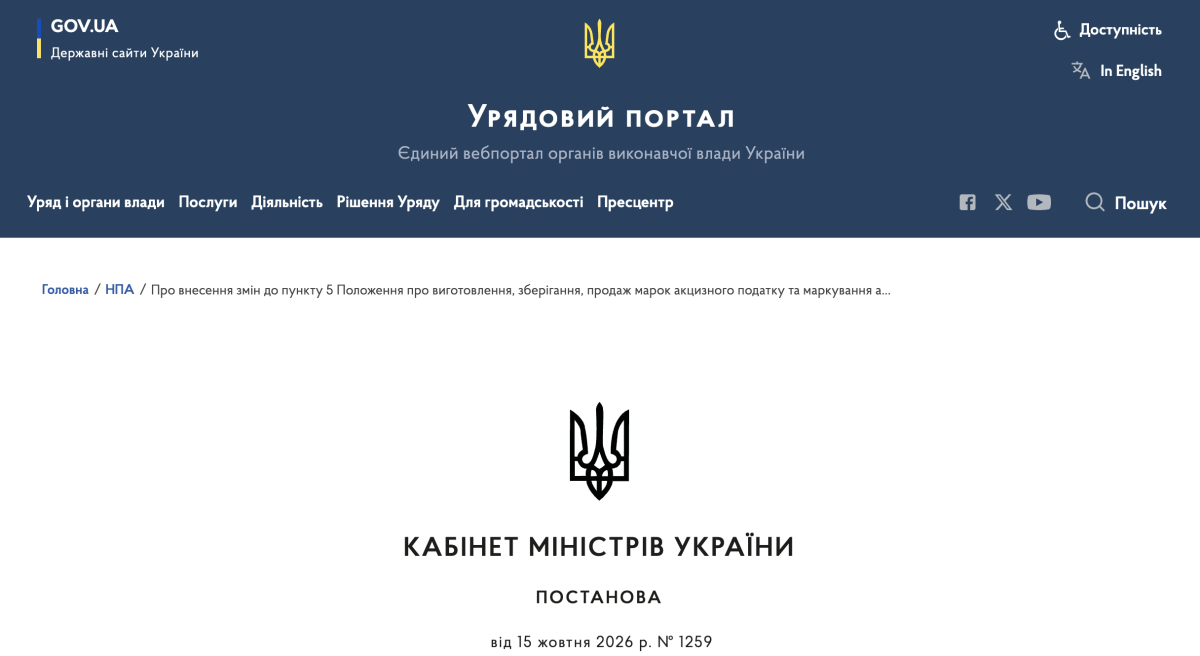
Ukraine Raises Excise Stamp Fees for Tobacco, Heated Tobacco and Vape Liquids by 30.5% as Parliament Backs E-Excise Delay to 2027
Ukraine's Cabinet of Ministers adopted Resolution No. 1259 on October 15, 2026, increasing excise stamp production fees for tobacco products and e-cigarette liquids by approximately 30.5%, from UAH 0.1643 to UAH 0.2144 per stamp. Fees for alcoholic beverages rose by about 30.2%. Separately, Ukraine's parliament passed Bill No. 15532 on October 13, proposing to postpone the full implementation of electronic excise stamps and traceability for alcohol, tobacco and e-cigarette liquids from November 1, 2026, to July 1, 2027. Parliament cited additional testing, configuration and integration requirements. The bill was sent to the president for signature on October 19.
Regulations
Oct.21