Key Points
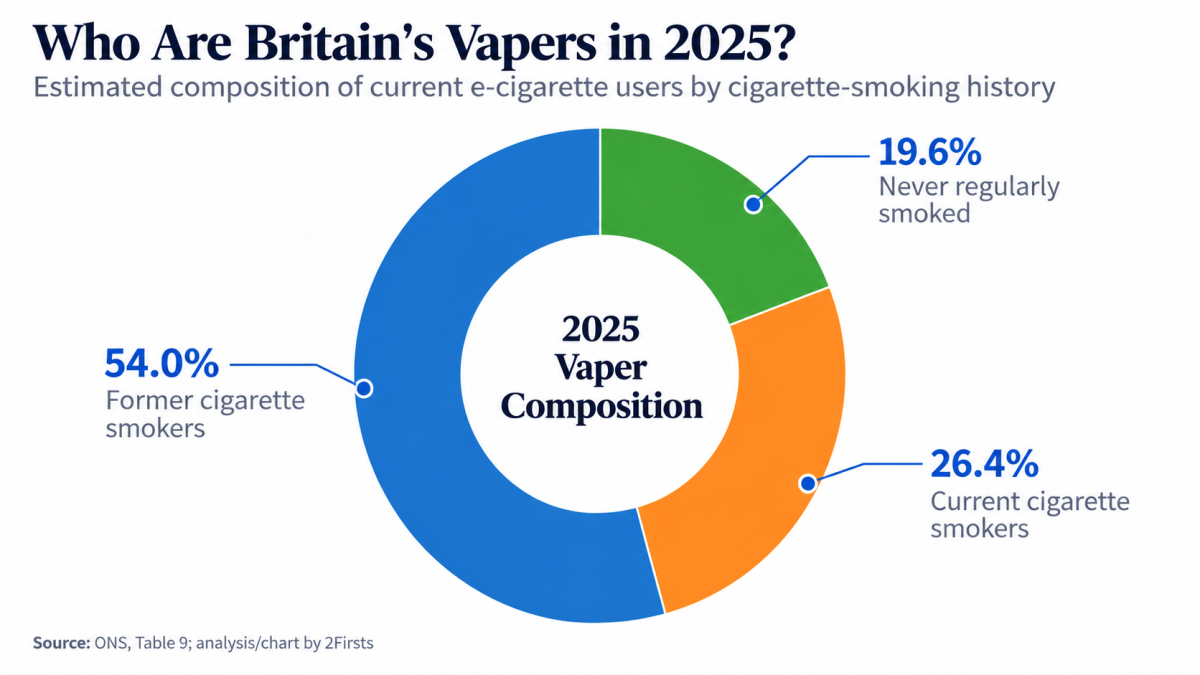
- Former cigarette smokers account for most vapers: Based on ONS weighted population data, 2Firsts estimates that 54% of current e-cigarette users were former cigarette smokers, 26% also smoked cigarettes and 20% had never regularly smoked.
- Vaping frequency differs by smoking history: Approximately 81% of former cigarette smokers who currently vape used e-cigarettes daily, compared with about 50% of current cigarette smokers who also vape.
- Dual-use prevalence has risen over the long term: The proportion of current cigarette smokers who also used e-cigarettes reached 33.8% in 2025, compared with 10.6% in 2014.
- More than one million never-regular smokers vape: Approximately 1.1 million adults who had never regularly smoked cigarettes used e-cigarettes in 2025. Prevalence reached 2.9%, up from 0.2% in 2014, but remained broadly stable over the latest three years.
2Firsts
October 14, 2026
Former cigarette smokers accounted for the largest share of Great Britain's e-cigarette users in 2025, while roughly one-quarter also smoked cigarettes and about one-fifth had never regularly smoked, according to the latest data released by the Office for National Statistics (ONS) on October 6, 2026.
Based on the ONS report Adult smoking habits in the UK: 2025 and its underlying dataset, 2Firsts estimates that approximately 54% of current vapers were former cigarette smokers, 26% were dual users of cigarettes and e-cigarettes, and 20% had never regularly smoked cigarettes.
Vaping frequency differed substantially across these groups. Among former cigarette smokers who currently used e-cigarettes, approximately 81% vaped daily, compared with about 50% of dual users.
The survey also found that 33.8% of current cigarette smokers used e-cigarettes daily or occasionally. Approximately 1.1 million adults who had never regularly smoked cigarettes were also current vapers.
The figures come from the ONS Opinions and Lifestyle Survey (OPN), which covers adults aged 16 and over in England, Scotland and Wales, excluding Northern Ireland.
Former Cigarette Smokers Account for 54% of Vapers, Dual Users for 26%
The ONS classifies adults by cigarette smoking history into current cigarette smokers, former cigarette smokers and people who have never regularly smoked cigarettes.
In 2025, vaping prevalence within these three groups was 33.8%, 20.7% and 2.9%, respectively.
The size of each population group, however, differs substantially, meaning that vaping prevalence within a group does not directly indicate its share of the total vaping population.
ONS weighted population estimates put the number of current cigarette smokers in Great Britain at approximately 4.21 million in 2025, compared with 14.03 million former cigarette smokers and 36.36 million adults who had never regularly smoked.
Using the weighted population figures and corresponding vaping prevalence rates, 2Firsts calculated the following estimated composition of Britain's current vaping population.
| Cigarette smoking history | Estimated vapers | Share of all vapers |
|---|---|---|
| Former cigarette smokers | About 2.90 million | About 54% |
| Current cigarette smokers | About 1.42 million | About 26% |
| Never regularly smoked | About 1.05 million | About 20% |
| Total | About 5.38 million | 100% |
Note: These are approximate calculations by 2Firsts using ONS Table 9 weighted population estimates and published rounded prevalence rates. The ONS reported approximately 5.4 million current e-cigarette users in 2025.
Former cigarette smokers represented the largest group of vapers. Although only 20.7% of former cigarette smokers currently used e-cigarettes, their large population size meant they accounted for more than half of all vapers.
Vaping prevalence was highest among current cigarette smokers, at 33.8%, but this group represented approximately 26% of the total vaping population.
Only 2.9% of adults who had never regularly smoked cigarettes used e-cigarettes. However, the group's population of approximately 36.36 million meant it contributed around one-fifth of all current vapers.
The three categories reflect different cigarette-smoking histories.
Former cigarette smokers are adults who previously smoked cigarettes but no longer do so. The ONS survey does not track the reasons they stopped smoking, so the group cannot be treated in its entirety as consumers who replaced cigarettes with e-cigarettes.
About 81% of Former Smokers Who Vape Use E-Cigarettes Daily, Versus 50% of Dual Users
The ONS figures show substantial differences in vaping frequency across smoking-history groups.
In 2025, 16.8% of current cigarette smokers reported vaping daily, while 17.0% reported occasional vaping, making the two groups approximately equal in size.
Among former cigarette smokers, 16.8% vaped daily and 3.9% occasionally.
For adults who had never regularly smoked cigarettes, daily and occasional vaping prevalence stood at 1.3% and 1.6%, respectively.
Vaping Prevalence by Smoking History and Frequency, 2025
| Group | Daily vaping | Occasional vaping | All current vaping |
|---|---|---|---|
| Current cigarette smokers | 16.8% | 17.0% | 33.8% |
| Former cigarette smokers | 16.8% | 3.9% | 20.7% |
| Never regularly smoked | 1.3% | 1.6% | 2.9% |
Note: Each percentage uses the corresponding cigarette-smoking-history group as its denominator.
Dividing daily vaping prevalence by overall current vaping prevalence provides an estimate of how frequently current vapers within each group use e-cigarettes.
Approximately 81.2% of former cigarette smokers who currently vaped used e-cigarettes daily.
The corresponding figure was 49.7% among current cigarette smokers who also vaped and 44.8% among current vapers who had never regularly smoked.
Former cigarette smokers therefore had lower overall vaping prevalence than current cigarette smokers, but daily vaping accounted for a considerably larger share of their current e-cigarette use.

The vaping status of former cigarette smokers also changed in another respect.
The proportion of former cigarette smokers who currently used e-cigarettes was broadly unchanged, slipping from 20.8% in 2024 to 20.7% in 2025.
However, the proportion who had previously used e-cigarettes but no longer used them increased from 11.1% to 13.5%, a rise of 2.4 percentage points.
| E-cigarette use among former cigarette smokers | 2024 | 2025 |
|---|---|---|
| Daily vaping | 17.3% | 16.8% |
| Occasional vaping | 3.5% | 3.9% |
| All current vaping | 20.8% | 20.7% |
| Previously used, no longer using | 11.1% | 13.5% |
| Never used | 68.1% | 65.8% |
The previous-use category includes people who had tried e-cigarettes but did not currently use them. It does not necessarily indicate a history of sustained vaping.
Because OPN surveys different samples of respondents each year, the figures do not establish how many former cigarette smokers stopped vaping during 2025.
The survey also does not provide e-cigarette consumption volumes, purchasing frequency, nicotine intake or spending for these smoking-history groups. Higher daily-use prevalence therefore cannot be directly translated into a larger contribution to e-cigarette sales.
Vaping Among Current Cigarette Smokers Rises From 10.6% in 2014 to 33.8% in 2025
Over the longer term, dual use of cigarettes and e-cigarettes has become substantially more prevalent in Great Britain.
In 2014, when the ONS began collecting e-cigarette use data, 10.6% of current cigarette smokers also used e-cigarettes.
The proportion reached 15.0% in 2018 and increased to 17.7% in 2020.
In 2021, vaping prevalence among current cigarette smokers rose to 25.3%, an increase of 7.6 percentage points from the previous year.
It subsequently reached 27.1% in 2022 and 31.7% in 2023.
The rate increased further to 32.8% in 2024 and 33.8% in 2025, bringing the total gain since 2014 to 23.2 percentage points.
Among former cigarette smokers, vaping prevalence rose from 6.8% in 2014 to 20.7% in 2025, an increase of 13.9 percentage points.
Among adults who had never regularly smoked cigarettes, prevalence rose from 0.2% to 2.9% over the same period.
Vaping Prevalence by Cigarette Smoking History, 2014–2025
| Year | Current cigarette smokers | Former cigarette smokers | Never regularly smoked |
|---|---|---|---|
| 2014 | 10.6% | 6.8% | 0.2% |
| 2015 | 14.4% | 7.7% | 0.2% |
| 2016 | 13.7% | 12.1% | 0.6% |
| 2017 | 14.9% | 11.3% | 0.4% |
| 2018 | 15.0% | 12.8% | 0.8% |
| 2019 | 15.5% | 11.7% | 0.4% |
| 2020 | 17.7% | 12.3% | 1.2% |
| 2021 | 25.3% | 14.9% | 1.4% |
| 2022 | 27.1% | 16.5% | 2.3% |
| 2023 | 31.7% | 18.6% | 2.8% |
| 2024 | 32.8% | 20.8% | 2.7% |
| 2025 | 33.8% | 20.7% | 2.9% |
Vaping prevalence increased substantially among both current and former cigarette smokers between 2020 and 2023.
Growth was more limited in the latest two years.
In 2025, vaping prevalence among current cigarette smokers rose by 1.0 percentage point from 2024. The rate among former cigarette smokers decreased by 0.1 percentage point, while prevalence among adults who had never regularly smoked increased by 0.2 percentage points.
These figures are point estimates from sample surveys. The relatively small latest annual movements do not, by themselves, establish new sustained upward or downward trends.
About 1.1 Million Adults Who Never Regularly Smoked Cigarettes Use E-Cigarettes
Adults who have never regularly smoked cigarettes also represent a substantial part of Britain's vaping population.
According to the ONS, approximately 1.1 million adults in this category currently used e-cigarettes in 2025, equivalent to 2.9% of that population.
Although the prevalence rate was comparatively low, the group's large population base meant it accounted for nearly 20% of all current vapers, according to 2Firsts calculations.
In the longer-term data, vaping prevalence among adults who had never regularly smoked cigarettes increased from 0.2% in 2014 to 0.6% in 2016 and 0.8% in 2018 before declining to 0.4% in 2019.
The rate rose to 1.2% in 2020, 1.4% in 2021 and 2.3% in 2022. It reached 2.8% in 2023, edged down to 2.7% in 2024 and stood at 2.9% in 2025.
The ONS estimated that approximately 940,000 adults who had never regularly smoked cigarettes used e-cigarettes in 2024, compared with approximately 1.1 million in 2025.
However, the prevalence rate increased by just 0.2 percentage points.
The published 95% confidence interval for 2025 was 2.3% to 3.5%, compared with 2.0% to 3.3% for 2024. The available estimates do not establish a statistically significant annual increase.
Over the longer term, vaping prevalence in this population was substantially higher than in 2014, although point estimates remained relatively stable between 2023 and 2025.
The ONS category "Never smoked" refers to adults who do not currently smoke cigarettes and have never smoked them regularly. It does not necessarily mean they have never tried cigarettes or previously used other nicotine products.
Vaping Prevalence Reaches 38.6% Among Female Cigarette Smokers, Versus 29.7% for Men
Sex-disaggregated data reveal further variation within the smoking-history groups.
In 2025, vaping prevalence among female current cigarette smokers was 38.6%, compared with 29.7% among male current cigarette smokers, a difference of 8.9 percentage points in the point estimates.
Among female current cigarette smokers, 19.8% vaped daily and 18.8% occasionally. The corresponding figures for men were 14.2% and 15.5%.
Vaping prevalence was similar among former cigarette smokers, at 20.3% for women and 21.1% for men.
Among adults who had never regularly smoked, 3.0% of women and 2.7% of men used e-cigarettes.
| Cigarette smoking history | Women | Men |
|---|---|---|
| Current cigarette smokers | 38.6% | 29.7% |
| Former cigarette smokers | 20.3% | 21.1% |
| Never regularly smoked | 3.0% | 2.7% |
Although the vaping prevalence point estimate was higher among female current cigarette smokers, the survey estimates are subject to sampling uncertainty. The figures alone do not establish whether the difference is statistically significant.
Britain's Vaping Population Spans Three Distinct Cigarette-Smoking Histories
ONS 2025 data and calculations by 2Firsts show that approximately 54% of current e-cigarette users in Great Britain were former cigarette smokers, 26% also smoked cigarettes and 20% had never regularly smoked.
Among former cigarette smokers who currently vape, daily use was predominant. Current cigarette smokers who also vape were divided approximately equally between daily and occasional use.
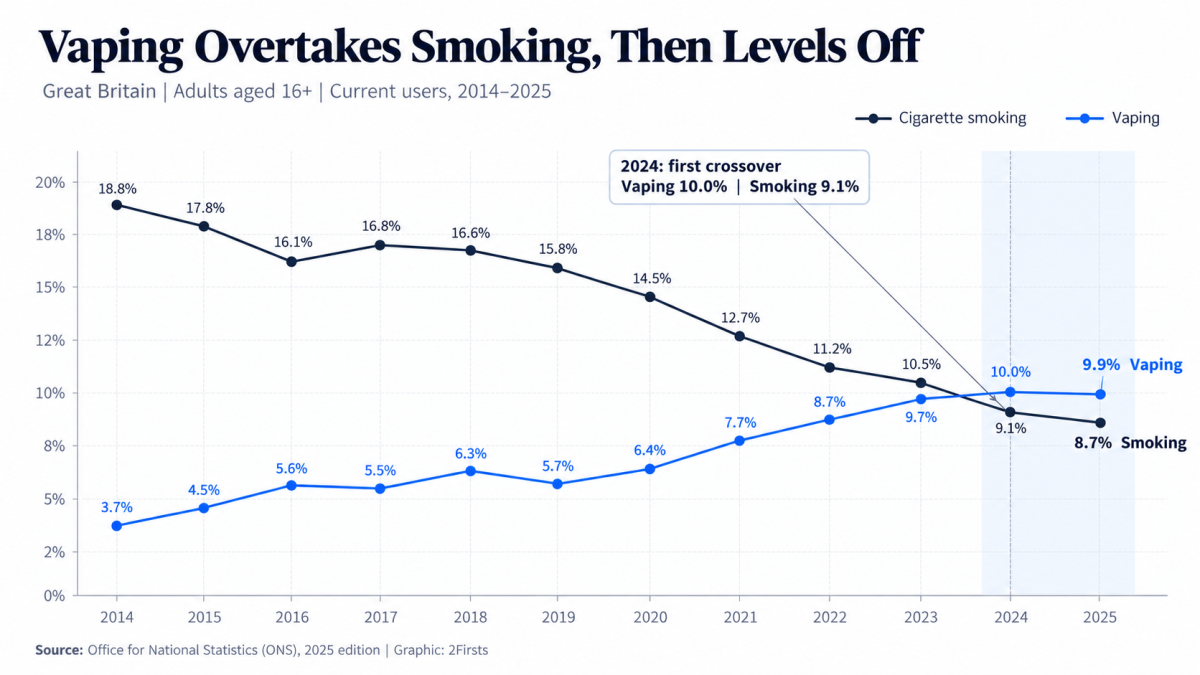
From 2014 to 2025, vaping prevalence increased across all three smoking-history groups. Dual-use prevalence rose from 10.6% to 33.8%, while vaping prevalence among those who had never regularly smoked increased from 0.2% to 2.9%.
These figures document differences in vaping population composition and usage frequency. However, the ONS survey does not follow the same individuals over time and cannot establish why former cigarette smokers stopped smoking or how many switched directly from cigarettes to e-cigarettes.
Follow 2Firsts for timely updates on global tobacco and nicotine industry developments, market data and consumer trends.
Cover Image Source: Office for National Statistics (ONS), Adult smoking habits in the UK: 2025, and underlying statistical data. Analysis and graphics: 2Firsts.

Disclaimer
This article is provided solely for professional research, industry discussion, and informational purposes. Any references to brands, companies, products, technologies, or policies are made for factual reporting and analytical purposes only, and do not constitute endorsement, recommendation, promotion, or advertising by 2Firsts.
Nicotine-containing products, including but not limited to cigarettes, e-cigarettes, heated tobacco products, and nicotine pouches, carry significant health risks. Readers are responsible for complying with all applicable laws and regulations in their respective jurisdictions, including age restrictions and access limitations.
The information contained in this article should not be regarded as investment, legal, medical, regulatory, or commercial advice. While 2Firsts strives to ensure the accuracy and reliability of its content, it does not assume liability for any direct or indirect loss arising from errors, omissions, inaccuracies, or reliance on the information contained herein.
This article is not intended for individuals below the legal age for accessing tobacco or nicotine-related information in their jurisdiction.
Copyright Notice
This article is either original content produced by 2Firsts or content reproduced, translated, summarized, or adapted from third-party sources with attribution where applicable. The intellectual property rights of the original content remain with 2Firsts or the respective original rights holders.
No individual or organization may copy, reproduce, distribute, republish, modify, translate, or otherwise use this content without prior authorization. Any unauthorized use may result in legal action.
For copyright-related inquiries, corrections, or removal requests, please contact: info@2firsts.com.
AI-Assisted Translation and Editing Notice
Portions of this article may have been translated, edited, or reviewed with the assistance of artificial intelligence tools to improve efficiency and readability. Due to the limitations of AI-assisted translation and editing, discrepancies, omissions, or inaccuracies may exist when compared with the original source.
Where applicable, readers are advised to refer to the original source for the most complete and accurate information. If you identify any errors or believe that any content infringes upon your rights, please contact us at info@2firsts.com, and we will review and address the matter promptly.