Malaysia Customs Seizes 2.5 million Cigarettes in Raid

Regulations by 2FIRSTS.ai
Nov.28.2023
Malaysia Customs Seizes 2.5 million Cigarettes in Raid
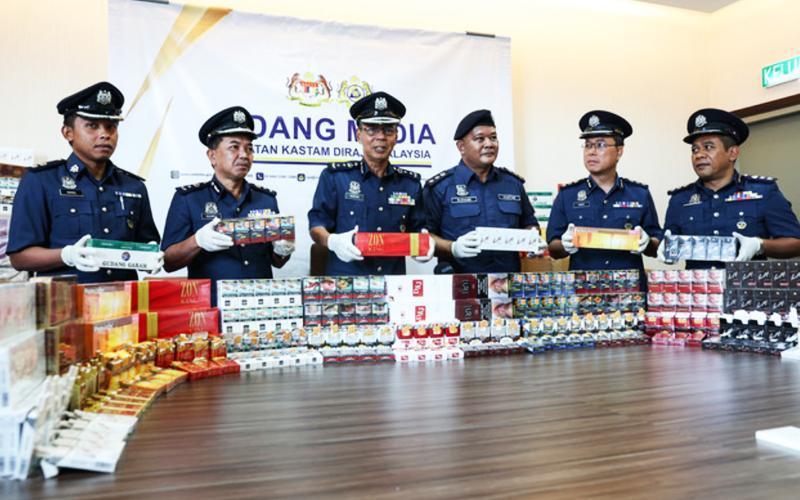
Malaysia's Royal Customs Department seized 2.5 million illegal cigarettes worth over RM2.1 million in a raid, the largest of its kind this year.

According to a report by Freemalaysiatoday, the Royal Malaysian Customs Department (JKDM) seized 2.5 million cigarettes worth over 2.1 million Malaysian Ringgit in a surprise operation in Bentong and Sungai Besar.


Director of the Customs Department, Abdul Ghafar Mohamad, has revealed yet another example of the department's exemplary enforcement efforts. This latest seizure is being hailed as the largest of its kind in the state this year.


He stated, "All cigarette boxes are wrapped in plastic to prevent them from getting wet, and no arrests have been made. In fact, we are still tracing the owners of the implicated properties to assist in the investigation.


The case is being investigated under section 135(1)(D) of the Customs Act 1967. If found guilty, the offender may be fined up to RM500,000 or face a maximum prison sentence of 5 years, or both.


We welcome news tips, article submissions, interview requests, or comments on this piece.

Please contact us at info@2firsts.com, or reach out to Alan Zhao, CEO of 2Firsts, on LinkedIn


Notice

1.  This article is intended solely for professional research purposes related to industry, technology, and policy. Any references to brands or products are made purely for objective description and do not constitute any form of endorsement, recommendation, or promotion by 2Firsts.

2.  The use of nicotine-containing products — including, but not limited to, cigarettes, e-cigarettes, nicotine pouchand heated tobacco products — carries significant health risks. Users are responsible for complying with all applicable laws and regulations in their respective jurisdictions.

3.  This article is not intended to serve as the basis for any investment decisions or financial advice. 2Firsts assumes no direct or indirect liability for any inaccuracies or errors in the content.

4.  Access to this article is strictly prohibited for individuals below the legal age in their jurisdiction.


Copyright


This article is either an original work created by 2Firsts or a reproduction from third-party sources with proper attribution. All copyrights and usage rights belong to 2Firsts or the original content provider. Unauthorized reproduction, distribution, or any other form of unauthorized use by any individual or organization is strictly prohibited. Violators will be held legally accountable.

For copyright-related inquiries, please contact: info@2firsts.com


AI Assistance Disclaimer


This article may have been enhanced using AI tools to improve translation and editorial efficiency. However, due to technical limitations, inaccuracies may occur. Readers are encouraged to refer to the cited sources for the most accurate information.

We welcome any corrections or feedback. Please contact us at: info@2firsts.com

Denver’s Flavored Tobacco Ban Faces Constitutional Challenge From Vape Trade Group
A Colorado vape industry trade group says Denver’s voter-approved flavored tobacco sales ban is unconstitutional and too vague to enforce. The group is asking a state court for a permanent injunction blocking enforcement of Ordinance 24-1765 and for a declaration allowing flavored tobacco and vape sales, citing state constitutional vagueness concerns and multiple U.S. constitutional issues.
Jan.27 by 2FIRSTS.ai
Special Report | Belarus Rejects Vape Ban, Opts for Tighter Market Controls
After weeks of debate over a potential blanket prohibition, Belarus has decided against banning electronic cigarettes, choosing instead to tighten control over wholesale, imports and licensing. President Alexander Lukashenko warned that an outright ban could drive the market underground and undermine state revenues, as officials move to curb widespread illicit trade while keeping retail sales largely intact.
Mar.04
Haypp Voluntarily Sets a 20 mg Nicotine-Strength Cap for Nicotine Pouches and Urges the UK to Establish a Regulatory Limit
Online nicotine pouch retailer Haypp said it has voluntarily adopted a 20 mg per pouch nicotine-strength cap across its e-commerce platforms and is urging the UK government to formalize that cap as the limit as it develops a regulatory framework. Haypp said proportionate limits would protect consumers while preserving nicotine pouches as a viable reduced-risk alternative to cigarettes.
Feb.26 by 2FIRSTS.ai
Dalton, Georgia considers new licensing rules and caps for vape shops
Dalton, Georgia is weighing a proposal to require city licenses for vape shops, limit how many can operate within city limits, and impose a 1,000-foot buffer for new shops from schools and other community facilities. City officials say the ordinance would not eliminate existing vape shops outright, though some may be impacted if ownership changes or licenses expire.
Feb.05 by 2FIRSTS.ai
South Dakota Legislature Approves Two Nicotine Licensing Bills Pending Governor’s Decision
The South Dakota Legislature gave final approval on Tuesday to two proposals requiring state licenses for businesses that sell nicotine products. Under the bills, wholesalers, distributors and retailers of nicotine products in the state would need to be licensed by the government.
Mar.12 by 2FIRSTS.ai
Louisiana lawmaker pushes bill to ban vape product sales within 300 feet of schools
A Louisiana lawmaker has introduced HB 302, which would prohibit businesses from selling vapor products within 300 feet of schools. The bill would measure the distance by a person walking on the sidewalk from the nearest point on school property to the nearest point of the business. It would also give the commissioner authority to modify how the distance is calculated, while maintaining the 300-foot limit.
Feb.26 by 2FIRSTS.ai