Meeting Between State Tobacco Monopoly Administration and South Nanyang Brothers

Sep.27.2024
Meeting Between State Tobacco Monopoly Administration and South Nanyang Brothers
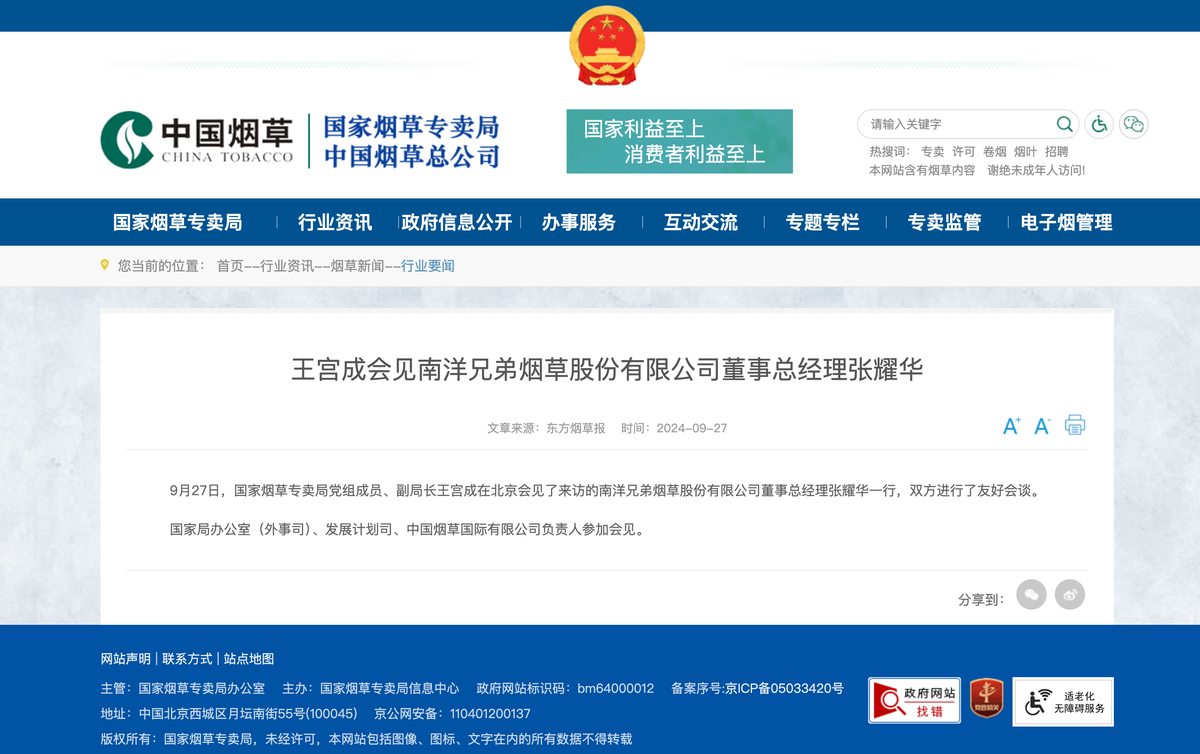
Wang Gongcheng, deputy director of State Tobacco Monopoly Administration, met with Zhang Yaohua from Nanyang Brothers Tobacco in Beijing.

On September 27, Wang Gongcheng, member of the Party Committee and deputy director of the State Tobacco Monopoly Administration, met with Zhang Yaohua, the Director General of Nanyang Brothers Tobacco Co., Ltd., in Beijing. The two sides held friendly discussions.


Officials from the National Bureau of Administration (Department of Foreign Affairs), Development Planning Department, and the China Tobacco International Limited Company attended the meeting.


We welcome news tips, article submissions, interview requests, or comments on this piece.

Please contact us at info@2firsts.com, or reach out to Alan Zhao, CEO of 2Firsts, on LinkedIn


Notice

1.  This article is intended solely for professional research purposes related to industry, technology, and policy. Any references to brands or products are made purely for objective description and do not constitute any form of endorsement, recommendation, or promotion by 2Firsts.

2.  The use of nicotine-containing products — including, but not limited to, cigarettes, e-cigarettes, nicotine pouchand heated tobacco products — carries significant health risks. Users are responsible for complying with all applicable laws and regulations in their respective jurisdictions.

3.  This article is not intended to serve as the basis for any investment decisions or financial advice. 2Firsts assumes no direct or indirect liability for any inaccuracies or errors in the content.

4.  Access to this article is strictly prohibited for individuals below the legal age in their jurisdiction.


Copyright


This article is either an original work created by 2Firsts or a reproduction from third-party sources with proper attribution. All copyrights and usage rights belong to 2Firsts or the original content provider. Unauthorized reproduction, distribution, or any other form of unauthorized use by any individual or organization is strictly prohibited. Violators will be held legally accountable.

For copyright-related inquiries, please contact: info@2firsts.com


AI Assistance Disclaimer


This article may have been enhanced using AI tools to improve translation and editorial efficiency. However, due to technical limitations, inaccuracies may occur. Readers are encouraged to refer to the cited sources for the most accurate information.

We welcome any corrections or feedback. Please contact us at: info@2firsts.com

Russia Proposes Mandatory Labelling of E-cigarettes from April 1, 2026
Russia’s Ministry of Industry and Trade has proposed introducing mandatory labelling for electronic cigarettes and other electronic devices used to consume nicotine, starting April 1, 2026. The draft resolution has been published on the regulatory portal. Under the proposal, market participants would be required to register with the national monitoring system and label products accordingly, as part of efforts to enhance state oversight of production and circulation.
Dec.19 by 2FIRSTS.ai
CBSA discloses seizure of 212,000 nicotine pouches at Pigeon River port of entry
The Canada Border Services Agency said officers inspecting an incoming vehicle at the Pigeon River port of entry in June found 212,000 nicotine pouches and seized more than 29,000 Canadian dollars (about 21,170 U.S. dollars) in currency and cheques. A CBSA spokesperson disclosed the seizure this week in a Newswatch interview about enforcement operations over the past year.
Dec.30 by 2FIRSTS.ai
Thailand to Establish Inter-Agency Committee to Strengthen E-Cigarette Enforcement
The Thai government will establish an inter-agency committee under the Prime Minister’s Office to address the rapid spread of e-cigarettes among youth. Deputy Prime Minister Sophon Sarum said the fragmented enforcement across multiple laws and agencies has created gaps. The new mechanism will coordinate enforcement, report directly to the Cabinet, and propose legal amendments if current laws are insufficient.
Nov.20 by 2FIRSTS.ai
Product | OXVA launches Artio 2 liquid-tobacco pod device, positioned as distinct from HNB and traditional flavored e-cigarettes
OXVA has released its Artio 2 pod device featuring the Liquid Tobacco Intelligent (LTI) platform. It offers around 400 puffs per charge, pods equivalent to about 35 cigarettes, five tobacco and shisha flavors, and a 900mAh battery with 30-minute fast charging. The company positions the device as distinct from HNB and traditional flavored e-cigarettes.
Nov.27 by 2FIRSTS.ai
BAT rolls out VELO nicotine pouches in Argentina as social media buzzes about ZYN distribution
BAT Argentina says it has launched VELO nicotine pouches in Argentina, positioning the product as an adult alternative that contains no tobacco and involves no combustion. At the same time, social media discussion and media reporting indicate that Philip Morris International’s ZYN nicotine pouches are also being distributed through Argentine channels.
Jan.12 by 2FIRSTS.ai
2FIRSTS Data Insight|China’s Vape Exports to the U.S. Hit a Record $590 Million: A Peak Driven by Enforcement Cycles, Not Real Demand
China’s vape exports to the U.S. surged to a record $590 million in October 2025—nearly double the usual monthly level and pushing the U.S. share above 50% of China’s global shipments.But the spike was not driven by demand. Instead, it reflected a temporary release created by tightened U.S. enforcement, a collapsed logistics pathway, and a bullwhip-style surge in replenishment.The peak signals more volatility ahead, not recovery.
Special Report
Nov.24