Key Takeaways
- Namibia’s deputy minister of health Susan Ndjaleka said the government is amending the Tobacco Products Control Act to address emerging tobacco products.
- Namibia is also working toward joining the protocol to eliminate illicit trade in tobacco products to curb the black market and protect public revenue.
- WHO country representative Richard Banda said Africa is at a turning point, with about 61 million tobacco users.
- Public health expert Nalucha Mulenga said Namibia has a reasonable legislative foundation, but the gap between policy and practice remains a persistent challenge.
- Mulenga said e-cigarettes and heated tobacco products are being aggressively marketed through social media platforms that directly reach young Namibians, while many young people see these products as harmless.
2Firsts, April 17, 2026
According to the report, Namibia is moving to tighten laws on e-cigarettes and other emerging nicotine products as part of efforts to strengthen tobacco control.
Namibia says it is amending tobacco law to cover emerging products
Deputy minister of health Susan Ndjaleka said the government is reviewing the Tobacco Products Control Act to close regulatory gaps. Speaking at the Africa Tobacco Control Core Partners Biannual Coordination meeting in Windhoek on Tuesday, she said Namibia is in the process of amending the law to address emerging tobacco products.
Namibia is also seeking to join the illicit trade protocol
Ndjaleka also said Namibia is working toward joining the Protocol to Eliminate Illicit Trade in Tobacco Products in order to curb the black market and protect public revenue.
The meeting brought together partners including the World Health Organization and the Bill & Melinda Gates Foundation. The report said this comes at a time when Africa is being targeted by tobacco companies as regulations tighten in other regions.
WHO says Africa is at a turning point
WHO country representative Richard Banda said the continent is at a turning point, with about 61 million tobacco users.
Experts say enforcement remains a major weakness
Public health expert Nalucha Mulenga said Namibia has laws in place, but implementation is weak. She said Namibia has a reasonable legislative foundation, but legislation alone is insufficient without robust enforcement, and that the gap between policy and practice remains a persistent challenge.
She said stronger monitoring and compliance are needed and warned about growing use of new nicotine products among young people.
Experts say new nicotine products are reaching young people through social media
Mulenga said e-cigarettes and heated tobacco products are aggressively marketed through social media platforms that reach young Namibians directly. She said what makes this especially dangerous is the perception among young people that these products are harmless, and that this perception increases risk.
She also said tobacco use is a primary driver of non-communicable diseases and is placing increasing strain on Namibia’s health infrastructure, while smoking is also worsening conditions such as tuberculosis.
Illicit trade and youth access remain major concerns
Mulenga added that smuggled and counterfeit tobacco products are sold at prices that bypass taxation entirely, and said that when consumers can access cheap, unregulated cigarettes, the deterrent effect of official pricing is neutralized. She said Namibia’s role as a transit economy increases the risk.
She also said the window for regulating new nicotine products before they become normalized among Namibia’s youth is narrowing rapidly, and that acting decisively now is more cost-effective than managing the consequences later.
Retailers say demand is rising and minors are hard to screen
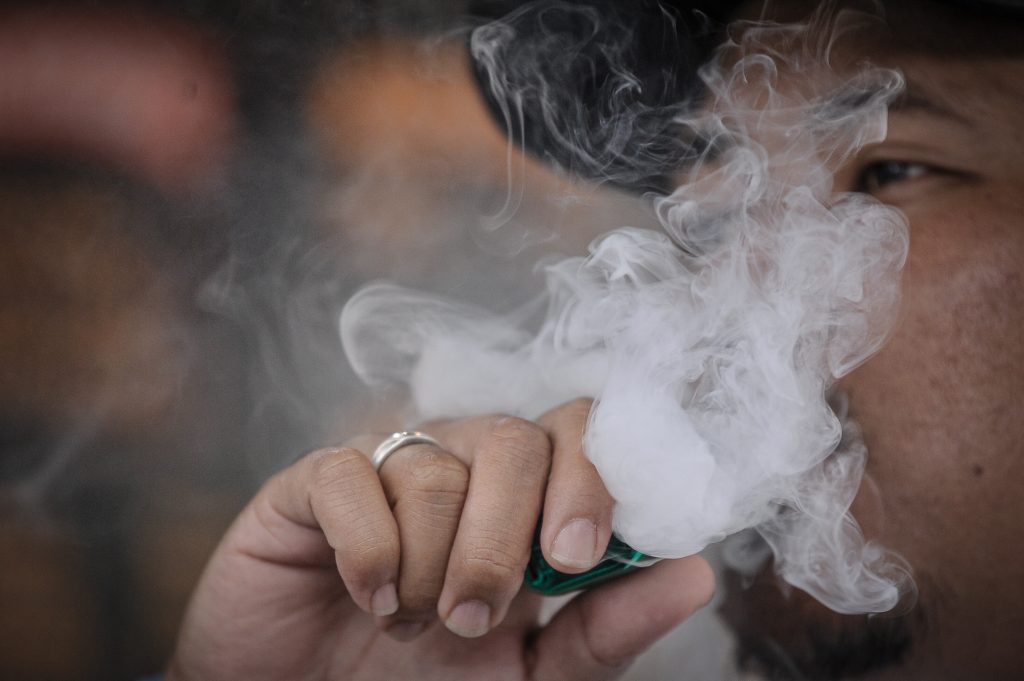
The report added that these products remain easy to access in practice. A vape shop owner in Windhoek said he has been selling such products for about two years and that demand is very high, especially from students and young people. He said there have been no complaints and that he believes these products are safer than cigarettes.
The shop owner also said enforcement is inconsistent, saying businesses like his are mostly still operating. He raised concerns about the effect of tighter rules on livelihoods, saying that if the government shuts down or restricts these products, business owners and their employees’ families would be affected.
He also admitted that controlling access by minors is difficult because young people send older friends to buy for them or appear older themselves, and said that even checking ID would not always work.
A 19-year-old student said vaping is common among youth
A 19-year-old student said vaping is very common among young people and that almost everyone they know has tried it. The student said cigarettes are seen as more dangerous, while vaping is treated more as a social activity.
The report said the meeting is expected to end tomorrow.
Image source: Observer 24.
We welcome news tips, article submissions, interview requests, or comments on this piece.
Please contact us at info@2firsts.com, or reach out to Alan Zhao, CEO of 2Firsts, on LinkedIn
Notice
1. This article is intended solely for professional research purposes related to industry, technology, and policy. Any references to brands or products are made purely for objective description and do not constitute any form of endorsement, recommendation, or promotion by 2Firsts.
2. The use of nicotine-containing products — including, but not limited to, cigarettes, e-cigarettes, nicotine pouchand heated tobacco products — carries significant health risks. Users are responsible for complying with all applicable laws and regulations in their respective jurisdictions.
3. This article is not intended to serve as the basis for any investment decisions or financial advice. 2Firsts assumes no direct or indirect liability for any inaccuracies or errors in the content.
4. Access to this article is strictly prohibited for individuals below the legal age in their jurisdiction.
Copyright
This article is either an original work created by 2Firsts or a reproduction from third-party sources with proper attribution. All copyrights and usage rights belong to 2Firsts or the original content provider. Unauthorized reproduction, distribution, or any other form of unauthorized use by any individual or organization is strictly prohibited. Violators will be held legally accountable.
For copyright-related inquiries, please contact: info@2firsts.com
AI Assistance Disclaimer
This article may have been enhanced using AI tools to improve translation and editorial efficiency. However, due to technical limitations, inaccuracies may occur. Readers are encouraged to refer to the cited sources for the most accurate information.
We welcome any corrections or feedback. Please contact us at: info@2firsts.com