CNIPA Targets E-Cigarettes as Key Focus in Crackdown on Trademark Violations

Nov.25.2025
CNIPA Targets E-Cigarettes as Key Focus in Crackdown on Trademark Violations
National Intellectual Property Office issued a notice to strengthen management of illegal use of trademarks, promoting fair competition.

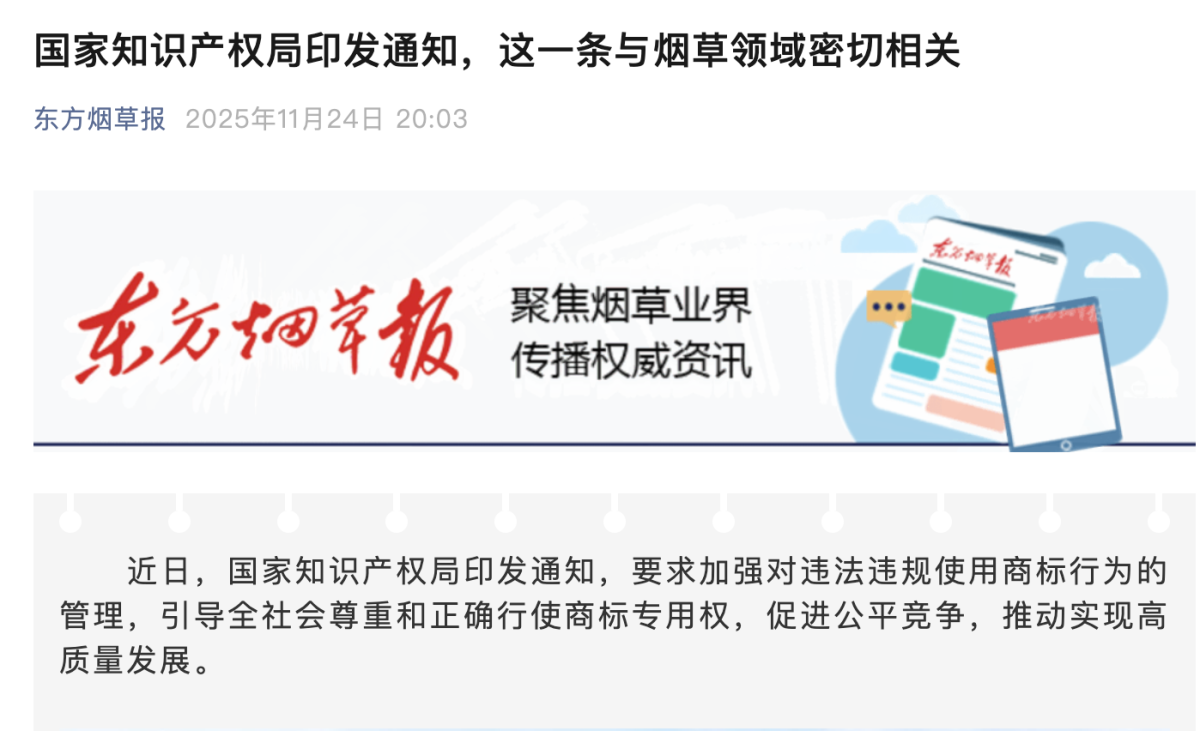
Recently, the National Intellectual Property Office issued a notice requiring the strengthening of management of illegal and improper use of trademarks, guiding all of society to respect and properly exercise trademark rights, promoting fair competition, and driving high-quality development. This information was originally reported in Oriental Tobacco News on November 25, 2025.


In the notice, particular attention is focused on seven types of illegal activities and violations.


(1) Using unregistered trademarks with deceptive features is prohibited.


The focus is on the unauthorized use of trademarks containing terms such as "exclusive," "special," "premium," "national," etc., which misleads the public about the supply channels or quality of goods; the unauthorized use of trademarks containing terms like "selenium-rich," "organic," "additive-free," "100%," etc., where the actual properties of the marked goods do not match the content, causing the public to have misconceptions about the main ingredients, components, etc.; and the unauthorized use of trademarks containing geographical names, years, "handcrafted," "handmade," etc., leading to public misconceptions about the origin, production time, production process, etc., of the goods.


(2) Deceptive use of registered trademarks.


Pay attention to the combination of registered trademarks with product names, advertising slogans, and product packaging designs, which may cause the public to misunderstand the quality, origin, and craftsmanship of the products. Changing the registration details may also lead to misconceptions about the quality of products, or altering them to attach to another person's trademark.


(3) Impersonating a registered trademark for use.


The focus is on the act of displaying a registered trademark symbol or indicating a registered trademark on deceptive unregistered trademarks.


(4) The registered trademark that should have been used but was not used.


Focus on the tobacco industry, particularly on new tobacco products such as e-cigarettes.


(5)Prominent use of the phrase "well-known trademark" in commercial activities.


Pay close attention to the use of the phrase "famous trademark" with a recognized record in advertising campaigns.


(6) Improper use of collective trademarks and certification trademarks.


The focus is on closely monitoring actions involving the use of collective trademarks and proving that goods bearing trademarks do not meet quality requirements under usage management rules.


(7) Trademark agency engaged in illegal representation.


Focus on trademark agencies and their practitioners who engage in malicious trademark registration applications and malicious "withdrawal of three" actions that harm the interests of trademark owners.


We welcome news tips, article submissions, interview requests, or comments on this piece.

Please contact us at info@2firsts.com, or reach out to Alan Zhao, CEO of 2Firsts, on LinkedIn


Notice

1.  This article is intended solely for professional research purposes related to industry, technology, and policy. Any references to brands or products are made purely for objective description and do not constitute any form of endorsement, recommendation, or promotion by 2Firsts.

2.  The use of nicotine-containing products — including, but not limited to, cigarettes, e-cigarettes, nicotine pouchand heated tobacco products — carries significant health risks. Users are responsible for complying with all applicable laws and regulations in their respective jurisdictions.

3.  This article is not intended to serve as the basis for any investment decisions or financial advice. 2Firsts assumes no direct or indirect liability for any inaccuracies or errors in the content.

4.  Access to this article is strictly prohibited for individuals below the legal age in their jurisdiction.


Copyright


This article is either an original work created by 2Firsts or a reproduction from third-party sources with proper attribution. All copyrights and usage rights belong to 2Firsts or the original content provider. Unauthorized reproduction, distribution, or any other form of unauthorized use by any individual or organization is strictly prohibited. Violators will be held legally accountable.

For copyright-related inquiries, please contact: info@2firsts.com


AI Assistance Disclaimer


This article may have been enhanced using AI tools to improve translation and editorial efficiency. However, due to technical limitations, inaccuracies may occur. Readers are encouraged to refer to the cited sources for the most accurate information.

We welcome any corrections or feedback. Please contact us at: info@2firsts.com

Hawaii's Largest Independent Vape Retailer and Wholesaler Volcano to Close All 13 Stores Ahead of 2027 Sales Rules
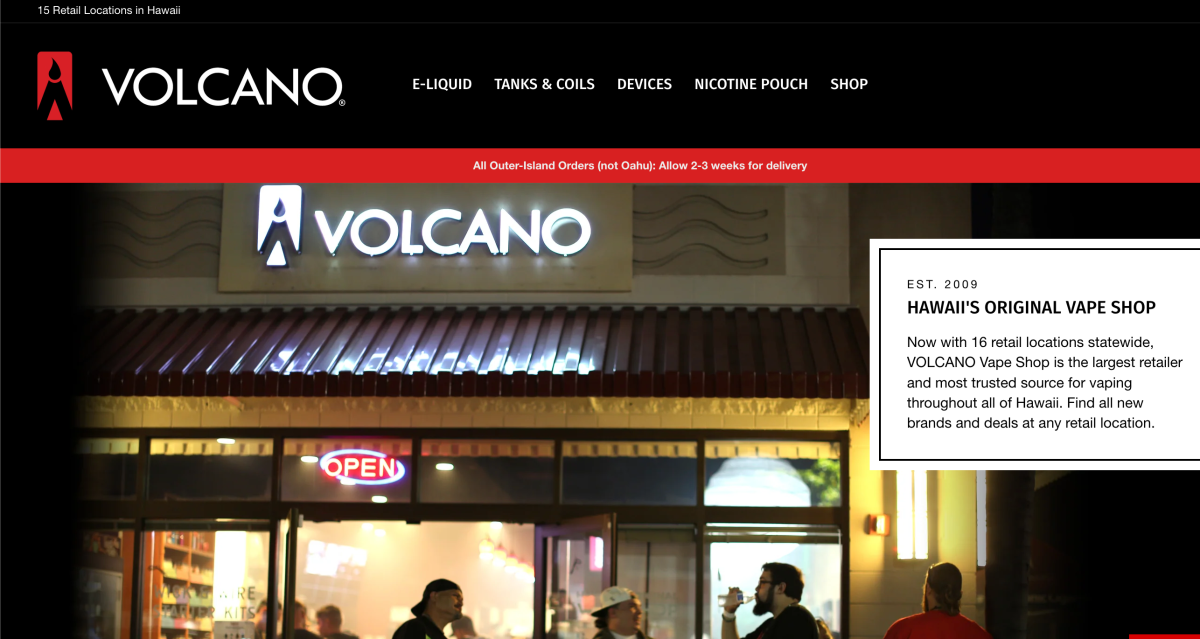
Hawaii-based vaping company Volcano eCigs plans to close all 13 physical retail stores on December 31, 2026, affecting approximately 56 employees. Volcano operates retail, wholesale, proprietary product and online sales businesses and has previously described itself in legislative testimony as Hawaii's largest independent vape retailer and wholesaler. Its operating company, Jocor Enterprises LLC, filed a formal closure notice on November 4, citing changes in the state's regulatory environment. From January 1, 2027, Hawaii will restrict the sale, acquisition and possession of vaping devices and e-liquids not listed in a state product directory, alongside separate restrictions on certain disposable devices. The closure concerns Volcano's physical retail network; the company has not announced the termination of wholesale or online operations.
Market
Nov.09
U.S. Health Groups Seek to Overturn FDA Enforcement Discretion for Pending PMTAs as Altria's Helix, NJOY and AVM Move to Intervene
American Vapor Manufacturers (AVM) and Altria subsidiaries Helix Innovations and NJOY filed separate motions on October 7, 2026, seeking to intervene on the FDA's side in a lawsuit challenging its enforcement guidance for certain e-cigarette and nicotine pouch products with pending premarket tobacco product applications (PMTAs). Seven public health and tobacco-control organizations, including the Campaign for Tobacco-Free Kids, sued the agency in July to overturn the policy. AVM argues that vacating the guidance could disrupt orders, inventory, retail distribution and investments in regulatory submissions.
Regulations
Oct.09
DATA|UK Retail Research Group IGD Says Convenience Tobacco and Vape Sales Fell 10.6%, With 15.4% Market Share Versus Alcohol's 15.1%; Top Rank at Risk in 2027
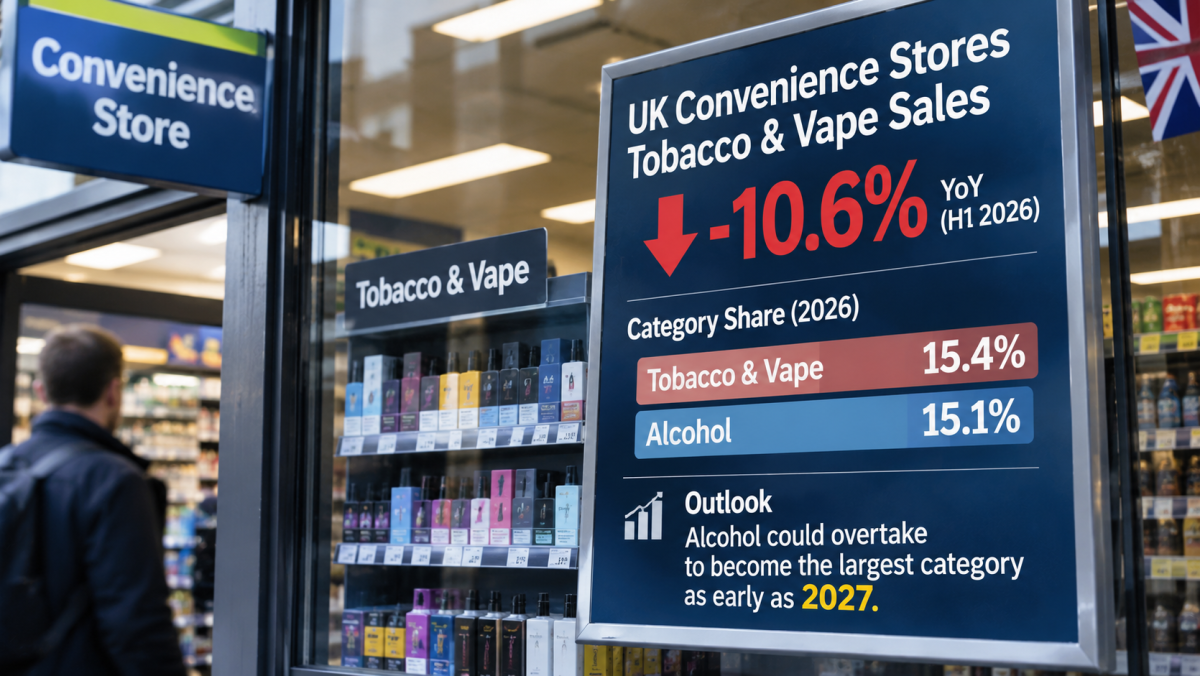
Combined tobacco and vaping sales in UK convenience stores fell 10.6% year over year in the first half of 2026, making the category a major drag on channel performance, according to retail research organization IGD. Total convenience sales declined 1.2%, while sales excluding tobacco and vaping increased 0.7%. IGD's 2026 category-share figures show tobacco and vaping accounting for 15.4% of convenience sales, compared with 15.1% for alcohol. The organization forecasts alcohol could overtake tobacco and vaping as the largest category by sales value as early as 2027 if current trends continue. IGD expects the convenience market to increase from £48.6 billion in 2026 to £54.9 billion in 2031, a 2.5% compound annual growth rate, or 3.4% excluding tobacco and vaping.
DATA
Nov.11
Japanese Addiction Psychiatrist Says Complete Abstinence Is Not Always the Goal of Harm Reduction | 2Firsts Interview
Complete abstinence is not always the goal of addiction treatment under a harm-reduction approach, Japanese psychiatrist Tomohiro Shirasaka told 2Firsts in Manila. In the interview, he discussed patients' quality of life, Japan's shift towards heated tobacco products, and the challenges of quitting smoking for people with mental illness. Drawing on addiction treatment work in the Philippines, he advocated support rather than punishment and questioned whether fear-based health warnings effectively address the reasons people continue smoking.
Nov.10
North Carolina Tightens Vape Product Directory Enforcement, Expands State and Local Powers as Violators Face Fines, Product Seizures and License Suspension or Revocation
North Carolina has expanded enforcement of its vapor product directory rules, authorizing more state and local law enforcement participation and establishing a task force led by the State Bureau of Investigation. The legislation requires at least one unannounced compliance inspection annually for retailers, distributors and wholesalers handling covered products. Penalties effective October 1, 2026, include civil fines of $500–$750 for a first violation and $1,000–$1,500 for repeated violations within 12 months, along with potential license suspension or revocation. Manufacturers may face penalties of $10,000 per unlisted product. The measures strengthen the product directory system established in 2024.
Regulations
Oct.28
Reuters Reveals California Raid on Illegal Vape Factory Involving Geek Bar and Foger, Days After WSJ Reported Importer's $1 Billion Factory Plan and White House Lobbying to Release Detained Vape Imports
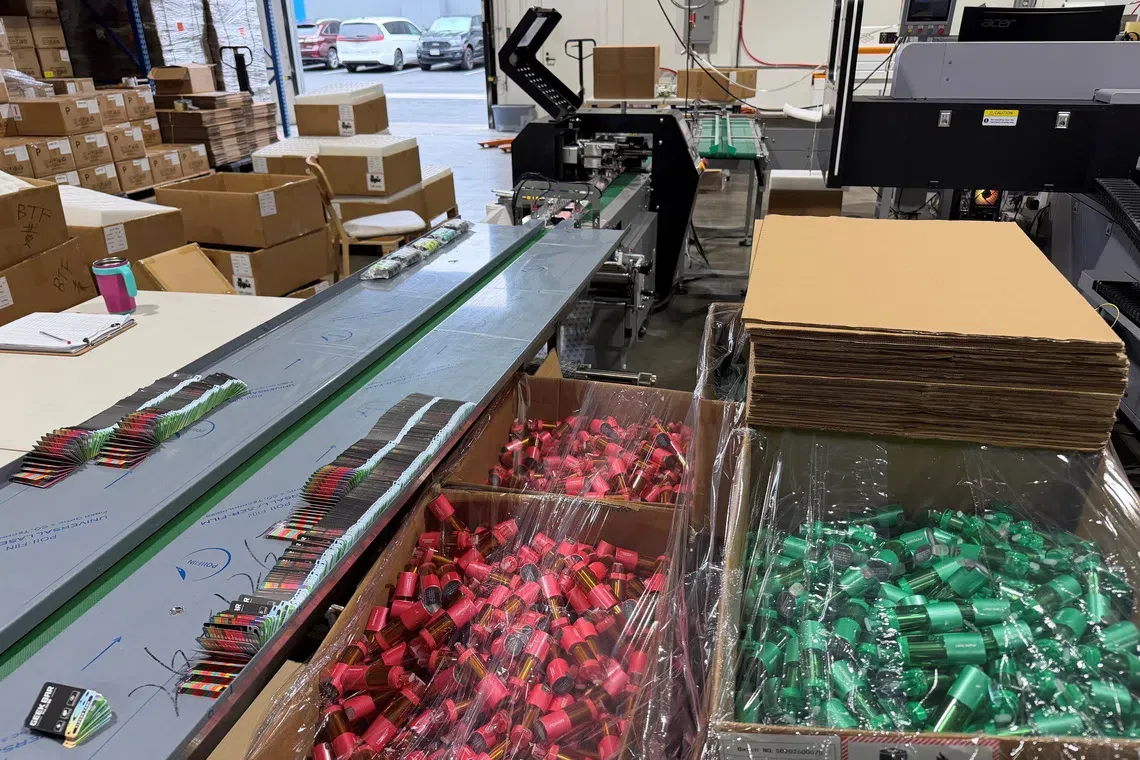
US authorities raided a suspected illegal vape manufacturing facility in Chino, California, on October 30, 2026, discovering production and packaging machinery, unfinished vaping devices and approximately 850,000 vape-related items associated with brands including Geek Bar and Foger, Reuters reported on November 17. A person involved in the investigation said the raid provided concrete evidence of some manufacturing activities involving major Chinese vape labels taking place in the United States. Four days earlier, The Wall Street Journal reported that Hillfield, a US importer of Geek Bar products, had enlisted politically connected advisers to seek the release of detained vape shipments while presenting a $1 billion US manufacturing plan to the White House. No connection between the proposed investment and the raided facility has been established.
Enforcement
Nov.17