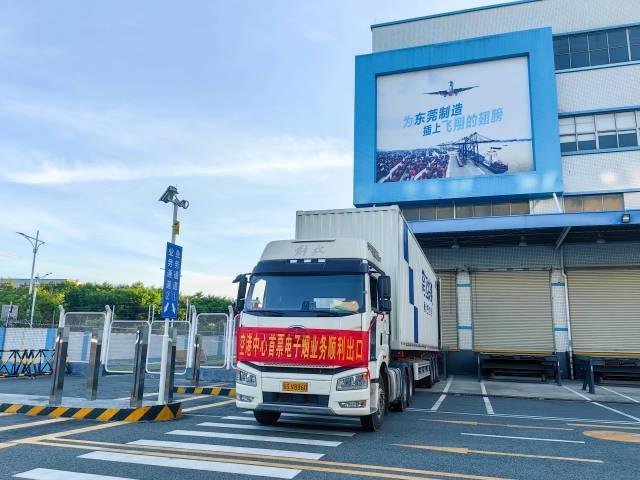
According to a report from Southern Plus on August 5th, batches of e-cigarettes are going through a streamlined process at the "Dongguan-Hong Kong International Airport Center" (referred to as the "Airport Center"). This process involves completing customs clearance, security checks, and boarding procedures all in one place. The e-cigarettes are then transported via the Bay Area Express by sea to the Hong Kong airport terminal, where they are loaded onto airplanes and shipped worldwide.
Dongguan Port International Air Transport (Hong Kong) Co., Ltd., a subsidiary of the Port Group, has become the first registered operator in Hong Kong for the e-cigarette transit monitoring program by the Hong Kong Customs. As of now, the company has successfully completed 8 shipments of e-cigarettes through air transportation, with a total value exceeding 20 million yuan.
It is understood that Dongguan has a strong foundation in the e-cigarette industry. Currently, there are a total of 109 licensed e-cigarette enterprises in Dongguan, with the industry scale reaching nearly 30 billion yuan. In June of this year, the Hong Kong Legislative Council revised the Import and Export Ordinance, which came into effect on June 30th, and included alternative smoking products transported through Hong Kong Airport by sea and air in the exemption category. This means that mainland e-cigarette products can now be exported to various countries around the world through the air-sea intermodal transportation via the Hong Kong Airport, bringing new development opportunities for Dongguan's e-cigarette export business.
To ensure a smooth operation of business at the Airfreight Centre upon the Legislative Council's approval, the Port Authority Group has conducted preliminary research on the e-cigarette industry. They have engaged in extensive discussions with the Hong Kong Civil Aviation Department, Huangpu Customs, and Dongguan Maritime Bureau to address the specifics of the business. Furthermore, they have actively collaborated with freight forwarders, factories, and organized promotional events for the e-cigarette industry. On July 13th, the first batch of e-cigarette products were transported via the Airfreight Centre to Hong Kong International Airport for export to the United States, marking the official launch of the e-cigarette air freight export business at the Airfreight Centre.
The Port Authority Group has announced its commitment to further support the development of e-cigarette companies in Dongguan. They aim to provide enhanced services to these companies and offer flexible, efficient, and cost-effective air freight export channels for e-cigarette products manufactured in Dongguan.
References:
Dongguan e-cigarette exports have found a new channel with 8 shipments already exported.
Disclaimer
This article is provided solely for professional research, industry discussion, and informational purposes. Any references to brands, companies, products, technologies, or policies are made for factual reporting and analytical purposes only, and do not constitute endorsement, recommendation, promotion, or advertising by 2Firsts.
Nicotine-containing products, including but not limited to cigarettes, e-cigarettes, heated tobacco products, and nicotine pouches, carry significant health risks. Readers are responsible for complying with all applicable laws and regulations in their respective jurisdictions, including age restrictions and access limitations.
The information contained in this article should not be regarded as investment, legal, medical, regulatory, or commercial advice. While 2Firsts strives to ensure the accuracy and reliability of its content, it does not assume liability for any direct or indirect loss arising from errors, omissions, inaccuracies, or reliance on the information contained herein.
This article is not intended for individuals below the legal age for accessing tobacco or nicotine-related information in their jurisdiction.
Copyright Notice
This article is either original content produced by 2Firsts or content reproduced, translated, summarized, or adapted from third-party sources with attribution where applicable. The intellectual property rights of the original content remain with 2Firsts or the respective original rights holders.
No individual or organization may copy, reproduce, distribute, republish, modify, translate, or otherwise use this content without prior authorization. Any unauthorized use may result in legal action.
For copyright-related inquiries, corrections, or removal requests, please contact: info@2firsts.com.
AI-Assisted Translation and Editing Notice
Portions of this article may have been translated, edited, or reviewed with the assistance of artificial intelligence tools to improve efficiency and readability. Due to the limitations of AI-assisted translation and editing, discrepancies, omissions, or inaccuracies may exist when compared with the original source.
Where applicable, readers are advised to refer to the original source for the most complete and accurate information. If you identify any errors or believe that any content infringes upon your rights, please contact us at info@2firsts.com, and we will review and address the matter promptly.