New Deadline for Smoking and Vape Laws in South Africa

Regulations by 2FIRSTS.ai
Jun.28.2023
New Deadline for Smoking and Vape Laws in South Africa
According to BusinessTech, the public consultation for South Africa's new tobacco and e-cigarette law will end on July 28th. The law aims to regulate traditional cigarettes and e-cigarettes, which are becoming increasingly popular. The health department introduced the content of the law, which includes regulations on nicotine and non-nicotine e-cigarettes, graphic health warning labels and plain packaging, banning e-cigarette displays at sales points, implementing 100% smoke-free public areas, a

According to a report by Businesstech, the South African health department has announced that the public consultation for the new Tobacco Products and E-cigarette Bill will come to an end on July 28th.


The deadline for public consultation was initially set from June 21 to August 4, 2023. The proposed legislation aims to regulate traditional cigarettes as well as e-cigarettes, which are increasingly gaining popularity as a smoking cessation tool and a consumer nicotine product.


The Ministry of Health has provided an overview of the contents of the bill:


The bill will focus on legislating both nicotine and non-nicotine e-cigarettes; introducing graphic health warning labels and minimalist packaging; prohibiting the display of e-cigarettes at point of sale; establishing 100% smoke-free public areas; and implementing a complete ban on the sale of e-cigarettes in vending machines.


At the beginning of this month, the South African Ministry of Health presented this new bill in parliament. Many stakeholders expressed concerns over the potential ripple effects of the new legislation, as the tobacco industry is currently a vital driver of economic growth in South Africa.


Members of Parliament expressed concerns that the proposed legislation could potentially drive more individuals towards the illicit tobacco market and result in job loss for those involved in the sector.


Asanda Gcoyi, the CEO of the Vapour Product Association of South Africa (VPASA), has stated that e-cigarette products should be viewed as a solution to reducing the harm caused by traditional cigarettes, rather than a new problem.


She said that the South African government is currently demonizing e-cigarettes, considering them to be more destructive than conventional cigarettes. The new bill not only regulates e-cigarettes but also includes them in the tax framework for tobacco products.


Barry Buchman, the managing director at e-cigarette company Vaperite, has stated that the implementation of a consumer tax on e-cigarette products has had negative impacts on retailers, with many fearing that it will drive consumers towards the black market.


Buchman added that the tax policy encourages consumers to purchase e-cigarette liquids with the highest nicotine content and the highest addictive potential. This contradicts the government's original intentions, as it is a more cost-effective option.


References:


【1】New deadline for smoking and vape laws in South Africa


Disclaimer

This article is provided solely for professional research, industry discussion, and informational purposes. Any references to brands, companies, products, technologies, or policies are made for factual reporting and analytical purposes only, and do not constitute endorsement, recommendation, promotion, or advertising by 2Firsts.

Nicotine-containing products, including but not limited to cigarettes, e-cigarettes, heated tobacco products, and nicotine pouches, carry significant health risks. Readers are responsible for complying with all applicable laws and regulations in their respective jurisdictions, including age restrictions and access limitations.

The information contained in this article should not be regarded as investment, legal, medical, regulatory, or commercial advice. While 2Firsts strives to ensure the accuracy and reliability of its content, it does not assume liability for any direct or indirect loss arising from errors, omissions, inaccuracies, or reliance on the information contained herein.

This article is not intended for individuals below the legal age for accessing tobacco or nicotine-related information in their jurisdiction.


Copyright Notice

This article is either original content produced by 2Firsts or content reproduced, translated, summarized, or adapted from third-party sources with attribution where applicable. The intellectual property rights of the original content remain with 2Firsts or the respective original rights holders.

No individual or organization may copy, reproduce, distribute, republish, modify, translate, or otherwise use this content without prior authorization. Any unauthorized use may result in legal action.

For copyright-related inquiries, corrections, or removal requests, please contact: info@2firsts.com.


AI-Assisted Translation and Editing Notice

Portions of this article may have been translated, edited, or reviewed with the assistance of artificial intelligence tools to improve efficiency and readability. Due to the limitations of AI-assisted translation and editing, discrepancies, omissions, or inaccuracies may exist when compared with the original source.

Where applicable, readers are advised to refer to the original source for the most complete and accurate information. If you identify any errors or believe that any content infringes upon your rights, please contact us at info@2firsts.com, and we will review and address the matter promptly.

STIIIZY Redesign Fails to Escape PAX Labs Patent Import Ban as Section 337 Case Also Involves China ALD
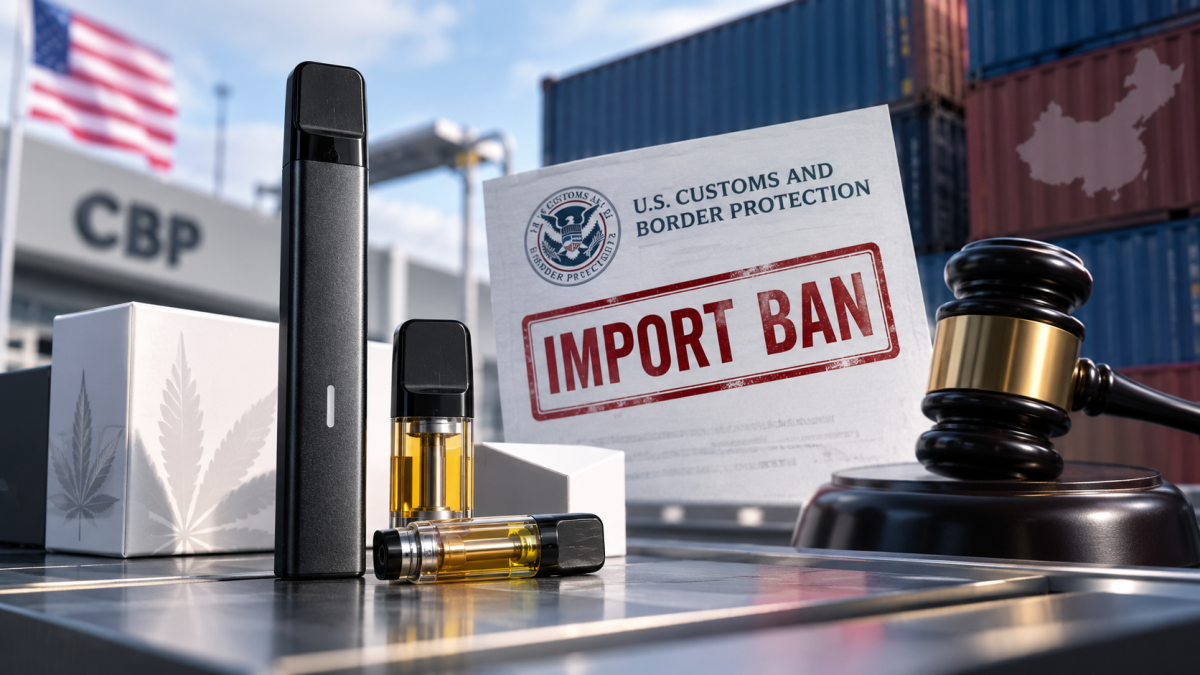
U.S. Customs and Border Protection ruled that STIIIZY had not shown that the redesigned cannabis-vape products covered by its latest request fall outside an ITC limited exclusion order tied to PAX Labs patents. CBP accepted some of STIIIZY’s claim-construction and non-infringement arguments, but the company did not address two additional claims in the same patent. Earlier STIIIZY redesigned cartridges and certain associated components imported with them had received separate CBP clearance.
Sep.16
U.S. Rep. Krishnamoorthi Questions FDA Over Planned PMTA Rewrite, Seeks Communications With Altria and Reynolds
U.S. Rep. Raja Krishnamoorthi on Oct. 6 questioned the FDA over its plan to reassess and potentially replace the 2021 PMTA regulatory framework, asking the agency to identify provisions it may change or eliminate, state whether current scientific evidentiary standards will be maintained, and disclose communications with Altria, Reynolds and other parties challenging the rule. Krishnamoorthi led a congressional investigation into JUUL and youth vaping in 2019 and has since remained active on e-cigarette regulation and enforcement.
Regulations
Oct.08
Product | Philip Morris Korea Launches Two TEREA ONYX Capsule Tobacco Sticks, Expanding Portfolio to Five Lines
Philip Morris Korea launched TEREA ONYX, a new tobacco stick line for IQOS ILUMA devices, on October 15, 2026. The initial products, AMANG PEARL and CALI PEARL, feature tropical-inspired flavors, Fresh Filters and capsules designed to deliver different flavor experiences before and after activation. Both are priced at KRW 4,800 per pack and are available at convenience stores nationwide and IQOS-operated stores in South Korea. The launch expands the Korean TEREA portfolio from four product lines to five, following earlier capsule tobacco stick additions in 2026.
product
Oct.23
Wisconsin Vape Directory One Year On: Retailer Reports Four Store Closures and 70% Staff Cuts
Wisconsin's electronic vaping device directory has been fully enforced for more than a year, and local vape retailers say the reduced range of eligible products has contributed to declining sales, store closures and layoffs. Johnny Vapes owner Ben Hall said he has closed four of seven locations and cut about 70% of his staff. State law bars the sale of vaping devices not listed on the Wisconsin Department of Revenue directory and allows penalties of $1,000 per day for each unlisted device sold or offered for sale. In April 2026, the U.S. Court of Appeals for the Seventh Circuit allowed enforcement of the law to continue.
Regulations
Oct.10
China Tobacco Yunnan files patent for cellulose-free nicotine pouch scaffold to replace microcrystalline cellulose
China Tobacco Yunnan Industrial Co., Ltd. has filed a patent application for a cellulose-free scaffold material for nicotine pouches, proposing a combination of bioceramic material, polydextrose and sugar alcohols to replace conventional microcrystalline cellulose and cellulose derivatives. The filing aims to address issues including powdery mouthfeel, residue and limited release control, while also reducing reliance on existing cellulose-based patent portfolios. In patent examples, one fast-release formulation reached a nicotine release rate of 50% at 10 minutes and more than 90% at 20 minutes.
Sep.02
Australia Adds 6-Methylnicotine to Schedule 9 Prohibited Substances, Effective October 1
Australia's Therapeutic Goods Administration published a final decision on September 25 to classify 6-methylnicotine as a Schedule 9 prohibited substance under the Poisons Standard, effective October 1, 2026. TGA said the chemical has been reported in e-cigarette liquids sold in Australia and marketed as nicotine-free or nicotine alternatives, while evidence also indicates its use in preparations such as oral pouches. The government originally proposed a Schedule 7 classification but ultimately adopted the stricter Schedule 9 designation, citing acute toxicity, dependence risk, use in unapproved consumer products and misleading marketing.
News
Sep.29 by 2Firsts Perspectives