New Irish Law Requires Costly Licenses for Vape Shops

Jun.19.2023
New Irish Law Requires Costly Licenses for Vape Shops
Irish e-cigarette shops may face a €500 annual license fee under new laws, aimed at banning temporary stalls and vending machines.

According to the Irish Examiner, the Irish Health Minister, Stephen Donnelly, is considering setting a license fee of €500 per year for every e-cigarette retail store. This would mean that e-cigarette retailers with multiple storefronts in the country will be facing fees of thousands of euros annually.


However, under the current tobacco retail system, a one-time registration fee of only 50 euros allows retailers to operate an unlimited number of e-cigarette retail stores at any time.


The new licensing system is expected to be implemented this fall. In addition to a price increase, licenses will only be granted to business owners who have operated in the location for at least 12 months, as the government aims to eradicate temporary stalls. The move will prohibit the sale of tobacco products and e-cigarettes at music festivals, as well as the sale of such products from vending machines.


Reference:


Vape companies could be required to pay thousands of pounds for licenses under new legislation.


Disclaimer

This article is provided solely for professional research, industry discussion, and informational purposes. Any references to brands, companies, products, technologies, or policies are made for factual reporting and analytical purposes only, and do not constitute endorsement, recommendation, promotion, or advertising by 2Firsts.

Nicotine-containing products, including but not limited to cigarettes, e-cigarettes, heated tobacco products, and nicotine pouches, carry significant health risks. Readers are responsible for complying with all applicable laws and regulations in their respective jurisdictions, including age restrictions and access limitations.

The information contained in this article should not be regarded as investment, legal, medical, regulatory, or commercial advice. While 2Firsts strives to ensure the accuracy and reliability of its content, it does not assume liability for any direct or indirect loss arising from errors, omissions, inaccuracies, or reliance on the information contained herein.

This article is not intended for individuals below the legal age for accessing tobacco or nicotine-related information in their jurisdiction.


Copyright Notice

This article is either original content produced by 2Firsts or content reproduced, translated, summarized, or adapted from third-party sources with attribution where applicable. The intellectual property rights of the original content remain with 2Firsts or the respective original rights holders.

No individual or organization may copy, reproduce, distribute, republish, modify, translate, or otherwise use this content without prior authorization. Any unauthorized use may result in legal action.

For copyright-related inquiries, corrections, or removal requests, please contact: info@2firsts.com.


AI-Assisted Translation and Editing Notice

Portions of this article may have been translated, edited, or reviewed with the assistance of artificial intelligence tools to improve efficiency and readability. Due to the limitations of AI-assisted translation and editing, discrepancies, omissions, or inaccuracies may exist when compared with the original source.

Where applicable, readers are advised to refer to the original source for the most complete and accurate information. If you identify any errors or believe that any content infringes upon your rights, please contact us at info@2firsts.com, and we will review and address the matter promptly.


Former FDA Scientist Questions ZYN Review Over Pouch Material and Microplastic Risk
A former FDA toxicologist has questioned whether the agency fully assessed the material used in ZYN nicotine pouches before authorizing them for sale, raising concerns over possible microplastic exposure, according to STAT and The Examination.
Jul.16
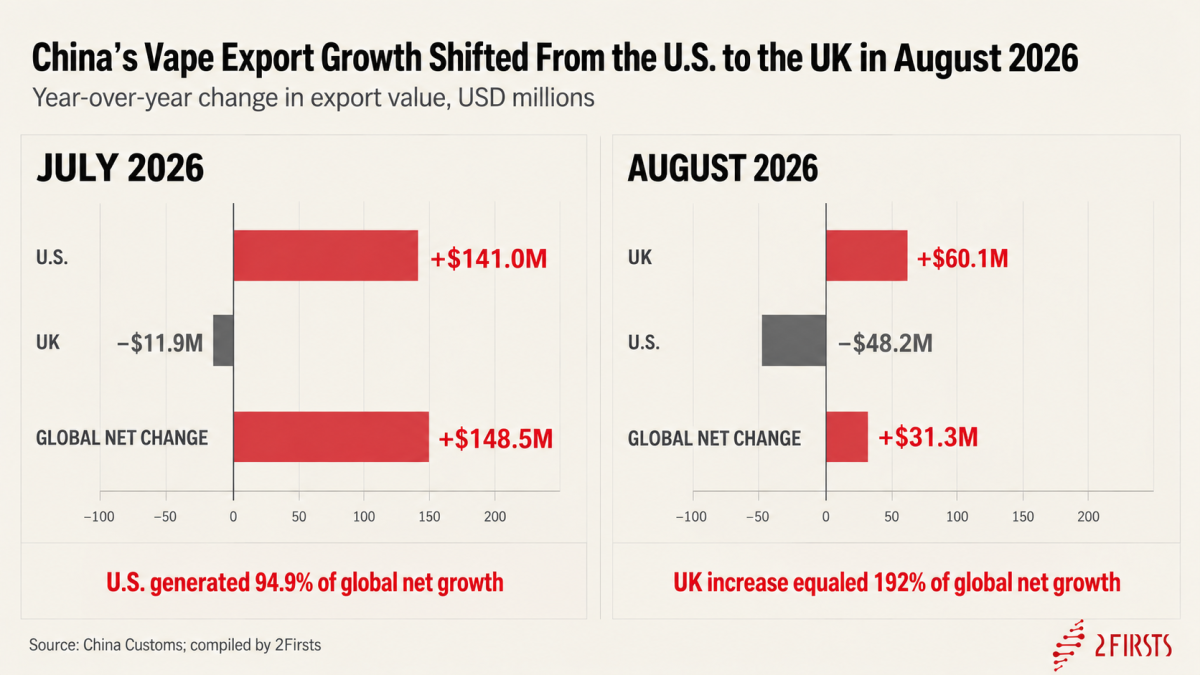
2Firsts Data | China’s Vape-Related Exports Rise 16.5% in July 2026 as U.S.-Bound Shipments Jump 53.5%
China’s vape-related exports reached $1.047 billion in July 2026, up 16.5% year on year and the highest monthly total of the year. Growth was heavily concentrated in the U.S., where exports jumped 53.5% to $404 million and accounted for 94.9% of the overall increase. Exports to all other markets rose just 1.2%. By category, nicotine-containing non-combustible products—primarily vapes—under HS24041200 rose 24.7% and generated 95.5% of the total increase. Vape-device exports under HS85434000 fell 0.4%, while other nicotine-substitute products under HS24041990 grew 88.9% but remained comparatively small.
DATA
Aug.24
Science | International Experts Propose a New Smoking Cessation Pathway, Citing Higher Quit Rates With E-Cigarettes Than Nicotine Replacement Therapy
A new expert paper in JAMA urges U.S. clinicians to include nicotine e-cigarettes in smoking-cessation discussions, citing higher quit rates than nicotine replacement therapy. It also stresses that products must deliver enough nicotine to replace cigarettes, dual use should be brief, and complete switching is the goal. 2Firsts argues the recommendations matter beyond clinics: public-health professionals should reassess relative risk, regulators should preserve sufficient product appeal for adult smokers, and manufacturers should focus on helping users quit cigarettes more sustainably.
SCIENCE
Aug.03 by 2Firsts Perspectives
China’s HTP Exports Fell 14.3% in H1 2026 as Russia and Belarus Accounted for 76% Lead
In H1 2026, China’s HS 24041100 exports stood at $1.32 million, down 14.3% YoY, with volume falling 17.2% to 55.33 tons. Market distribution shifted drastically amid overall export drops. Exports to Russia and Belarus totaled $1 million, taking 76.0% of all shipments versus 29.5% in H1 2025. Belarus became the top destination with export value jumping 177.5%, while the Philippines, Singapore and Indonesia’s combined share slumped from 49.3% to 11.2%.Domestically, Yunnan led exporter registrations; Jiangsu and Shanghai were key suppliers, yet Anhui and Sichuan had no exports. Heavy concentration means order or declaration changes for Russia/Belarus greatly affect national aggregate data. The data shows customs entry points (not end markets), covering tobacco consumables only, excluding heating equipment and the complete HTP supply chain.
Aug.11
Italian Court Ends Six-Year Cigarette Excise Dispute, Rejecting Damages Claim
Italy’s Lazio Regional Administrative Court has dismissed an appeal by Italian Tobacco Manufacturing and Manifattura Italiana Tabacco over the cigarette excise calculation mechanism, upholding the minimum tax burden rules and excluding compensation for smaller tobacco operators.
News
Jun.26 by 2Firsts Perspectives
Changing Assumptions in U.S. Cigar Consumption: 2Firsts Interviews Cigar Educator Mechelle Merkerson
U.S. premium cigar culture is shifting toward education, broader choice and deeper links to craftsmanship and origin, cigar educator Mechelle Merkerson told 2Firsts. She sees boutique brands, women consumers and production-region experiences making knowledge central to cigar participation. For global brands, retailers and emerging markets such as China, education may help turn curiosity into sustained engagement.
Special Report
Jul.06