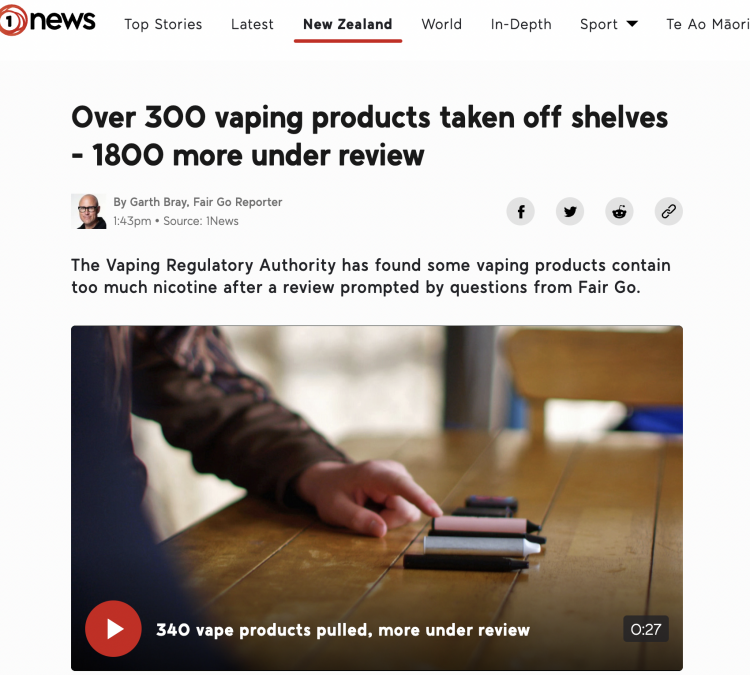
The New Zealand regulatory authority has reviewed over 8000 products that have been notified to its register.
Matthew Burgess, a regulatory agency manager, stated that while no issues were found for most of the reviewed products, there were instances where the information provided by manufacturers or importers indicated that they may contain prohibited ingredients or have nicotine salt levels exceeding legal limits.
After a review, the company has withdrawn notifications for 340 electronic cigarette products, meaning they can no longer be legally sold in New Zealand. We will soon publish a list of products that will no longer be notified on the Ministry of Health's website.
As many as 1,800 electronic cigarette products may still be removed from the market. Authorities are working with the companies that manufacture or sell them and have requested more information by next week.
We have initiated an investigation into the illegal sale of e-cigarettes to underage customers and have discovered a mysterious 14-year-old customer who was unaware that he could purchase e-cigarettes at the counter.
Since then, there has been an ongoing investigation into confusing e-cigarette labels and the high nicotine concentrations found in some e-cigarettes. It appears that certain manufacturers and importers have been selling e-cigarettes with nicotine salts, which contain nicotine levels that exceed legal limits by up to 80%.
Supporters of high-intensity e-cigarettes believe that they provide a closer smoking experience, which they believe is crucial for helping smokers quit.
Advocates for stricter regulation say that the electronic cigarettes here are too potent and can be highly addictive, especially for young users who have not previously smoked.
2FIRSTS will continue to report on this topic and further updates will be available on the "2FIRSTSAPP". Scan the QR code below to download the app.
Disclaimer
This article is provided solely for professional research, industry discussion, and informational purposes. Any references to brands, companies, products, technologies, or policies are made for factual reporting and analytical purposes only, and do not constitute endorsement, recommendation, promotion, or advertising by 2Firsts.
Nicotine-containing products, including but not limited to cigarettes, e-cigarettes, heated tobacco products, and nicotine pouches, carry significant health risks. Readers are responsible for complying with all applicable laws and regulations in their respective jurisdictions, including age restrictions and access limitations.
The information contained in this article should not be regarded as investment, legal, medical, regulatory, or commercial advice. While 2Firsts strives to ensure the accuracy and reliability of its content, it does not assume liability for any direct or indirect loss arising from errors, omissions, inaccuracies, or reliance on the information contained herein.
This article is not intended for individuals below the legal age for accessing tobacco or nicotine-related information in their jurisdiction.
Copyright Notice
This article is either original content produced by 2Firsts or content reproduced, translated, summarized, or adapted from third-party sources with attribution where applicable. The intellectual property rights of the original content remain with 2Firsts or the respective original rights holders.
No individual or organization may copy, reproduce, distribute, republish, modify, translate, or otherwise use this content without prior authorization. Any unauthorized use may result in legal action.
For copyright-related inquiries, corrections, or removal requests, please contact: info@2firsts.com.
AI-Assisted Translation and Editing Notice
Portions of this article may have been translated, edited, or reviewed with the assistance of artificial intelligence tools to improve efficiency and readability. Due to the limitations of AI-assisted translation and editing, discrepancies, omissions, or inaccuracies may exist when compared with the original source.
Where applicable, readers are advised to refer to the original source for the most complete and accurate information. If you identify any errors or believe that any content infringes upon your rights, please contact us at info@2firsts.com, and we will review and address the matter promptly.