Official List of Registered E-Cigarette Products in Italy

Mar.15.2023
Official List of Registered E-Cigarette Products in Italy
Italy allows sale of 22,729 registered e-cigarette products with 10,322 containing nicotine and 12,407 without, subject to customs and agency approval.

Recently, the Italian Customs and Monopoly Agency (ADM) released a list of electronic cigarette products allowed for sale in the country. The data revealed that a total of 22,729 electronic cigarette products have been officially registered in Italy.


Among them, there are 10,322 types containing nicotine and 12,407 types not containing nicotine.


It is reported that electronic cigarettes and e-cigarette oils can only be released onto the market in Italy after being registered with customs and authorized retailers. To prevent counterfeiting, these authorized retailers regularly publish a product list on their official website for retailers to check before making purchases. The latest revision was made on March 8th.


Partial list | Photo source: Agenzia delle Dogane e Monopoli official website.


Disclaimer

This article is provided solely for professional research, industry discussion, and informational purposes. Any references to brands, companies, products, technologies, or policies are made for factual reporting and analytical purposes only, and do not constitute endorsement, recommendation, promotion, or advertising by 2Firsts.

Nicotine-containing products, including but not limited to cigarettes, e-cigarettes, heated tobacco products, and nicotine pouches, carry significant health risks. Readers are responsible for complying with all applicable laws and regulations in their respective jurisdictions, including age restrictions and access limitations.

The information contained in this article should not be regarded as investment, legal, medical, regulatory, or commercial advice. While 2Firsts strives to ensure the accuracy and reliability of its content, it does not assume liability for any direct or indirect loss arising from errors, omissions, inaccuracies, or reliance on the information contained herein.

This article is not intended for individuals below the legal age for accessing tobacco or nicotine-related information in their jurisdiction.


Copyright Notice

This article is either original content produced by 2Firsts or content reproduced, translated, summarized, or adapted from third-party sources with attribution where applicable. The intellectual property rights of the original content remain with 2Firsts or the respective original rights holders.

No individual or organization may copy, reproduce, distribute, republish, modify, translate, or otherwise use this content without prior authorization. Any unauthorized use may result in legal action.

For copyright-related inquiries, corrections, or removal requests, please contact: info@2firsts.com.


AI-Assisted Translation and Editing Notice

Portions of this article may have been translated, edited, or reviewed with the assistance of artificial intelligence tools to improve efficiency and readability. Due to the limitations of AI-assisted translation and editing, discrepancies, omissions, or inaccuracies may exist when compared with the original source.

Where applicable, readers are advised to refer to the original source for the most complete and accurate information. If you identify any errors or believe that any content infringes upon your rights, please contact us at info@2firsts.com, and we will review and address the matter promptly.

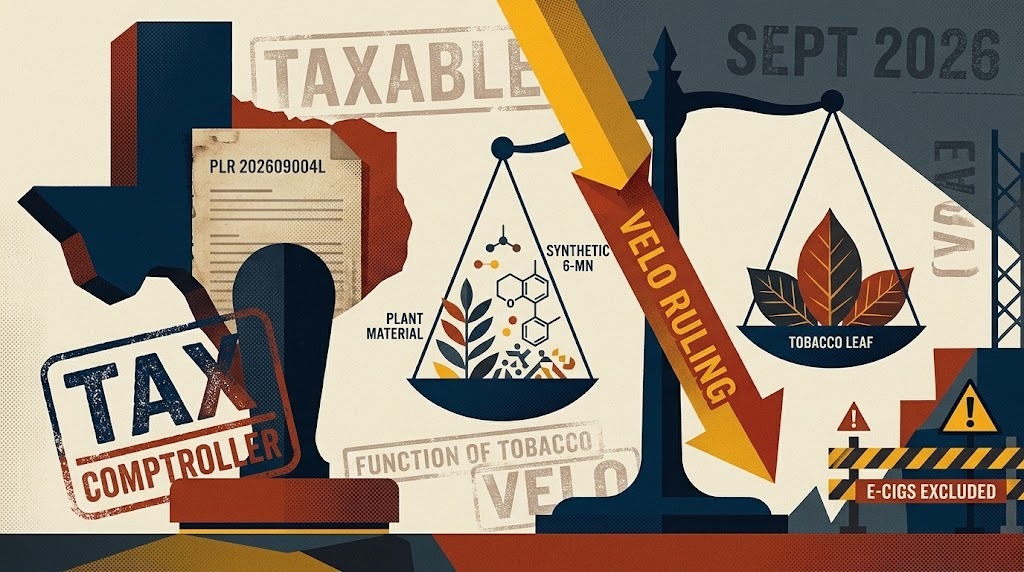
Texas Extends Tobacco Tax Interpretation to a 6-Methylnicotine Product, Citing VELO Ruling
The Texas Comptroller of Public Accounts ruled in September 2026 that a combustible product made with non-tobacco plant material and 6-methylnicotine (6-MN), a synthetic nicotine analog, qualifies as a taxable tobacco product. The applicant said the product contained neither tobacco leaf nor measurable conventional nicotine. The determination applies reasoning from a May Texas Supreme Court decision involving VELO nicotine pouches, finding that the plant material and 6-MN together perform the functions of tobacco in a conventional smoking product. The ruling carries applicable tax, licensing and reporting obligations but is limited to the facts submitted by the taxpayer. It does not establish a blanket tax classification for all 6-MN products or extend the same conclusion to e-cigarettes.
Regulations
Nov.06
New York City Opens Lottery for 55 Vape Retail License Slots Across 23 Community Districts, Including 28 in Brooklyn
New York City's Department of Consumer and Worker Protection (DCWP) opened applications on November 2, 2026, for a lottery covering tobacco and electronic cigarette retail dealer licenses, with a deadline of 5 p.m. New York local time on November 30. According to the city's October 1 notice, 55 electronic cigarette retail license slots are available across 23 community districts, including 28 in Brooklyn, alongside 322 tobacco retail license slots across 41 districts. Businesses must enter the lottery and, if invited, complete licensing requirements within 65 days. New York City continues to restrict e-cigarette retail sales to tobacco-flavored or unflavored products, while city retail licenses do not replace FDA product marketing authorization.
Market
Nov.04
Smoke-Free Business Hits 42% of Q2 Net Revenue as PMI’s First TNFD Report Covers Single-Use Electronics, Critical Raw Materials and IQOS Repairs
Philip Morris International has published its first report aligned with the Taskforce on Nature-related Financial Disclosures, bringing its electronics supply chain and the use and end-of-life stages of smoke-free devices and consumables into its nature-related assessment. PMI said its smoke-free business accounted for about 42% of total net revenues in the second quarter of 2026. The report says non-circular electronic products, particularly single-use items, can increase consumption of limited natural resources and also details an IQOS repair pilot. A 2040 circularity scenario tests assumptions including a 50% reduction in product waste-related costs, 10% raw-material savings and a 25% substitution rate for refurbished products versus new products.
Sep.23
Swedish Match Faces Broader Labeling Order After ZYN Inspection, Documents Obtained by 2Firsts Show
Documents obtained by 2Firsts show that Sweden's Public Health Agency ordered Swedish Match to revise ingredient labels beyond the five ZYN products inspected. The dispute centers on whether flavoring ingredients must be individually disclosed, with Swedish Match citing trade-secret protection and the regulator insisting on full ingredient disclosure. The company faces a conditional penalty of SEK 2 million per month for noncompliance. As of October 22, the agency had received no appeal, despite the company's stated intention to challenge the decision.
Oct.22
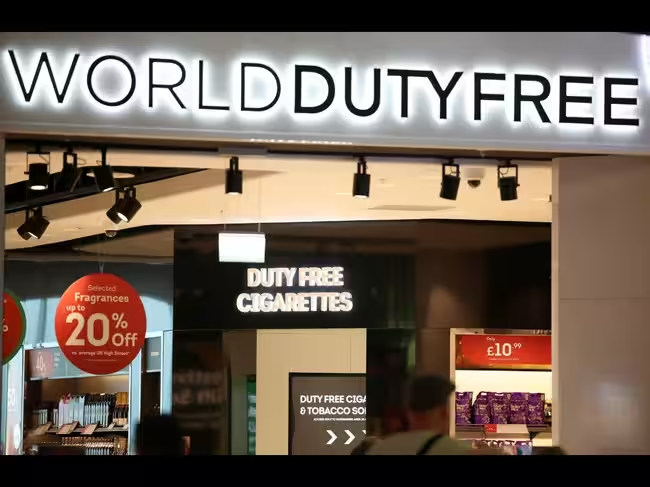
India Duty-Free Nicotine Pouch Sales Face Regulatory Test as ZYN, FOX Classification Remains Open
The Bombay High Court has ruled that airport duty-free shops are not exempt from India's domestic regulatory laws merely because they operate beyond the customs barrier, leaving in place a sales halt covering ZYN and FOX nicotine pouches at Mumbai's international airport. The court, however, did not determine that the products necessarily qualify as "drugs" under India's Drugs and Cosmetics Act. The retailers have four weeks to submit product information to the appropriate authorities, including CDSCO, which must complete its review within 30 days of receiving the submissions.
Sep.24
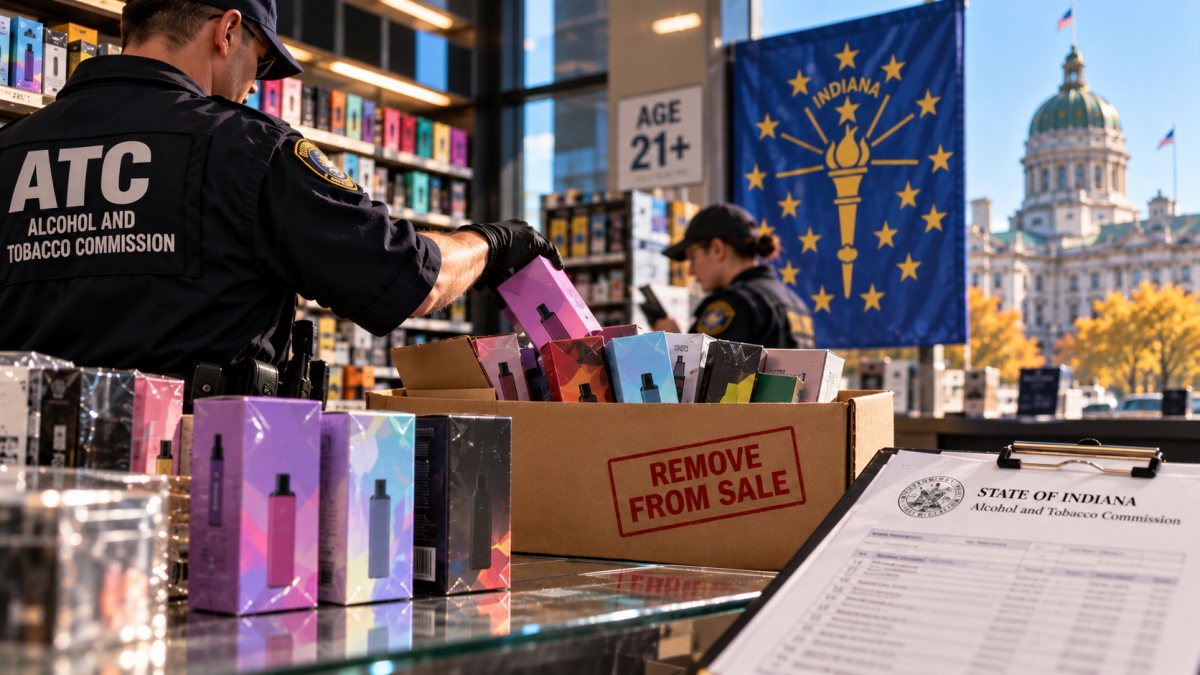
Indiana Halts Sales of Elf Bar, Lost Mary, MR FOG and iJOY Vapes Under Foreign-Adversary Rules; Some Products Return After Compliance Filings
Indiana's Alcohol and Tobacco Commission (ATC) ordered tobacco certificate holders in September to remove certain vaping products marketed under Elf Bar, Lost Mary, MR FOG, iJOY and other brands from inventory under the state's foreign-adversary product law. The agency later listed 257 MR FOG products and 77 Lost Mary product entries as lawful for sale. The Lost Mary revision expressly stated that compliance evidence had been received for 20 additional products. 2Firsts compliance expert Kurt said potential filings could include e-liquid and ingredient-origin records, U.S. nicotine-analog supply-chain documentation and FDA premarket application status.
Regulations
Oct.08