
Key Points
In written comments provided to 2Firsts, the two experts expressed the following views:
- Smokers’ alternatives: EU policymakers should not assess e-cigarettes, heated tobacco products and nicotine pouches only through a risk-prevention lens, but also consider their possible role in helping adult smokers move away from cigarettes.
- Relative risk: For adults who already smoke, the relevant comparison is not only non-use of nicotine products, but also the real-world alternative of continued cigarette smoking.
- Policy attribution: The experts argued that the decline in EU smoking rates should not be attributed too narrowly to EU-level rules such as the TPD, without considering taxation, cessation services, enforcement, illicit markets, social norms and consumer substitution.
- Flavours and proportionality: While supporting youth protection, the experts warned that blanket flavour bans or very low nicotine limits could weaken the appeal of alternatives for adult smokers and risk pushing some users back to cigarettes or informal markets.
- Science and consumer input: The experts called for more independent scientific evidence and consumer experience to be included before policy directions are fixed, warning against reducing a complex regulatory debate to a narrow risk-control exercise.
2Firsts
June 1, 2026
The European Commission’s review of EU tobacco and advertising rules has moved from evaluation to public feedback, opening a policy debate over how the bloc should regulate cigarettes, e-cigarettes, heated tobacco products and nicotine pouches.
In early April, the Commission published its evaluation of the EU tobacco control framework, saying smoking rates had fallen from 28% to 24% since 2012 and tobacco-related deaths had also declined. The same report identified e-cigarettes, heated tobacco products and nicotine pouches as emerging public-health concerns, particularly in relation to youth uptake, product attractiveness and online promotion.
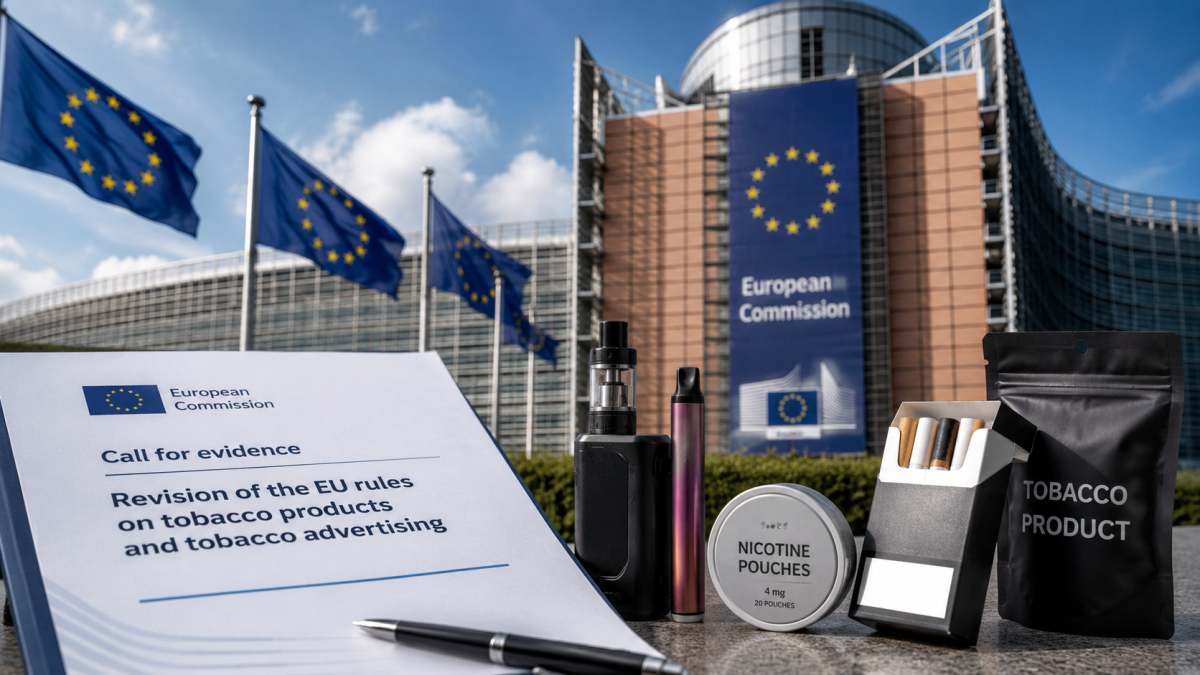
On May 18, the Commission opened a call for evidence on revising the Tobacco Products Directive (TPD) and Tobacco Advertising Directive (TAD). The feedback period runs until June 15, before a planned 12-week public consultation and expected Commission adoption in the fourth quarter of 2026.
Against this backdrop, Dr Garrett McGovern, an Irish physician, and Dr Carmen Escrig, a Spanish researcher and nicotine consumer advocate, provided written comments to 2Firsts by email. The contributors prepared their comments in a question-and-answer format. 2Firsts has summarised the main points below, with the full Q&A reproduced as an appendix.
How Alternatives Are Framed
McGovern and Escrig said the Commission’s evaluation correctly recognises that smoking has continued to decline under the existing EU framework. But they argued that the review gives insufficient weight to the possible role of alternatives such as e-cigarettes, heated tobacco products and nicotine pouches in helping some adults move away from combustible cigarettes.
The reports acknowledge the rapid emergence of alternative nicotine products and the regulatory gaps around them, McGovern noted, but do not fully capture the distinction between combustible smoking and non-combustible alternatives.
“In clinical and public-health terms, that distinction matters a lot,” McGovern said.
For McGovern, the central question is not whether alternative nicotine products carry risk. It is whether, for adults who would otherwise continue to smoke, they may offer a lower-risk route away from cigarettes or a practical “off-ramp” from smoking.
Escrig raised a similar concern from the perspective of consumers. She said many adults do not experience these products as a gateway into smoking, but as a way out of smoking.
“If policymakers focus only on the risks of uptake and not also on the opportunities to displace cigarettes, they risk writing rules that protect the market from change rather than protecting smokers from the most dangerous form of nicotine use,” Escrig said.
Their comments reflect a wider question for EU policymakers: whether future rules should treat all nicotine products mainly through a common risk-prevention lens, or distinguish more sharply between combustible tobacco and non-combustible alternatives.
Smoking Decline: EU Rules or Wider Forces?
The two contributors also questioned how far the fall in smoking can be attributed to EU-level regulation alone.
The report is on firmer ground when it says EU measures likely contributed to the direction of travel, McGovern said. But he said it is less convincing when trying to isolate how much of the decline can be attributed specifically to the directive, rather than to the wider policy and market environment.
Smoking prevalence, he said, has been shaped over the past decade by a broader mix of factors, including excise increases, national quit-smoking services, smoke-free laws, enforcement intensity, illicit-market dynamics, changing social norms and the arrival of non-combustible nicotine products.
Escrig also questioned whether the report separates the impact of EU rules from the wider environment in which consumer behaviour changes. She pointed to taxation, national rules on flavours and access, quit services, enforcement, price, product availability, illicit supply and whether lower-risk substitutes are accessible or discouraged.
Escrig concluded that the report identifies a plausible contribution from EU measures, but does not convincingly quantify that contribution against the broader conditions affecting smokers’ choices.
If the decline in smoking is attributed too confidently to existing EU rules, the experts warned, future policy may give too little attention to other forces that could have contributed to the shift, including consumer substitution and national-level differences in regulation and enforcement.
The Relative-Risk Divide
On risk assessment, McGovern and Escrig drew a sharp distinction between absolute risk and relative risk.
The Commission’s evaluation and call-for-evidence materials emphasise youth uptake, product attractiveness, online promotion and emerging health risks. McGovern and Escrig said those concerns are relevant, particularly for never-users and young people, but may be too narrow when applied to adults who already smoke.
“In medicine, we rarely assess interventions in a vacuum; we assess them against the realistic alternative,” McGovern said. For a long-term smoker who has repeatedly failed to quit, he said, the more relevant comparison may be continued cigarette smoking.
Escrig added that consumers are rarely choosing between nicotine use and “perfect abstinence” in the abstract. Many are choosing between continuing to smoke and trying something else.
That distinction matters when regulators consider restrictions on flavours, product formats, communications or taxation, the experts said. Such measures may reduce experimentation among young people, but they warned that the same measures could also reduce switching among adults who smoke, or make alternatives less acceptable to those who have already moved away from cigarettes.
McGovern and Escrig said future rules should be tested against two objectives at the same time: preventing youth uptake and enabling adult smokers to move away from combustible products.
Flavours, Precaution and Unintended Effects
The Commission and related technical assessments have pointed to uncertainty around the long-term health effects of novel nicotine products as a reason for caution. McGovern and Escrig accepted the need for caution, but argued that uncertainty should not automatically justify the strictest possible rules across every product category.
McGovern said policymakers should treat long-term uncertainty as a reason for caution, but not as a substitute for proportionate analysis. A proposed restriction, he said, should be assessed according to whether it is supported by robust evidence, addresses a clearly identified harm and avoids unintended consequences for adults who might otherwise switch away from cigarettes.
He said he would support strong health warnings and enforcement against youth-oriented marketing and retail practices, because those are directly linked to informed choice and prevention. But he said he would be more sceptical of blanket flavour bans or very low nicotine limits if the evidence for their net public-health benefit remains uncertain, particularly if they make alternatives less acceptable to current smokers.
Escrig made the same argument through consumer behaviour. A flavour ban, she said, might reduce youth appeal, but may also remove one of the features adult switchers say helped them leave cigarettes completely. She also argued that restrictions leaving only tobacco-flavoured products could weaken the appeal of alternatives for adult smokers and, in some cases, push established switchers back toward cigarettes or toward informal markets.
The flavour debate illustrates the policy tension. The Commission has identified flavoured products and colourful packaging as possible risks for youth initiation. The experts argued that for some adults, non-tobacco flavours may help break the sensory and behavioural connection with cigarettes.
Neither expert argued that all flavours or product descriptions should be unrestricted. McGovern said youth appeal remains a serious concern. Escrig said regulators could focus on branding, naming, promotion and retail practices that clearly target minors while preserving enough product variety for adults using alternatives as substitutes for cigarettes.
Calls for Science and Consumer Input
The experts also called for a more transparent evidence process as Brussels moves toward the next stages of the review.
McGovern said regulators need better evidence on whether flavours primarily attract never-smokers and adolescents or materially improve switching and relapse prevention among adults who already smoke. He also said further work is needed on whether lower nicotine limits reduce dependence overall or simply make products less effective substitutes for cigarettes.
For packaging and warnings, he said regulators should assess how messages affect risk perception, including whether they inform consumers without blurring the distinction between combustible and non-combustible products. On emissions testing and device rules, he said the science should identify which ingredients, emissions profiles and device characteristics are linked to adverse outcomes, rather than relying on broad assumptions across different product categories.
Escrig said consumer voices should also be included. She described Europe’s “90 million adult smokers and around 30 million users of vapes and pouches” as consumers whose needs and behaviours vary widely.
If Brussels considers flavour restrictions, she said, it should examine not only youth appeal but also adult switching, sustained abstinence from cigarettes and the likelihood that users may move to illicit or informal supply if lawful options narrow. If packaging and warnings are tightened, she said, the evidence should test whether they improve understanding or unintentionally imply that all nicotine products are broadly equivalent in risk.
Both experts argued that independent scientists and consumers should be involved before policy directions are fixed, rather than being invited to comment only after the main choices have already been made.
A Long Debate Ahead
The call for evidence is only an early step in a longer EU process. But the outcome could shape the next decade of tobacco and nicotine regulation across the bloc, influencing taxation, trade, market access and business strategy.
More importantly, the choices made in Brussels could affect the harm-reduction options and product safety available to tens of millions of adult consumers. For that reason, the debate should not be reduced to a narrow regulatory exercise. It requires broader, evidence-based and pluralistic discussion, including from policymakers, public-health experts, independent scientists, consumer representatives, industry operators and civil-society groups.
2Firsts will continue to follow the EU process and welcomes further submissions, comments and interview proposals from experts, policymakers, companies and civil-society groups engaged in the debate. Submissions may be sent to Alan Zhao at alan@2firsts.com.
Appendix: Full Q&A Submitted by Dr Garrett McGovern and Dr Carmen Escrig
The following Q&A was provided to 2Firsts by the contributors. The questions and answers were prepared by the contributors and are reproduced below without substantive editing, except for formatting.
The views expressed in the appendix are those of the contributors and do not necessarily reflect the editorial position of 2Firsts.
Q1: What is your overall reading of the EU’s TPD evaluation and the accompanying JRC reports? Do they accurately capture TPD2’s role in reducing smoking across Europe and the possible contribution of alternatives such as vapes, heated tobacco and modern oral products?
Dr Garrett McGovern: My reading is that the evaluation gets one important point right: smoking has continued to decline across the EU under the existing framework, and that should be recognised as a public-health success.
Where I part company with the evaluation’s more cautious tone is on the treatment of alternative nicotine products. The reports acknowledge their rapid emergence and the regulatory gaps around them, but I do not think they fully capture the distinction between the risks of combustible smoking and those of non-combustible alternatives. In clinical and public-health terms, that distinction matters a lot. If the policy goal is to further reduce smoking prevalence and harms from smoking, the key question is not simply whether these alternative products carry some risk that they likely do, but whether they may offer a lower-risk route away from cigarettes, or a practical off-ramp from smoking, for adults who would otherwise continue to smoke. On that point, I find the overall framing more guarded than it needed to be, even if I understand why the Commission is concerned about youth uptake and inconsistent rules across member states.
Dr Carmen Escrig: I would say the reports are somewhat useful, but scientifically incomplete in the way they frame the real-world role of alternative products. From a consumer perspective, many adults do not experience these products as a gateway into smoking; they experience them as a way out of smoking, a possible off-ramp from cigarettes rather than an on-ramp into them. That difference is crucial. The Commission’s evaluation highlights that novel products are not fully covered by the current framework and points to diverging national rules, especially for nicotine pouches, but it is more hesitant when it comes to recognising a potentially positive role in smoking substitution or cessation. That is where I disagree most. If policymakers focus only on the risks of uptake and not also on the opportunities to displace cigarettes, they risk writing rules that protect the market from change rather than protecting smokers from the most dangerous form of nicotine use. So, in short, I agree the reports identify genuine gaps in the law, but I think they understate the potential public-health upside of giving adults who smoke access to clearly regulated alternatives.
Q2: The evaluation credits TPD2 with helping drive smoking down, but the Regulatory Scrutiny Board urged the Commission to better account for outside factors. Does the final report really separate the impact of EU-level rules from taxation, national policy, cessation services, enforcement, illicit trade, consumer behaviour and the rise of novel products?
Dr Garrett McGovern: Not fully, in my view. The report is on firmer ground when it says EU-level measures likely contributed to the direction of travel, but much less convincing when it comes to isolating how much of the decline can be attributed specifically to the directive as opposed to everything happening around it. That is not a trivial distinction. Smoking prevalence has been shaped over the past decade by a broad policy mix: excise increases, national quit-smoking services, smoke-free laws, enforcement intensity, illicit-market dynamics, changing social norms and, increasingly, the arrival of non-combustible nicotine products. The Commission’s own methodology section acknowledges important evidence limitations, while the Regulatory Scrutiny Board criticised the draft for weaknesses in scope and evidence.
Dr Carmen Escrig: I do not think it does, at least not to the standard needed for a confident policy conclusion. The problem is that it still ends up assigning considerable weight to EU-level regulation. As a consumer, I know that taxation alone can have a major effect on smoking behaviour, and broader EU analysis outside the TPD review has pointed to taxes as a substantial driver of decline. On top of that, member states differ enormously in how they regulate flavours, public use, access, quit services and enforcement, while consumer choices are also shaped by price, availability, illicit supply and whether lower-risk substitutes are accessible or discouraged.So, my answer would be: the report identifies a plausible contribution from EU measures, but it does not convincingly quantify that contribution against the wider environment in which consumers’ smoking behaviour actually changes.
Q3: The report largely assesses e-cigarettes, heated tobacco and nicotine pouches through an absolute-risk lens, comparing use with non-use. What does that approach miss when the more relevant comparison, for many adults, is continued cigarette smoking?
Dr Garrett McGovern: In medicine, we rarely assess interventions in a vacuum; we assess them against the realistic alternative. For a 45-year-old smoker who has not quit despite repeated attempts and numerous consultations in the past, the more relevant comparison is continued cigarette smoking. Cigarettes remain the overwhelmingly most dangerous mainstream nicotine product because of combustion and the inhaled smoke with thousands of toxicants. So, if you impose restrictions that make lower-risk products less attractive, less available or less acceptable to adult smokers, you may reduce experimentation among youth but you may also reduce switching among people who currently smoke and you make revert those using these products to smoking again. These trade-offs deserve to be stated much more plainly. The Commission’s own evaluation does not, in my view, deal sufficiently with the possibility that the same measures could also influence whether smokers move away from combustibles at all.
Dr Carmen Escrig: For consumers, an absolute-risk lens on its own is not how decisions are actually made. People who smoke are not choosing between nicotine use and perfect abstinence in the abstract; many are choosing between continuing to smoke and trying something else. So, when the policy discussion is framed primarily around whether vaping, heated tobacco or nicotine pouches carry risk compared with non-use, it can miss the practical decision point facing adults who smoke. The Commission’s public materials emphasise youth uptake, gateway concerns and the need to adapt the rules to emerging risks. I understand that. But if the framework gives insufficient weight to relative risk, then restrictions on flavours, product formats, communications or taxation may end up making the alternatives less compelling precisely for the adults most likely to leave cigarettes behind. The result can be perverse for consumers: rules designed to reduce overall harm may protect the worst product category by making substitutes less usable or less attractive. That does not mean there should be no restrictions; it means they should be risk-proportional and tested against both goals at once—preventing youth uptake and enabling adult switching.
Q4: The evaluation points to uncertainty around the long-term health effects of novel products as a reason for strict regulation. How should policymakers interpret that uncertainty and is it enough, on its own, to justify measures such as flavour bans, lower nicotine limits, plain packaging, stronger warnings or tighter product controls?
Dr Garrett McGovern: A sense of proportionality is much needed in this discussion. Policymakers should treat long-term uncertainty as a reason for caution, but not as a substitute for proportionate analysis. That is the key distinction. The Joint Research Centre says the evidence base for these products is still weighted toward short- and medium-term outcomes, with long-term risks not yet fully knowable because the products have not been on the market long enough. It also says a precautionary approach is warranted. I think that is fair. But precaution does not automatically mean the strictest possible rule in every category and dimension. It should mean asking, product by product, whether a proposed restriction is supported by robust scientific evidence, whether it addresses a clearly identified harm, and whether it could have unintended consequences for adults who might otherwise switch away from cigarettes. In that sense, I would support robust health warnings and strong enforcement against youth-oriented marketing and retail because those are directly linked to informed choice and prevention. I would be more sceptical about blanket flavour bans or very low nicotine limits if the evidence for their net public-health benefit remains uncertain, particularly if they make alternatives less acceptable to current smokers. The same applies to plain packaging or rigid product-category controls: they may be justified in some contexts, but not simply because there is uncertainty. To me, the right test is whether the evidence is strong enough to show that a specific measure reduces overall harm once both youth uptake and adult switching are taken into account.
Dr Carmen Escrig: Uncertainty should be interpreted honestly: it means we do not yet know everything, not that the most restrictive option is automatically the most justified. A flavour ban, for example, might potentially reduce youth appeal, but it may also remove one of the features adult switchers say helped them leave cigarettes completely. Stricter nicotine limits may sound cautious, but if they make products less satisfying, some users may simply go back to smoking or turn to informal markets. Plain packaging and larger warnings may be more defensible where the aim is transparency and consistency, yet even those measures should be assessed in terms of how they affect perceptions of relative risk. So, I would say the current science is enough to justify a risk-proportionate regulation that is differentiated to cigarettes, monitoring and tighter controls on youth access and marketing. I would not say it is automatically sufficient to justify every restrictive measure across every product type without a clearer account of trade-offs, user behaviour and the possibility of unintended consequences.
Q5: With a revision of the TPD now approaching, what scientific questions still need answering before Brussels moves on flavours, nicotine limits, packaging, health warnings, emissions testing, device rules or nicotine pouches? And how should independent scientists make sure their voices are heard in that process?
Dr Garrett McGovern: On flavours, the key issue is not simply whether flavours increase appeal, but to whom and under what conditions: do they primarily attract never-smokers and adolescents, or do they materially improve switching and relapse prevention among adults who already smoke? On nicotine limits, the question is whether lower ceilings reduce dependence overall or simply make products less effective substitutes for cigarettes. For packaging and warnings, regulators need better evidence on how messages affect risk perception, especially whether they help inform consumers without blurring the distinction between combustible and non-combustible products enabling or preventing switching to potentially less harmful nicotine alternatives. On notification and emissions testing, the science needs to be robust enough to identify which ingredients, emissions profiles and device characteristics are actually linked to adverse outcomes, rather than relying on broad assumptions across very different product categories. And with nicotine pouches, the starting point should be basic epidemiology and toxicology: who is using them, who is switching from what, and what is the realistic risk profile compared with smoking and with other oral nicotine products. Independent scientists should be involved early, not merely invited to comment after the policy direction is set. If the Commission is serious about better regulation, it should hear from toxicologists, epidemiologists, behavioural scientists and cessation researchers with differing views and make clear how that scientific evidence is weighed.
Dr Carmen Escrig: And let consumer voices be heard too! The 90 million adult smokers and around 30 million users of vapes and pouches in Europe are not a monolith- these consumers’ needs and behaviours are varied and need to be better understood for Europe to be free from the harms of smoking. Policymakers sitting in the ivory tower could benefit from putting their ear to the ground and listen. If Brussels is considering flavour restrictions, it needs scientific evidence not only on youth appeal but on adult switching, sustained abstinence from cigarettes and the likelihood of users moving to illicit or informal supply if lawful options narrow. And this science already exists! If nicotine limits are under review, the question is whether those limits reduce harm or merely reduce effectiveness for adults who smoke trying to leave combustible products behind. If packaging and warnings are tightened, the evidence should test whether they improve understanding or whether they unintentionally imply that all nicotine products are broadly equivalent in risk.
Q6: Many adults say moving away from cigarettes is rarely a single-step process. It often involves experimentation with flavours, devices, strengths and formats—and sometimes a period of dual use along the way. How well does the evaluation reflect that more complicated switching journey?
Dr Garrett McGovern: I do not think the evaluation fully reflects how messy smoking cessation often is in real life. Many smokers do not move neatly from cigarettes to complete abstinence or to a single alternative product overnight. They try different devices, nicotine strengths, flavours and routines, often passing through a period of dual use before settling into a more stable pattern of exclusive use or even quitting all nicotine use in the end. From a clinical perspective, that should not automatically be read as failure. For some people, dual use is a transitional stage rather than a fixed end point, and experimentation is part of how they find something acceptable enough to fully replace cigarettes. If regulation is designed around a more linear model of ‘one smoker, one product, one clean switch’, it risks misreading how behaviour actually changes. The danger is that policymakers may remove exactly the features that make switching possible, and in doing so narrow one of the few workable off-ramps available to smokers who are not ready or able to stop using nicotine in a single step. In practice, that could make alternatives less workable for the very adults the policy is supposed to move away from smoking.
Dr Carmen Escrig: In my view, the report only partially captures these switching pathways. It is far more comfortable describing product categories and regulatory gaps than the ‘imperfect’, trial-and-error process many adults actually go through. Consumers often test multiple combinations before they find something that works: a stronger liquid, a different device, a new format, a flavour that breaks the sensory link with cigarettes, or even a temporary period of using two products at once. If regulation assumes that any dual use is simply a negative outcome, or that every smoker should be able to switch in one clean step, it risks punishing transitional behaviour that may in fact be part of successful change. That matters because overly rigid rules can narrow choice at exactly the point when choice is most important. A more realistic framework would recognise that switching is often iterative, imperfect and highly individual and that the path off cigarettes is usually a gradual off-ramp, not a single leap. If the law is written around an idealised consumer journey instead of a real one, the likely result is that fewer smokers will find a route out of cigarettes at all.
Q7: The report frames flavours mainly through the lens of youth appeal. From a consumer perspective, what role do flavours play in helping adults move away from smoking and how should regulators separate youth protection from adult cessation or substitution needs?
Dr Garrett McGovern: Flavours are often discussed as if they are merely a marketing flourish, but for many adults trying to move away from cigarettes they serve a functional purpose. Part of the challenge in switching is breaking the sensory and behavioural attachment to smoking itself. For some people, non-tobacco flavours help create distance from the taste and ritual of cigarettes, making relapse less likely rather than more. That does not mean every flavour and especially flavour descriptions should be permitted without restriction, or that youth appeal is not a serious concern. It means regulators should be careful not to treat the very characteristics that may help adults stop smoking as if they have no legitimate role at all. In practice, the policy question should be whether specific flavour rules can reduce youth uptake without collapsing the range of options that adult smokers rely on as an off-ramp from smoking. If the framework recognises only one side of that equation, it risks protecting against one harm while entrenching another.
Dr Carmen Escrig: From a consumer point of view, flavours are not a side issue; they are often part of the mechanism of switching. Many adult users say that finding a flavour they actually liked and that did not remind them too closely of tobacco, was part of what helped them move away from cigarettes over time. Actually restrictions to tobacco-flavoured products only may pose the risk of driving consumers into smoking rather than preventing uptake of these alternatives to smoking. That is especially relevant for people whose transition is gradual rather than immediate. If policymakers see flavours only through the lens of youth appeal, they may miss the fact that the same feature can serve a very different function for an adult smoker trying to leave combustible tobacco behind. The challenge for regulators is to separate those two realities instead of collapsing them into one. That could mean stricter controls on branding, naming, promotion and retail practices that clearly target minors, while preserving enough product variety for adults using these products as substitutes and off-ramps from cigarettes. If regulation ignores that distinction, the likely result is a system that looks tough on paper but is less effective at helping smoking rates fall in practice.
Q8: The evaluation emphasises the risks tied to newer nicotine technologies, but gives far less attention to studies showing lower toxicant exposure than cigarette smoking. When the science is mixed or still evolving, how should EU institutions synthesise the evidence without inviting accusations of cherry-picking?
Dr Garrett McGovern: The first step is to be explicit about what kind of evidence is answering which question. Reduced toxicant exposure does not by itself settle the long-term disease question, but neither should it be brushed aside simply because epidemiological outcomes will take longer to mature. To avoid accusations of cherry-picking, the process needs to be visibly systematic: clear inclusion criteria, transparent grading of study quality, pre-defined review questions and a willingness to show where the evidence points in different directions rather than forcing a single neat narrative. That would not eliminate disagreement, but it would make it much harder for either side to claim that inconvenient findings were simply ignored.
Dr Carmen Escrig: When the science is evolving, institutions should resist the temptation to present uncertainty selectively. If there are studies showing lower toxicant exposure than cigarette smoking, those findings should be part of the official picture even if they do not answer every single question about long-term harm. A more credible approach would be to publish a transparent evidence framework that explains how different study types are weighted, where the evidence is stronger, where it is weaker and what assumptions are driving the final judgement. That means not only summarising risks, but also openly addressing relative risk, substitution effects and the behavioural realities of switching. It also means making space for independent review, competing expert interpretations and sensitivity analysis around disputed assumptions. The point is not to produce artificial consensus. It is to show that the institutions are engaging with the full body of evidence, even when that body of evidence is incomplete or uncomfortable, and that conclusions have been reached through a process that others can scrutinise.
Q9: Any concluding thoughts or call for action?
Dr Garrett McGovern: As a clinician at the coalface, I have seen too many patients who smoke struggle to quit and/or relapse with licensed medications and behavioural interventions for a host of reasons. Not least the unattractiveness or taste fatigue from licensed nicotine gums and lozenges. These adult patients who smoke need better regulated, safer, appealing alternatives, that they can trust to give them happier, healthier and longer lives. Surely the politicians in the EU can commit to giving that to their 90 million adult citizens who smoke!?are a human right. Not even asking for their views and when heard, ignoring the lived experiences of adults who smoke, and ex-smokers whose lives are transformed due to switching completely to vapes, heated tobacco products or nicotine pouches, should not be brushed under the rug. Instead, that should be celebrated as a win for EU citizens’ free will, choice and right to health.
Background Link | EU TPD/TAD Revision Call for Evidence
Disclaimer
This article is provided solely for professional research, industry discussion, and informational purposes. Any references to brands, companies, products, technologies, or policies are made for factual reporting and analytical purposes only, and do not constitute endorsement, recommendation, promotion, or advertising by 2Firsts.
Nicotine-containing products, including but not limited to cigarettes, e-cigarettes, heated tobacco products, and nicotine pouches, carry significant health risks. Readers are responsible for complying with all applicable laws and regulations in their respective jurisdictions, including age restrictions and access limitations.
The information contained in this article should not be regarded as investment, legal, medical, regulatory, or commercial advice. While 2Firsts strives to ensure the accuracy and reliability of its content, it does not assume liability for any direct or indirect loss arising from errors, omissions, inaccuracies, or reliance on the information contained herein.
This article is not intended for individuals below the legal age for accessing tobacco or nicotine-related information in their jurisdiction.
Copyright Notice
This article is either original content produced by 2Firsts or content reproduced, translated, summarized, or adapted from third-party sources with attribution where applicable. The intellectual property rights of the original content remain with 2Firsts or the respective original rights holders.
No individual or organization may copy, reproduce, distribute, republish, modify, translate, or otherwise use this content without prior authorization. Any unauthorized use may result in legal action.
For copyright-related inquiries, corrections, or removal requests, please contact: info@2firsts.com.
AI-Assisted Translation and Editing Notice
Portions of this article may have been translated, edited, or reviewed with the assistance of artificial intelligence tools to improve efficiency and readability. Due to the limitations of AI-assisted translation and editing, discrepancies, omissions, or inaccuracies may exist when compared with the original source.
Where applicable, readers are advised to refer to the original source for the most complete and accurate information. If you identify any errors or believe that any content infringes upon your rights, please contact us at info@2firsts.com, and we will review and address the matter promptly.



