An organization calling for a doubling of tobacco taxes is citing research from a university in Hong Kong stating that if cigarette prices increase, approximately two-thirds of smokers would reduce their consumption or quit altogether.
The Hong Kong Council on Smoking and Health stated on Tuesday that a telephone survey conducted by the University of Hong Kong revealed that 76.4% of participants support an increase in tobacco tax next year.
Last month, the committee proposed raising the current tax on a pack of cigarettes from 38 Hong Kong dollars (about 34 yuan) to 76 Hong Kong dollars (about 68 yuan), which would push the price up to 100 Hong Kong dollars (about 89 yuan) next year.
According to a survey conducted by the university, approximately 67% of the 1,719 respondents stated that they would reduce or quit smoking if the price of a pack of cigarettes was higher. More than half (52%) also indicated that they would quit smoking altogether.
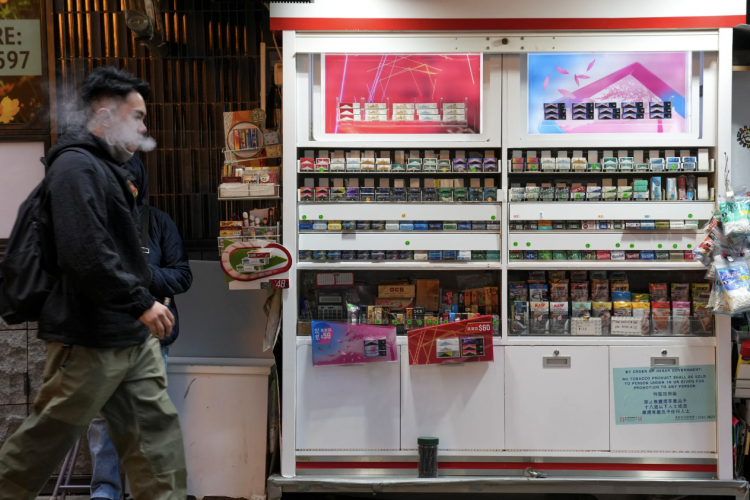
The Hong Kong Council on Smoking and Health has proposed raising the current tax on cigarettes from 38 Hong Kong dollars to 76 Hong Kong dollars per pack. Photo by Yi Yangwen.
An organization urging authorities to double tobacco taxes cites a study from a Hong Kong university, which states that if cigarette prices increase, approximately two-thirds of smokers will reduce or quit smoking.
On Tuesday, the Hong Kong Council on Smoking and Health stated that a telephone survey conducted by the University of Hong Kong revealed that 76.4% of respondents supported the increase of tobacco tax next year.
Last month, the committee proposed increasing the current tax on a pack of cigarettes from HKD 38 (USD 5) to HKD 76, which would push the price up to HKD 100 next year.
According to a survey conducted by the university, around 67% of the 1,719 respondents stated that they would reduce or quit smoking if the price of a pack of cigarettes were to increase. More than half of the respondents (52%) stated that they would quit smoking completely.
Due to the immediacy and effectiveness of tax increases, we are aware of the strong opposition from tobacco consumers and other stakeholders," said Lin Daxing, Honorary Clinical Professor at the University School of Public Health.
Smokers are victims of nicotine and it is difficult for them to quit smoking on their own.
Lin added that raising taxes is an important stepping stone that can help the government achieve its goal of reducing Hong Kong's smoking rate from the current 9.5% to 7.8% within three years.
If the government does not raise tobacco taxes, the goal is almost impossible to achieve," Lin said. "Raising prices to 100 Hong Kong dollars is already a very conservative measure. It's like going from failing an exam to just passing it.
Former heavy smoker Li Mingda, who successfully quit smoking about two years ago, suggests that significantly increasing tobacco taxes could deter people from purchasing cigarettes.
The Hong Kong Council on Smoking and Health has proposed raising the current tax on cigarettes from HK$38 to HK$76 per pack. Photo by Yiyang Wen.
An organization urging authorities to double tobacco taxes cites a study from a university in Hong Kong, which suggests that an increase in cigarette prices may lead approximately two-thirds of smokers to reduce or quit smoking.
The Hong Kong Council on Smoking and Health stated on Tuesday that a telephone survey conducted by the University of Hong Kong revealed that 76.4% of respondents support an increase in tobacco tax next year.
Last month, the committee proposed increasing the current tax on a pack of cigarettes from HKD 38 (USD 5) to HKD 76, which would raise the price to HKD 100 next year.
More than half of the university survey respondents stated that they would quit smoking completely if cigarette prices increased. Photo: Sam Tsang
According to a survey conducted by the university, approximately 67% of the 1,719 respondents reported that they would reduce or quit smoking if the price of a pack of cigarettes was higher. More than half (52%) stated that they would quit smoking altogether.
We know that tobacco consumers and other stakeholders strongly oppose the immediate and effective implementation of tax increases," said Lin Daxing, Honorary Clinical Professor at the University's School of Public Health.
Smokers are victims of nicotine and find it challenging to quit smoking on their own.
Lin added that increasing taxes is a crucial stepping stone in helping the government achieve its goal of reducing Hong Kong's smoking rate from the current 9.5% to 7.8% within the next three years.
If the government does not increase tobacco taxes, achieving the goal is nearly impossible," Lin said. "Raising the price to 100 Hong Kong dollars is already a very conservative measure. It's like going from failing an exam to just barely passing.
Li Mingda, a former heavy smoker who successfully quit smoking about two years ago, suggests that a significant increase in tobacco taxes may discourage people from buying cigarettes.
At present, a pack costs around HKD 60, which is roughly equivalent to the price of a meal. This may not deter people from buying cigarettes," he said. "But when it increases to the price of two meals, consumers may start to reconsider.
The committee stated that they believe increasing tax revenue could help the disadvantaged community in the city.
The estimated tax revenue of approximately HKD 8 billion can be used to support existing poverty alleviation, healthcare, and anti-smoking programs," said Executive Director of the committee, Lai Wai-kin.
She added, as more people quit smoking, medical costs associated with smoking-related illnesses may decrease and productivity may improve.
The committee also proposed further increasing tobacco taxes over time, so that by 2025 the price of a pack of cigarettes will ultimately reach HKD 200.
It stated that over the past decade, from 2011 to 2021, tax rates have remained stagnant while the inflation rate has increased by approximately 30%.
As inflation rates rise, tobacco prices have remained largely unchanged in recent years due to tax freezes," said Lai. "In this situation, it is possible that more people may purchase cigarettes, which is not something we want to see.
The committee has proposed additional measures to reduce smoking, including banning Hong Kong residents born in 2009 or later from purchasing cigarettes before they turn 18 in 2027.
The Health Bureau is expected to release their plan to strengthen smoking control early next year, seeking public opinion.
Disclaimer
This article is provided solely for professional research, industry discussion, and informational purposes. Any references to brands, companies, products, technologies, or policies are made for factual reporting and analytical purposes only, and do not constitute endorsement, recommendation, promotion, or advertising by 2Firsts.
Nicotine-containing products, including but not limited to cigarettes, e-cigarettes, heated tobacco products, and nicotine pouches, carry significant health risks. Readers are responsible for complying with all applicable laws and regulations in their respective jurisdictions, including age restrictions and access limitations.
The information contained in this article should not be regarded as investment, legal, medical, regulatory, or commercial advice. While 2Firsts strives to ensure the accuracy and reliability of its content, it does not assume liability for any direct or indirect loss arising from errors, omissions, inaccuracies, or reliance on the information contained herein.
This article is not intended for individuals below the legal age for accessing tobacco or nicotine-related information in their jurisdiction.
Copyright Notice
This article is either original content produced by 2Firsts or content reproduced, translated, summarized, or adapted from third-party sources with attribution where applicable. The intellectual property rights of the original content remain with 2Firsts or the respective original rights holders.
No individual or organization may copy, reproduce, distribute, republish, modify, translate, or otherwise use this content without prior authorization. Any unauthorized use may result in legal action.
For copyright-related inquiries, corrections, or removal requests, please contact: info@2firsts.com.
AI-Assisted Translation and Editing Notice
Portions of this article may have been translated, edited, or reviewed with the assistance of artificial intelligence tools to improve efficiency and readability. Due to the limitations of AI-assisted translation and editing, discrepancies, omissions, or inaccuracies may exist when compared with the original source.
Where applicable, readers are advised to refer to the original source for the most complete and accurate information. If you identify any errors or believe that any content infringes upon your rights, please contact us at info@2firsts.com, and we will review and address the matter promptly.