Penang Consumer Group Pushes for Vape Ban Amid Youth Addiction Concerns

Nov.19.2024
Penang Consumer Group Pushes for Vape Ban Amid Youth Addiction Concerns
The Consumers Association of Penang urges Malaysia's Health Ministry to ban vapes, citing rising youth addiction and concerns over their link to drug abuse.

The Consumers Association of Penang (CAP) in Malaysia has called on the Health Ministry (KKM) to adopt Sultan Abdullah of Pahang's recommendation to impose a complete ban on electronic cigarettes, including vapes, NST reported on November 18.


N. V. Subbarow, CAP's education officer, stated that this measure should be implemented to protect the safety of future generations.


"CAP is pleased with Al-Sultan Abdullah's statement recommending the complete ban on electronic cigarettes or vapes. This is news we have been waiting for, including parents and teachers," he said


Previously, Abdullah suggested completely banning the use of electronic cigarettes or vapes. According to statistics from the National Anti-Drug Agency (AADK), he is concerned about the increasingly serious problem of drug abuse among young people in Pahang. He stated that one of the main reasons why young people develop addiction is directly or indirectly starting from using e-cigarettes.


Subbarow also pointed out that the issue of vape abuse is not only occurring in Pahang but has also spread to other states.


 

Malaysia's Poisons Board Backs New Vape Nicotine Exemption After Unanimously Opposing 2023 Proposal
Malaysia's Poisons Board has endorsed Health Minister Dzulkefly Ahmad's proposal to exempt liquid nicotine used in vaping products from the Poisons List, according to a November 2, 2026, report by CodeBlue. The Board unanimously opposed a similar proposal in 2023, but the government proceeded with the exemption. The Kuala Lumpur High Court invalidated the 2023 decision in May 2026, and the government withdrew its appeal in August. No new ministerial order has been published. The development raises questions about the interaction between Malaysia's two regulatory frameworks and the treatment of RM354.51 million in excise duties collected on e-cigarette and vape products between May 2023 and June 11, 2026.
Regulations
Nov.03
Swedish-Founded Nicotine Pouch Retailer GotPouches Shifts to U.S.-Based Operations, Reaching Over 25 States
Swedish-founded online nicotine pouch retailer GotPouches has completed the localization of its U.S. operations under UpNorth Retail LLC, with corporate operations in Franklin, Tennessee, domestic fulfillment from Nashville and U.S.-based customer support. The company says its catalog covers more than 20 nicotine pouch brands and it currently serves customers in more than 25 U.S. states.
Sep.18
North Carolina Tightens Vape Product Directory Enforcement, Expands State and Local Powers as Violators Face Fines, Product Seizures and License Suspension or Revocation
North Carolina has expanded enforcement of its vapor product directory rules, authorizing more state and local law enforcement participation and establishing a task force led by the State Bureau of Investigation. The legislation requires at least one unannounced compliance inspection annually for retailers, distributors and wholesalers handling covered products. Penalties effective October 1, 2026, include civil fines of $500–$750 for a first violation and $1,000–$1,500 for repeated violations within 12 months, along with potential license suspension or revocation. Manufacturers may face penalties of $10,000 per unlisted product. The measures strengthen the product directory system established in 2024.
Regulations
Oct.28
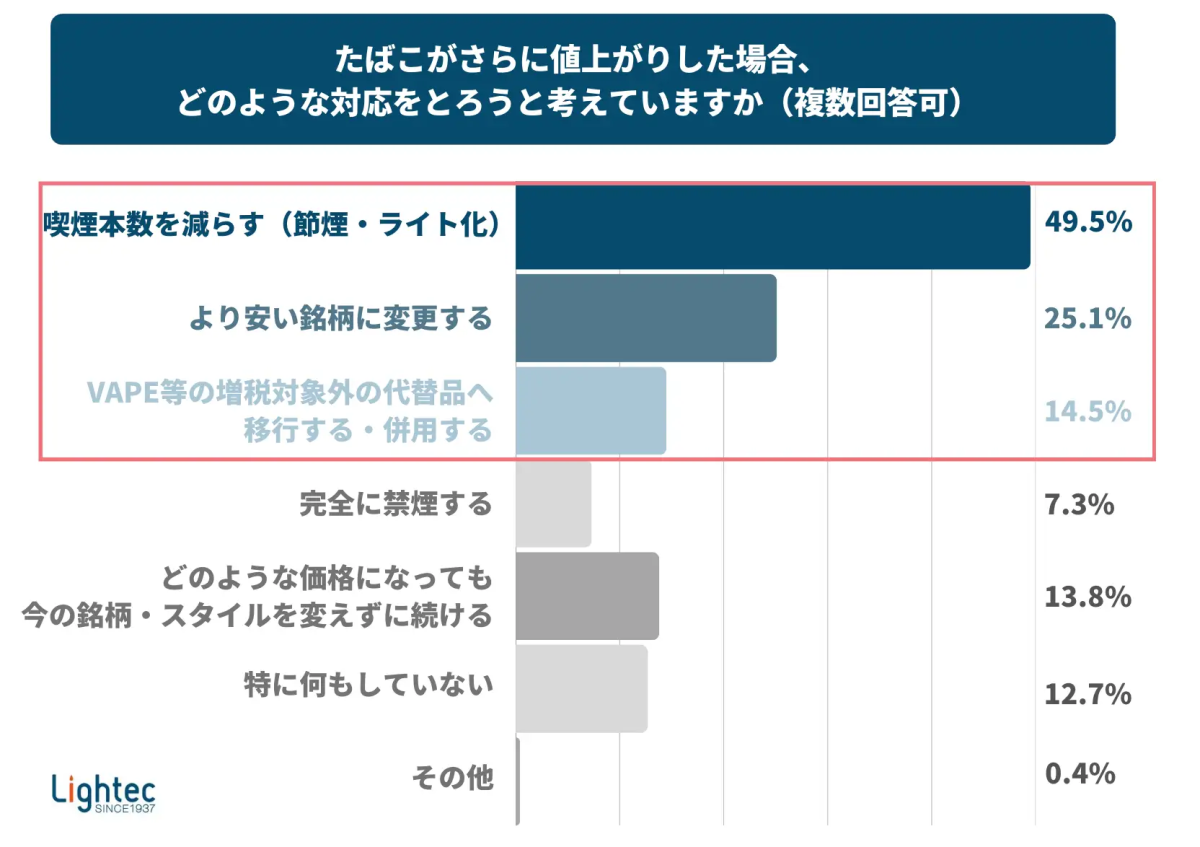
Japan Survey Finds 49.5% Would Cut Tobacco Use if Prices Rise, 64.6% Show Interest in Nicotine-Free Alternatives
A September online survey commissioned by Japanese smoking-accessories company Lightec found that 49.5% of respondents would consider reducing tobacco use if prices rose further, while 25.1% would consider switching to cheaper brands and 14.5% would consider using or combining alternatives such as vapes and nicotine-free herbal sticks. Another 64.6% expressed some level of interest in such alternatives. The survey covered 1,088 respondents aged 20 to 70 and was conducted by a company that sells NICOLESS nicotine-free vaping and herbal-stick products, meaning its findings should not be treated as representative of Japan's smoking population.
DATA
Oct.12
Special Report | From Oversupply to Supply Gaps: Global Tobacco Leaf Markets Diverge Ahead of 2027
Global tobacco leaf markets diverged sharply in 2026, with India cutting authorised FCV production amid oversupply while Malawi faced a supply shortfall. U.S. demand improved in some leaf categories, but growers in Brazil, Colombia, Tanzania and Zimbabwe faced pressure from prices, buyer access, costs and weather. With nicotine consumption patterns also shifting, 2027 will test whether supply, demand and grower profitability can move back toward balance.
Oct.26
Special Report | Can Nicotine Be Replaced? 6-MN Is Already on the Market While Key Human Evidence Is Still Missing
Nicotine analogues such as 6-methylnicotine are already appearing in e-cigarettes and oral pouches, even as key human evidence remains limited. A new Nixodine-S study adds nonclinical data showing differences from nicotine in cytotoxicity and receptor activity, while independent studies point to a more complex toxicological picture. With supply-chain activity growing and FDA seeking clearer authority over nicotine analogues, the industry now faces a larger question: what evidence is needed before these substances can credibly replace nicotine?
SCIENCE
Sep.23