Permitless carry gun bill, vaping tax and more: These Indiana laws go into effect July 1

Regulations
Jun.28.2022
Vaping products are about to get more expensive due to a new tax that goes into effect in July.

The 2022 legislative session ended in March, but many of the laws Gov. Eric Holcomb signed months ago will go into effect July 1.


These laws could impact everything from Hoosiers' safety to which children are allowed to play school sports.


Here are some of the more notable Indiana law changes to watch for starting in July.


'Constitutional carry'


Starting July 1, people will no longer need a permit to carry a handgun in Indiana. The same people prohibited from carrying a handgun under the permit system, including those with felonies, would still be prohibited from carrying a handgun. It now will be up to Hoosiers to know if they are allowed to carry.


Permits still will be available to those who want one — such as people traveling to another state that has reciprocity with Indiana. The new law could limit police officers' ability to quickly see who should legally be allowed to carry a handgun. It also could restrict gun crime investigations in the state because police often used the charge of carrying without a permit to open the door to broader criminal investigations into gun crimes.


Vape tax


Vaping products are about to get more expensive due to a new tax that goes into effect in July. The tax on prefilled e-cigarette cartridges, or vape pods, will be 15% of the wholesale price. A 15% retail tax will be implemented for other vaping products.

Some of the vaping taxes were supposed to be higher. Lawmakers had first inserted the new taxes in the 2021 budget but lowered the prefilled e-cigarette cartridge tax a year later before it could go into effect to create more parity between the different products, they said. Health experts widely criticized the change.


Bail


The Bail Project, a national organization that's garnered some scrutiny for its work in Indianapolis, and other charitable bail organizations will face new restrictions on who they can bail out come July. House Bill 1300 prevents such groups from bailing out people accused of violent crimes and requires them to register with the Indiana Department of Insurance.


The commercial bond industry is still free to bail out whoever it wants.


Lawmakers pushing for the bill said it stemmed from a desire to reduce Indianapolis violent crime, but an IndyStar investigation found that commercial bond agents bailed out more people who were later accused of murder than did the Bail Project.


Coerced abortion


During the legislative session, lawmakers avoided making sweeping changes to Indiana's abortion laws in anticipation of a U.S. Supreme Court ruling on a Mississippi law banning abortion after 15 weeks. But they did pass a law they say is intended to protect women from being forced into an abortion.


Under House Bill 1217, abortion clinics would have to ask anyone seeking an abortion if they are being coerced into having the procedure. If an abortion clinic employee suspects someone is being coerced, the clinic must report it to law enforcement, who must then investigate.


Transgender sports bill


In May, lawmakers voted to override Gov. Eric Holcomb's veto of a bill that prohibited transgender girls from participating in girls school sports. That means, despite Holcomb's opposition, it will go into effect in July.


The American Civil Liberties Union of Indiana is suing the Indianapolis Public Schools district on behalf of a 10-year-old transgender girl who will no longer be able to play softball on her school’s all-girls softball team, so it's possible there could still be an injunction before the law goes into effect.


Rape loophole


Starting in July, the definition of rape in Indiana will be more expansive. Under House Bill 1079, a person who has sexual intercourse with someone who attempts to "physically, verbally, or by other visible conduct refuse the person's acts" commits rape.


Already Indiana law contained language saying intercourse is considered rape if it's done by force or if it occurs with someone who is mentally incapacitated or unaware that it’s happening.


State fossil


Indiana will finally have a state fossil starting July 1: the mastodon.


Already Indiana has a state snack, popcorn; a state bird, the cardinal; a state insect, Say’s firefly; and a state flower, the peony. But it was one of five states without a state fossil.


Source:yahoo
 

Also read:

Indiana vape tax to go into effect July 1

Special Report | From New York to Washington: How FDA’s Tobacco Center Is Reworking Product Review
FDA’s Center for Tobacco Products is reshaping how it approaches tobacco product review. Based on 2Firsts’ on-site reporting in New York and Washington, this report traces CTP’s emerging direction: stronger links between PMTA and tobacco harm reduction, more category-specific review, greater emphasis on decision-relevant science, more predictable timelines and expanded use of sPMTA for product modifications. CTP also acknowledged major constraints, including just nine PMTA review teams, persistent backlogs and limits on hiring capacity.
Regulations
Oct.08
China’s HTP Exports Fell 14.3% in H1 2026 as Russia and Belarus Accounted for 76% Lead
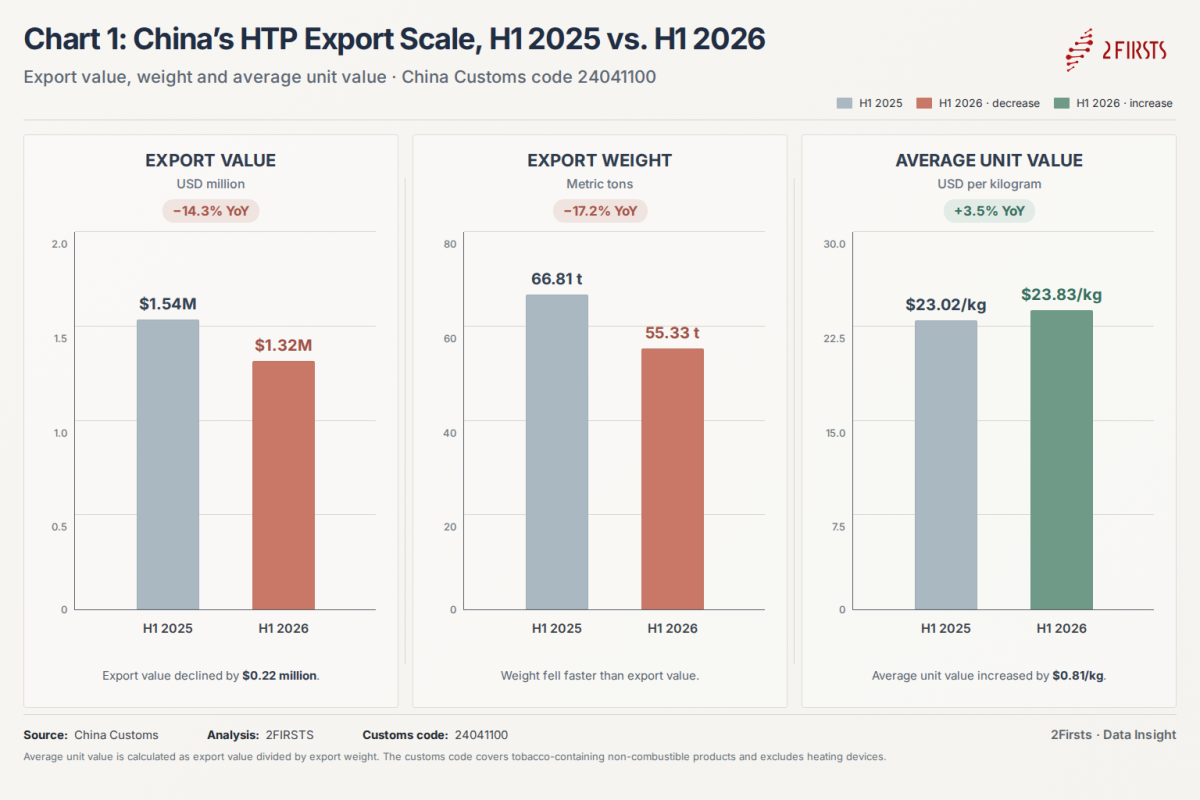
In H1 2026, China’s HS 24041100 exports stood at $1.32 million, down 14.3% YoY, with volume falling 17.2% to 55.33 tons. Market distribution shifted drastically amid overall export drops. Exports to Russia and Belarus totaled $1 million, taking 76.0% of all shipments versus 29.5% in H1 2025. Belarus became the top destination with export value jumping 177.5%, while the Philippines, Singapore and Indonesia’s combined share slumped from 49.3% to 11.2%.Domestically, Yunnan led exporter registrations; Jiangsu and Shanghai were key suppliers, yet Anhui and Sichuan had no exports. Heavy concentration means order or declaration changes for Russia/Belarus greatly affect national aggregate data. The data shows customs entry points (not end markets), covering tobacco consumables only, excluding heating equipment and the complete HTP supply chain.
Aug.11
New York’s 75% Wholesale Tax on Nicotine Pouches Takes Effect Sept. 1, With Aug. 31 Inventory Subject to Floor Tax
New York State will extend its tobacco products tax to “alternative nicotine products,” including tobacco-free nicotine pouches, from September 1, 2026, at a rate of 75% of the wholesale price. Distributors, wholesalers and retailers must also inventory products held as of 11:59 p.m. on August 31 and pay a floor tax. Vapor products are excluded from the new category and remain subject to New York's separate 20% supplemental sales tax on the retail price.
Aug.26
JTI Invests ₱2.1 Billion to Upgrade Batangas Manufacturing Hub, Adds First Southeast Asia DIET Facility
JTI Asia Manufacturing Corp. has invested ₱2.1 billion, or about $37 million, in its manufacturing site in Malvar, Batangas, Philippines, to expand tobacco-processing capabilities. About ₱1.9 billion is allocated to JTI's first Dry Ice Expanded Tobacco, or DIET, facility in Southeast Asia, while more than ₱177 million has been spent on expanding its Controlled Atmosphere treatment facility. The Batangas plant supplies the Philippine market and exports to 22 overseas markets, making it one of JTI's key manufacturing hubs in Asia.
Sep.24
JUUL Purchasers Ask Ninth Circuit to Preserve Antitrust Classes in Case Over Altria’s $12.8 Billion Investment
Private antitrust litigation stemming from Altria's 2018 $12.8 billion investment for a 35% economic interest in JUUL is advancing before the U.S. Court of Appeals for the Ninth Circuit. Direct purchasers, indirect purchasers and indirect resellers of JUUL products filed answering briefs this week seeking to preserve class certifications granted by a California federal court in February. Altria and JUUL argue that individual consumers and large distributors differ too much in purchasing terms to remain in a single direct-purchaser class, while a separate dispute concerns whether California antitrust law can apply to indirect purchasers across 27 jurisdictions. A September trial has been put on hold during the appeal.
Sep.23
Russia’s Vape Device Labeling Regime Enters Force: Registration Starts in September, Mandatory Coding in December
Russia's digital labeling regime for reusable e-cigarettes and similar personal vaping devices entered its first mandatory phase in September 2026. From September 1, manufacturers, importers and other market participants must register with the national Chestny ZNAK tracking system. From December 1, newly manufactured and imported covered devices will be required to carry digital identification codes and be reported as entering circulation. Russia has also issued new operational guidance for imports, marking the transition from a voluntary pilot to phased mandatory implementation.
Sep.15