Philip Morris International delays new tobacco product launch in Spain

Feb.24.2025
Philip Morris International delays new tobacco product launch in Spain
Philip Morris International suspends new product launch in Spain, awaiting health regulations, says regional VP Marco Hannappel.

According to a report from Cinco Dias on February 22, Philip Morris International (PMI) has halted the launch of alternative products to traditional cigarettes in Spain, as well as related investments, pending the issuance of a Royal Decree by the Ministry of Health.


During an interview with Cinco dias, Marco Hannappel, Vice President of Philip Morris International (PMI) for the Southwest Europe region, stated that "before the regulatory framework is clear, we cannot consider investing in and launching products that may be aborted." This includes regulations in Italy and Spain, two major markets.


The executive admitted to being interested in launching ZYN nicotine pouches in Spain.


Providing all alternative products in our product lineup to Spanish consumers is our way of achieving a smoke-free future. However, due to ongoing regulatory discussions, this issue has not yet been discussed.


In December 2024, the Spanish Ministry of Health concluded a public hearing to receive proposals for reforming Royal Decree 579/2017, introducing regulations for regulating nicotine pouches. Previously, Spain had adjusted its regulations in accordance with EU directives, harmonizing legislation on heated tobacco and traditional cigarettes, banning added flavors, and requiring health warnings on packaging.


Hannapel stated that Spain should not simply treat heated tobacco products the same as traditional cigarettes in terms of regulation. He noted that Belgium's ban on heated tobacco products was due to equating them with traditional cigarettes, while countries such as Japan, Greece, Italy, and Portugal have promoted the development of heated tobacco products through reasonable regulatory frameworks and tax policies.


According to the financial data released by Philip Morris International (PMI) by the end of 2024, the company's sales of heated tobacco products in Spain increased by 18.7% year-on-year, while sales of traditional cigarettes decreased by 3%. However, traditional cigarettes still hold a market share nearly 10 times that of heated tobacco products. Hannes Pierl, a spokesperson for PMI, stated that the market for heated tobacco products has rapidly developed in Spain over the past two years and still has great potential for the future.


The tobacco sales model in Italy is similar to that of Spain, with tobacco products being sold through tobacco specialty shops and advertising being restricted. However, the regulations in Italy do not clearly equate heated tobacco products with traditional cigarettes. The Spanish Ministry of Health approved a "Anti-Smoking Plan" last year, which pointed out that heated tobacco products are trying to attract consumers by emphasizing their lower harm compared to traditional cigarettes.


Philip Morris International (PMI) has set a target for 66% of its sales to come from non-traditional cigarette products by 2030. By the end of 2024, this figure is expected to be at 40%, with even higher numbers in the European market. Hanan Perl believes Europe will be the first region to achieve the 2030 target, but he also emphasizes the significant regulatory differences among the 27 member countries of the European Union.


We welcome news tips, article submissions, interview requests, or comments on this piece.

Please contact us at info@2firsts.com, or reach out to Alan Zhao, CEO of 2Firsts, on LinkedIn


Notice

1.  This article is intended solely for professional research purposes related to industry, technology, and policy. Any references to brands or products are made purely for objective description and do not constitute any form of endorsement, recommendation, or promotion by 2Firsts.

2.  The use of nicotine-containing products — including, but not limited to, cigarettes, e-cigarettes, nicotine pouchand heated tobacco products — carries significant health risks. Users are responsible for complying with all applicable laws and regulations in their respective jurisdictions.

3.  This article is not intended to serve as the basis for any investment decisions or financial advice. 2Firsts assumes no direct or indirect liability for any inaccuracies or errors in the content.

4.  Access to this article is strictly prohibited for individuals below the legal age in their jurisdiction.


Copyright


This article is either an original work created by 2Firsts or a reproduction from third-party sources with proper attribution. All copyrights and usage rights belong to 2Firsts or the original content provider. Unauthorized reproduction, distribution, or any other form of unauthorized use by any individual or organization is strictly prohibited. Violators will be held legally accountable.

For copyright-related inquiries, please contact: info@2firsts.com


AI Assistance Disclaimer


This article may have been enhanced using AI tools to improve translation and editorial efficiency. However, due to technical limitations, inaccuracies may occur. Readers are encouraged to refer to the cited sources for the most accurate information.

We welcome any corrections or feedback. Please contact us at: info@2firsts.com

Kelly White Bets on Female Consumers as Nicotine Pouch Competition Intensifies | 2Firsts Interview
Swedish nicotine pouch brand Kelly White is building its strategy around adult female consumers. Founder and CEO Sophia Wilsby told 2Firsts that women accounted for around 70% of the brand’s repeat customers on HAYPP in Sweden in 2025. The interview explores female consumer segmentation, product and design differentiation, gender stereotypes, packaging regulation, and how independent brands can compete with global players such as ZYN and VELO while considering funding, partnerships and future ownership options.
Business
Sep.24
German Tobacco Tax Revenue Falls 10.8% Through August as Tax-Paid Cigarette Volume Drops 12.6%
Germany collected €9.789 billion in total tobacco tax revenue from January through August 2026, down 10.8% from a year earlier, according to the Federal Ministry of Finance. Germany's tobacco tax base covers not only cigarettes and fine-cut tobacco but also heated tobacco and vaping liquids taxed as tobacco substitutes. The German Association of the Tobacco Industry and Novel Products, or BVTE, citing federal statistical data, said tax-paid cigarette volume fell 12.6% to 40.6 billion sticks. BVTE is using the latest figures to argue against further tax increases planned from 2027 through 2030, while Germany's parliament is scheduled to hold a first reading of the bill on September 24.
Sep.23
Reynolds Showcases Vuse Pro Flavors and VELO Nicotine Pouches at NACS Show 2026
Reynolds American, a BAT subsidiary, showcased four Vuse Pro flavored e-cigarette pods and its VELO nicotine pouch portfolio at NACS Show 2026. Booth staff confirmed to 2Firsts that the Vuse Pro flavors are sold in the U.S., although they have not received FDA marketing authorization. BAT outlined plans to expand Vuse retail distribution and reported that VELO held a 30.5% year-to-date volume share of the U.S. modern oral nicotine category through August 2026. The booth also featured the newly launched VELO MAX range and merchandising displays combining cigarettes, vaping products and oral nicotine brands.
EXPO
Oct.09
Pennsylvania Vape Directory Enforcement Starts Oct. 19, Barring Retail Sales of Unlisted Products
Pennsylvania's Act 57 vape directory regime will reach the end of its 120-day inventory transition period on Oct. 19. Nicotine-containing e-cigarettes intended for retail sale in the state that are not listed on the Attorney General's ENDS directory will then be barred from retail sale and treated as contraband subject to seizure, forfeiture and destruction. Manufacturers face annual product certification, brand- and style-based fees and a minimum $50,000 surety bond, while retailers and wholesalers must source through licensed channels and monitor the directory.
Regulations
Oct.08
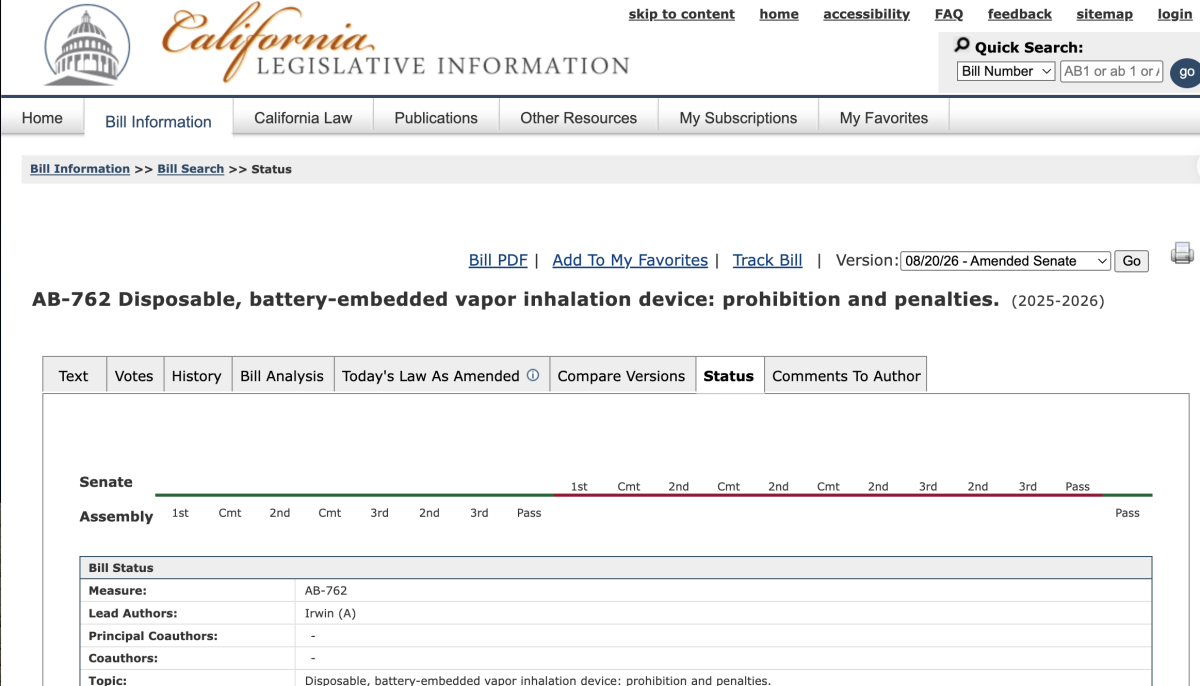
California Lawmakers Pass Disposable Nicotine Vape Ban, With Sales Prohibition Set for 2028
According to CBS Los Angeles on August 27, 2026, California lawmakers have passed Assembly Bill 762, which would phase out disposable, battery-embedded nicotine vapes in the state. If signed by Governor Gavin Newsom, manufacturing and importation of the covered products would be prohibited beginning January 1, 2027, followed by a sales ban on January 1, 2028. Driven primarily by concerns over electronic waste, lithium-battery fires and environmental pollution, the legislation would further shift California’s legal vape market toward rechargeable, refillable or replaceable-pod devices.
Aug.28
U.S. Judge Stays Helix, NJOY Challenge to FDA PMTA Rule Pending New Rulemaking Court Stays Altria's Helix, NJOY Challenge to PMTA Rule as FDA Prepares New Rulemaking
A federal judge in Texas on Oct. 8 granted a joint request by the FDA and plaintiffs including Altria subsidiaries Helix Innovations and NJOY to stay litigation challenging the agency's 2021 PMTA rule. The court cited FDA's anticipated rulemaking concerning the regulation at issue. FDA announced on Sept. 28 that it intends to reassess the PMTA framework and could initiate new rulemaking to replace it. The parties must file a joint status report within 45 days and every 45 days thereafter. A motion by three Reynolds American companies to intervene remains pending.
Regulations
Oct.10