Philippine Government Exceeds 2024 Fiscal Revenue Target with Surplus

Jan.21.2025
Philippine Government Exceeds 2024 Fiscal Revenue Target with Surplus
Philippine government exceeds fiscal revenue target in 2024, thanks to increased tax and non-tax revenue, DOF data shows.

According to a report from the Philippine News Agency on January 20, data from the Department of Finance (DOF) of the Philippines shows that the government's fiscal revenue exceeded its target in 2024, primarily due to an increase in tax and non-tax revenues.


Preliminary data released by the Department of Finance (DOF) in the Philippines showed that as of January 16, total revenue reached 4.4 trillion Philippine pesos (750 billion USD), with the Bureau of Internal Revenue (BIR) collecting 2.86 trillion pesos (490 billion USD) in taxes. BIR Commissioner Romeo Lumagui Jr. attributed the agency's surplus in the billions of pesos in 2024 to good governance and enforcement actions against false receipts, illegal tobacco, and e-cigarette transactions.


The Customs Bureau (BOC) collected taxes amounting to 916 billion pesos (15.6 billion US dollars), while total tax revenue from other departments amounted to 323.8 billion pesos (5.5 billion US dollars).


Finance Minister Ralph Recto commended the performance of the BIR and BOC.


I believe that our revenue as a percentage of GDP reached a new high of 16.5% last year, the highest in 27 years. I look forward to the BIR continuing to meet their goals by 2025, although the task for the BOC will be more challenging as we have increased their revenue target.


We welcome news tips, article submissions, interview requests, or comments on this piece.

Please contact us at info@2firsts.com, or reach out to Alan Zhao, CEO of 2Firsts, on LinkedIn


Notice

1.  This article is intended solely for professional research purposes related to industry, technology, and policy. Any references to brands or products are made purely for objective description and do not constitute any form of endorsement, recommendation, or promotion by 2Firsts.

2.  The use of nicotine-containing products — including, but not limited to, cigarettes, e-cigarettes, nicotine pouchand heated tobacco products — carries significant health risks. Users are responsible for complying with all applicable laws and regulations in their respective jurisdictions.

3.  This article is not intended to serve as the basis for any investment decisions or financial advice. 2Firsts assumes no direct or indirect liability for any inaccuracies or errors in the content.

4.  Access to this article is strictly prohibited for individuals below the legal age in their jurisdiction.


Copyright


This article is either an original work created by 2Firsts or a reproduction from third-party sources with proper attribution. All copyrights and usage rights belong to 2Firsts or the original content provider. Unauthorized reproduction, distribution, or any other form of unauthorized use by any individual or organization is strictly prohibited. Violators will be held legally accountable.

For copyright-related inquiries, please contact: info@2firsts.com


AI Assistance Disclaimer


This article may have been enhanced using AI tools to improve translation and editorial efficiency. However, due to technical limitations, inaccuracies may occur. Readers are encouraged to refer to the cited sources for the most accurate information.

We welcome any corrections or feedback. Please contact us at: info@2firsts.com

As JUUL2 Wins FDA Authorization, Harm Reduction Journal Highlights the Role of Real-World Evidence in Nicotine Product Regulation
A commentary published in the international open-access, peer-reviewed Harm Reduction Journal argues that randomized controlled trials remain central to evaluating smoking cessation efficacy but cannot alone capture real-world uptake, complete switching, longer-term use and population impact of non-combustible nicotine products such as e-cigarettes, heated tobacco and nicotine pouches. The authors frame impact as “reach × efficacy” and call for real-world evidence to complement RCTs. Three days after publication, the FDA authorized three JUUL2 products and highlighted complete switching among adult smokers in explaining its decision, providing a timely regulatory backdrop to the debate.
Sep.08
From Nicotine Salts to Cocrystals: China’s Shenzhen Huabao institute explores a more stable form for sustained nicotine release
China-based Shenzhen Huabao Collaborative Innovation Technology Research Institute Co., Ltd. has filed a patent application for a nicotine-ascorbic acid cocrystal, exploring a new solid-state form of nicotine. The patent proposes applications across e-liquids, heated tobacco sticks, oral tobacco, chewing tobacco and snuff. In nicotine pouch tests disclosed in the filing, cocrystal formulations showed less than a 6% decline in nicotine content after three months of accelerated storage and a release profile combining early-stage release with sustained delivery over 60 minutes. The filing reflects exploration of nicotine forms beyond conventional nicotine base and nicotine salts.
Aug.13
F1 Faces Renewed Pressure Over Tobacco and Nicotine Sponsorships as 67 Groups Target ZYN and VELO Ahead of Madrid Race
Ahead of the Formula 1 race in Madrid, 67 Spanish and international public-health, medical and consumer organizations have sent an open letter to F1 President and CEO Stefano Domenicali calling for an end to sponsorships linked to the tobacco and nicotine industry, including nicotine pouches, vaping products and heated tobacco. The letter focuses on Philip Morris International’s ZYN partnership with Ferrari and British American Tobacco’s long-running partnership with McLaren and exposure for VELO. The campaign follows a March letter in which more than 160 organizations worldwide made a similar request to Formula 1.
Sep.10
New York’s 75% Wholesale Tax on Nicotine Pouches Takes Effect Sept. 1, With Aug. 31 Inventory Subject to Floor Tax
New York State will extend its tobacco products tax to “alternative nicotine products,” including tobacco-free nicotine pouches, from September 1, 2026, at a rate of 75% of the wholesale price. Distributors, wholesalers and retailers must also inventory products held as of 11:59 p.m. on August 31 and pay a floor tax. Vapor products are excluded from the new category and remain subject to New York's separate 20% supplemental sales tax on the retail price.
Aug.26
PMI Q2 Revenue Rises 10.4% as IQOS and VEEV Expand, U.S. ZYN Growth Slows
Philip Morris International’s second-quarter net revenues rose 10.4% to a record $11.19 billion, as heated tobacco and e-vapor expanded across international markets. IQOS remained the main smoke-free growth engine, while VEEV shipments jumped 55.1%. In the United States, however, ZYN shipments increased just 1.8% and consumer offtake was broadly flat to slightly higher. Cigarette volumes also rose, showing that PMI’s transformation is advancing, but growth is becoming increasingly uneven across categories and markets.
PMI
Jul.22
Australia Extends Illicit Tobacco Crackdown From Tougher Penalties to Customs and Logistics Supply Chains
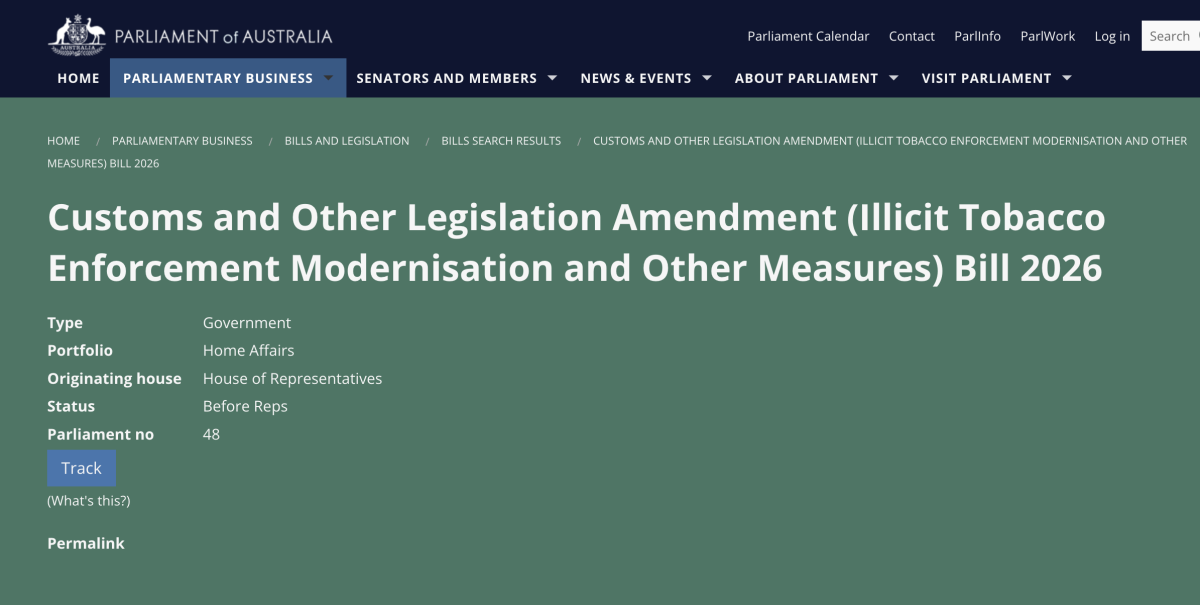
Australia's federal government introduced a new illicit tobacco enforcement bill on September 10 that would strengthen evidentiary presumptions, representative sampling, seizure and forfeiture procedures, proceeds-of-crime powers and obligations for customs and logistics operators. The proposal follows the Combatting Illicit Tobacco Act 2026, which took effect in August and increased penalties while expanding investigative and asset-recovery tools. Together, the reforms extend Australia's crackdown from tougher criminal sanctions into import, logistics and evidentiary enforcement.
Sep.14