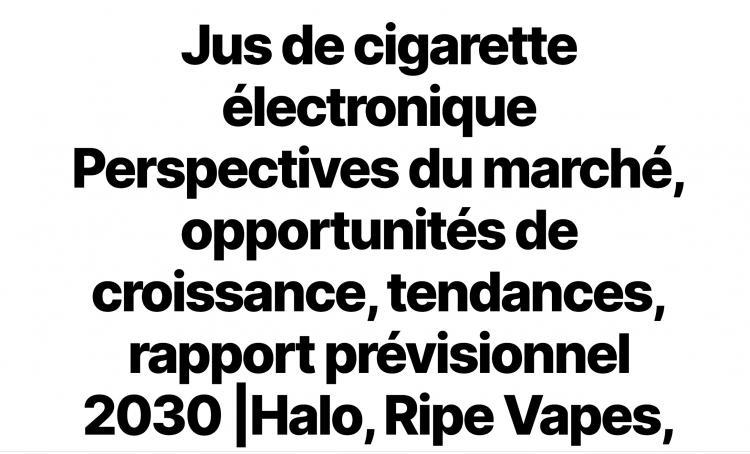
The report titled "Electronic E-liquid Market" provides a comprehensive overview of the electronic e-liquid industry, including different product definitions, classifications, and industry chain structure participants. Considering the competitive landscape, development trends, and key success factors (CSF) prevalent in the electronic e-liquid industry, the report presents both quantitative and qualitative analysis for the global electronic e-liquid market.
This report thoroughly analyzes various parameters used to identify the growth in the market for e-cigarette juice and emphasizes solutions for further increasing market share. The growth rate of the market is detailed based on the number of mobile products grouped by each manufacturer. Additionally, the report has a separate section providing a detailed analysis of the manufacturing process with information collected from primary and secondary data sources.
A comprehensive analysis of the global e-cigarette liquid market size has been detailed in this research report, including an examination of market size at the regional and national level, compound annual growth rates during the forecast period, revenue, major driving factors, competitive landscape, and payment sales analysis. Additionally, the report outlines the major challenges and risks facing the market in the forecast period. The e-cigarette liquid market is segmented by type and application. Participants, stakeholders, and other involved parties in the global e-cigarette liquid market will have the upper hand as they leverage this report as a powerful resource.
The report on e-cigarette liquids analyzes various key limiting factors that affect the global market, such as commodity prices, production capacity, profit and loss statistics, and transportation and delivery channels. It also includes important factors such as studying the demand for e-cigarette liquids, product trends and development, various organizations, and the impact process of the global market.
Statement
This article is compiled from third-party sources and is intended solely for industry exchange and learning.
This article does not represent the views of 2FIRSTS and 2FIRSTS cannot confirm the truthfulness and accuracy of the article's content. The translation of this article is only intended for discussion and research within the industry.
Due to limitations in the level of translation, the compiled article may not fully express the same meaning as the original. Please refer to the original text for accuracy.
2FIRSTS fully aligns with the Chinese government on all domestic, Hong Kong, Macau, Taiwan, and foreign statements and positions.
The compilation of information is subject to original media and author copyrights. If there is an infringement, please contact for removal.
Disclaimer
This article is provided solely for professional research, industry discussion, and informational purposes. Any references to brands, companies, products, technologies, or policies are made for factual reporting and analytical purposes only, and do not constitute endorsement, recommendation, promotion, or advertising by 2Firsts.
Nicotine-containing products, including but not limited to cigarettes, e-cigarettes, heated tobacco products, and nicotine pouches, carry significant health risks. Readers are responsible for complying with all applicable laws and regulations in their respective jurisdictions, including age restrictions and access limitations.
The information contained in this article should not be regarded as investment, legal, medical, regulatory, or commercial advice. While 2Firsts strives to ensure the accuracy and reliability of its content, it does not assume liability for any direct or indirect loss arising from errors, omissions, inaccuracies, or reliance on the information contained herein.
This article is not intended for individuals below the legal age for accessing tobacco or nicotine-related information in their jurisdiction.
Copyright Notice
This article is either original content produced by 2Firsts or content reproduced, translated, summarized, or adapted from third-party sources with attribution where applicable. The intellectual property rights of the original content remain with 2Firsts or the respective original rights holders.
No individual or organization may copy, reproduce, distribute, republish, modify, translate, or otherwise use this content without prior authorization. Any unauthorized use may result in legal action.
For copyright-related inquiries, corrections, or removal requests, please contact: info@2firsts.com.
AI-Assisted Translation and Editing Notice
Portions of this article may have been translated, edited, or reviewed with the assistance of artificial intelligence tools to improve efficiency and readability. Due to the limitations of AI-assisted translation and editing, discrepancies, omissions, or inaccuracies may exist when compared with the original source.
Where applicable, readers are advised to refer to the original source for the most complete and accurate information. If you identify any errors or believe that any content infringes upon your rights, please contact us at info@2firsts.com, and we will review and address the matter promptly.