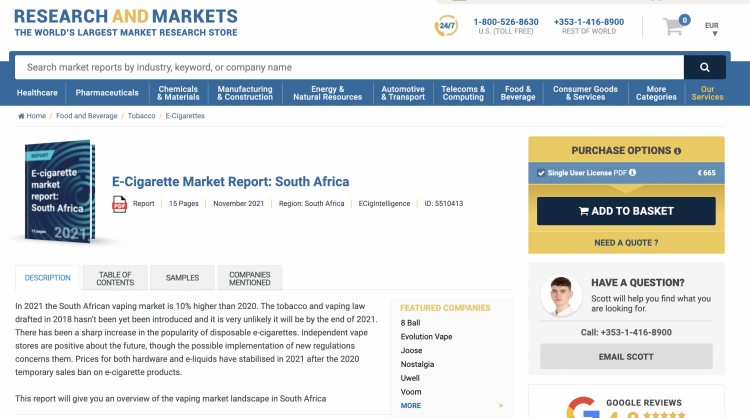
A report released by ECigIntelligence highlights the current state of the e-cigarette market in South Africa. According to the report, the market share for 2021 has increased by 10% compared to the previous year, possibly due to the popularity of disposable e-cigarettes. Independent e-cigarette retailers are currently optimistic about the future, but they express concerns about potential further policy restrictions.
Joe Phaahla, South Africa's Deputy Health Minister, announced the new Tobacco Products and Electronic Delivery Systems Control Bill in May 2020, which is currently undergoing review. The bill aims to prohibit smoking in public places and establish stricter regulations on electronic cigarettes, including restrictions on the use, marketing, and sale of certain tobacco products. Additionally, it will introduce a provision that allows the government to enforce a "100% public smoking ban.
In addition, in December of last year, the South African National Treasury released a discussion paper outlining plans to tax electronic cigarette products that contain nicotine. "Unlike traditional tobacco products, these products are largely unregulated in South Africa, so the Department of Health has also begun amending current tobacco control legislation to bring these products into the regulatory framework," the paper stated. "Similarly, governments in other countries around the world have started using tax and non-tax measures to regulate the consumption and use of electronic cigarettes.
The proposal document is open for public comment until January 25, 2022, and suggests the possibility of imposing taxes on devices and electronic liquids/capsules, which would allow for taxation based on the nicotine content of products. Meanwhile, the report states that after the temporary ban on the sale of e-cigarette products in 2020, prices for hardware and e-liquids have stabilized in 2021.
The report covers the following topics:
1. Summary 2. Market background 3. Market size and number of electronic cigarette consumers 4. Dimensions 5. Distribution breakdown 6. Popular brands 7. Pricing 8. Insights from vape stores 9. Companies covered in this report: The heating tobacco industry.
The following are names of various vaping products and brands: Vuse, Vaperite, Vapeking, Evolution Vape, Smok, Voopoo, Geekvape, Vaporesso, Uwell, Aspire, Voom, Hellvape, Eleaf, Yuoto, TKO, 8 Ball, Nostalgia, Bewolk, Joose, Nasty Juice, Jam Monster, Majestic Vapor, Loaded, and Snow Cone.
Statement
This article is compiled from third-party information and is intended for industry exchange and learning purposes.
This article does not represent the views of 2FIRSTS and the company cannot confirm the authenticity and accuracy of its content. The compilation of this article is only intended for internal industry research and communication purposes.
Due to limitations in translation ability, the translated article may not fully express the same idea as the original. Please refer to the original article for accuracy.
2FIRSTS maintains complete alignment with the Chinese government on any statements or positions concerning domestic issues, as well as those relating to Hong Kong, Macau, Taiwan, and foreign affairs.
The copyright of compiled information belongs to the original media and author. If there is any infringement, please contact us for removal.
Disclaimer
This article is provided solely for professional research, industry discussion, and informational purposes. Any references to brands, companies, products, technologies, or policies are made for factual reporting and analytical purposes only, and do not constitute endorsement, recommendation, promotion, or advertising by 2Firsts.
Nicotine-containing products, including but not limited to cigarettes, e-cigarettes, heated tobacco products, and nicotine pouches, carry significant health risks. Readers are responsible for complying with all applicable laws and regulations in their respective jurisdictions, including age restrictions and access limitations.
The information contained in this article should not be regarded as investment, legal, medical, regulatory, or commercial advice. While 2Firsts strives to ensure the accuracy and reliability of its content, it does not assume liability for any direct or indirect loss arising from errors, omissions, inaccuracies, or reliance on the information contained herein.
This article is not intended for individuals below the legal age for accessing tobacco or nicotine-related information in their jurisdiction.
Copyright Notice
This article is either original content produced by 2Firsts or content reproduced, translated, summarized, or adapted from third-party sources with attribution where applicable. The intellectual property rights of the original content remain with 2Firsts or the respective original rights holders.
No individual or organization may copy, reproduce, distribute, republish, modify, translate, or otherwise use this content without prior authorization. Any unauthorized use may result in legal action.
For copyright-related inquiries, corrections, or removal requests, please contact: info@2firsts.com.
AI-Assisted Translation and Editing Notice
Portions of this article may have been translated, edited, or reviewed with the assistance of artificial intelligence tools to improve efficiency and readability. Due to the limitations of AI-assisted translation and editing, discrepancies, omissions, or inaccuracies may exist when compared with the original source.
Where applicable, readers are advised to refer to the original source for the most complete and accurate information. If you identify any errors or believe that any content infringes upon your rights, please contact us at info@2firsts.com, and we will review and address the matter promptly.