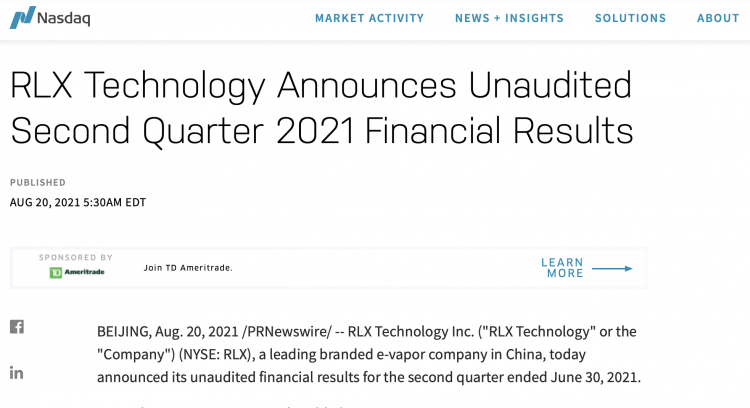
RLX, a Chinese e-cigarette company, released its second-quarter financial report for 2022 on September 21 at 6:00 AM Eastern Time (18:00 Beijing Time) on NASDAQ. Below are the key takeaways compiled by 2FIRSTS.
Net income for the second quarter of 2022 was 2.2339 billion yuan ($333.5 million USD), a 12.1% decrease compared to the same period in 2021, which had a net income of 2.5414 billion yuan.
Reasons for the decrease: The company halted store expansions and new product releases during a transitional period to comply with regulatory requirements. The net profit for the second quarter of 2022, confirmed under the US Generally Accepted Accounting Principles (GAAP), was 441.6 million yuan, a 46.4% decrease compared to the same period in 2021, which saw a net profit of 824.3 million yuan.
The net profit for Q2 2022, unadjusted for GAAP standards, was 634.7 million yuan, a 2.6% decrease compared to 651.8 million yuan in the same period of 2021.
In the second quarter of 2022, the gross profit margin was 43.8%, compared to 45.1% during the same period in 2021.
Reasons for the decline: adjustment of product lines, increase in inventory, and impairment losses incurred in order to comply with regulatory requirements on properties, factories, and equipment.
In the second quarter of 2022, operating costs reached RMB 530.9 million (USD 79.3 million), representing a growth of 217.6% compared to the same period in 2021, where operating costs were RMB 167.2 million. The increase in operating costs was mainly due to a change in equity incentive expenses, with RMB 193.2 million (USD 28.8 million) in Q2 2022, compared to RMB 172.5 million in the same period last year.
In the second quarter of 2022, general and administrative expenses amounted to 290.7 million yuan (approximately 43.4 million US dollars), representing a 531.3% increase from the same period in 2021, which amounted to 46.1 million yuan. The significant increase was primarily due to increased compensation expenses based on stock and higher salaries and benefits.
In the second quarter of 2022, research and development expenses amounted to RMB 117.6 million (USD 17.6 million), compared to RMB 4.9 million in the same period last year. The increase was mainly due to compensation expenses, salary and welfare increases, and consulting fees.
In the second quarter of 2022, the operating revenue was 446.9 million yuan (66.7 million US dollars), a decrease of 54.4% compared to the same period in 2021, when it was 979.3 million yuan. However, interest income increased by double, from 160.7 million yuan in the same period in 2021 to 427.2 million yuan. Investment income also increased nearly twice, from 238.7 million yuan in the same period in 2021 to 406.3 million yuan.
As of the end of the second quarter of 2022, the cash and cash equivalents of the company stood at RMB 1.7091 billion, down 67.2% from the previous year's RMB 5.209 billion. Short-term deposits were RMB 5.315 billion, up 32.1% from the previous year's RMB 4.0221 billion.
As of the end of the second quarter of 2022, the total assets amounted to RMB 17.5163 billion, compared to RMB 16.3651 billion at the end of the previous year. The total liabilities were RMB 2.9084 billion, which is slightly higher than the RMB 2.8464 billion at the end of the previous year. The debt-to-asset ratio decreased from 17.4% at the end of the previous year to 16.6%.
According to the financial report, a subsidiary of Yooz, a Chinese e-cigarette brand, has been awarded a production license by the State Tobacco Monopoly Administration. The production quota for the license includes 15.05 million refillable e-cigarette devices, 328.7 million pod cartridges, and 6.1 million disposable e-cigarettes annually. The license is valid from July 18, 2022, to July 31, 2023.
Statement:
1. This article is intended only for internal industry research and exchange. It does not make any investment or brand recommendations. It is not intended to be used as a basis for any investment decisions. 2. The data and analysis conclusions cited in this article have not been confirmed in writing by the companies referenced. Please refer to the company's official publications for all data.
This article is an original piece created by 2FIRSTS Technology Co., Ltd. of Shenzhen. The copyright and permission to use it belong to the company, and no individual or organization is authorized to commercially reproduce, copy, or use it in any way that infringes upon the company's copyright without prior permission. Any violations of this will result in the company reserving the right to pursue legal action.
Disclaimer
This article is provided solely for professional research, industry discussion, and informational purposes. Any references to brands, companies, products, technologies, or policies are made for factual reporting and analytical purposes only, and do not constitute endorsement, recommendation, promotion, or advertising by 2Firsts.
Nicotine-containing products, including but not limited to cigarettes, e-cigarettes, heated tobacco products, and nicotine pouches, carry significant health risks. Readers are responsible for complying with all applicable laws and regulations in their respective jurisdictions, including age restrictions and access limitations.
The information contained in this article should not be regarded as investment, legal, medical, regulatory, or commercial advice. While 2Firsts strives to ensure the accuracy and reliability of its content, it does not assume liability for any direct or indirect loss arising from errors, omissions, inaccuracies, or reliance on the information contained herein.
This article is not intended for individuals below the legal age for accessing tobacco or nicotine-related information in their jurisdiction.
Copyright Notice
This article is either original content produced by 2Firsts or content reproduced, translated, summarized, or adapted from third-party sources with attribution where applicable. The intellectual property rights of the original content remain with 2Firsts or the respective original rights holders.
No individual or organization may copy, reproduce, distribute, republish, modify, translate, or otherwise use this content without prior authorization. Any unauthorized use may result in legal action.
For copyright-related inquiries, corrections, or removal requests, please contact: info@2firsts.com.
AI-Assisted Translation and Editing Notice
Portions of this article may have been translated, edited, or reviewed with the assistance of artificial intelligence tools to improve efficiency and readability. Due to the limitations of AI-assisted translation and editing, discrepancies, omissions, or inaccuracies may exist when compared with the original source.
Where applicable, readers are advised to refer to the original source for the most complete and accurate information. If you identify any errors or believe that any content infringes upon your rights, please contact us at info@2firsts.com, and we will review and address the matter promptly.